Is Plinko one game or a type of casino game?
The familiar layout has rows of pegs above a strip of prize pockets. An on-screen ball reveals a result by arriving at one pocket. In the multiplier model, that pocket identifies an amount relative to the appropriate stake. The board’s appearance alone does not identify the rules.
Pragmatic Play’s Plinko+, 1X2gaming’s Plinko GO and BGaming’s Plinko are different products. Their shared name does not give them one payout table or one RTP. A slot with a Plinko-style bonus is another format again: its reel game and bonus entry rules still apply.
For the worked arithmetic here, we use a published Plinko+ rule model hosted by Ontario operator Casino Time. It identifies paid balls and their pocket multipliers. That foreign help is a labelled mechanics example, not evidence of a current GB installation. Check the rules supplied by the exact game you open.
If a title includes a crash-style cash-out decision or reels before a ball feature, read those extra stages separately. Our crash-games guide explains the timing decision that a simple pocket-settlement game does not have.
How does a Plinko round work?
- Identify the complete game title and supplier, then open its rules and payout information.
- Read the amount charged for the next accepted round. Distinguish a per-ball value from a total-round price.
- Where available, select a row count and risk setting, and check the resulting pocket values.
- If the game offers several balls in one round, check their number and combined cost before committing.
- Start the round with a separate action. The animation reveals where each accepted ball is settled.
- Read the credited total and compare it with the full amount spent, including any separately priced extra.
BGaming’s published model, for example, lists 8–16 rows and Low, Normal and High settings. Those labels do not establish the options in every supplier’s product. A disabled control can reflect the selected model or stage; instructions from another game cannot establish what it should do.
No reel payline or poker hand is required in the basic ball-drop format. The important fields are the accepted stake, chosen configuration, pocket result and amount credited.
Does a 0.5× or 1× pocket mean a win?
In the multiplier model used here, the pocket value expresses the amount returned from that ball relative to its stake. You do not add the stake a second time. With a hypothetical 20p ball, a 1× result returns 20p and makes no profit; 0.5× returns 10p and loses 10p.
| Illustrative pocket | Returned on one 20p ball | Net against that 20p cost |
|---|---|---|
| 0.5× | 10p | −10p |
| 1× | 20p | £0 |
| 1.4× | 28p | +8p |
| 5.5× | £1.10 | +90p |
These pocket values occur in the published eight-row, low-risk Plinko+ table. The 20p stake is chosen for arithmetic, not quoted as a current minimum. Return = stake × multiplier; net result = return − stake.
A positive credit and a profitable result are different. A game can credit every ball while many of those credits remain below the amount charged. Read the multiplier convention before treating a displayed payment as profit.
How much does a multi-ball round cost?
The cited Plinko+ help charges for each ball. Its multi-ball results are added together. If b is the chosen stake per ball and n balls are accepted, the opening cost is n × b; each ball’s return is b multiplied by its own pocket value. The return is not calculated by multiplying every ball’s pocket by the whole round’s cost.
| Ball count in this hypothetical calculation | Stake per ball | Opening round cost |
|---|---|---|
| 1 | 20p | 20p |
| 2 | 20p | 40p |
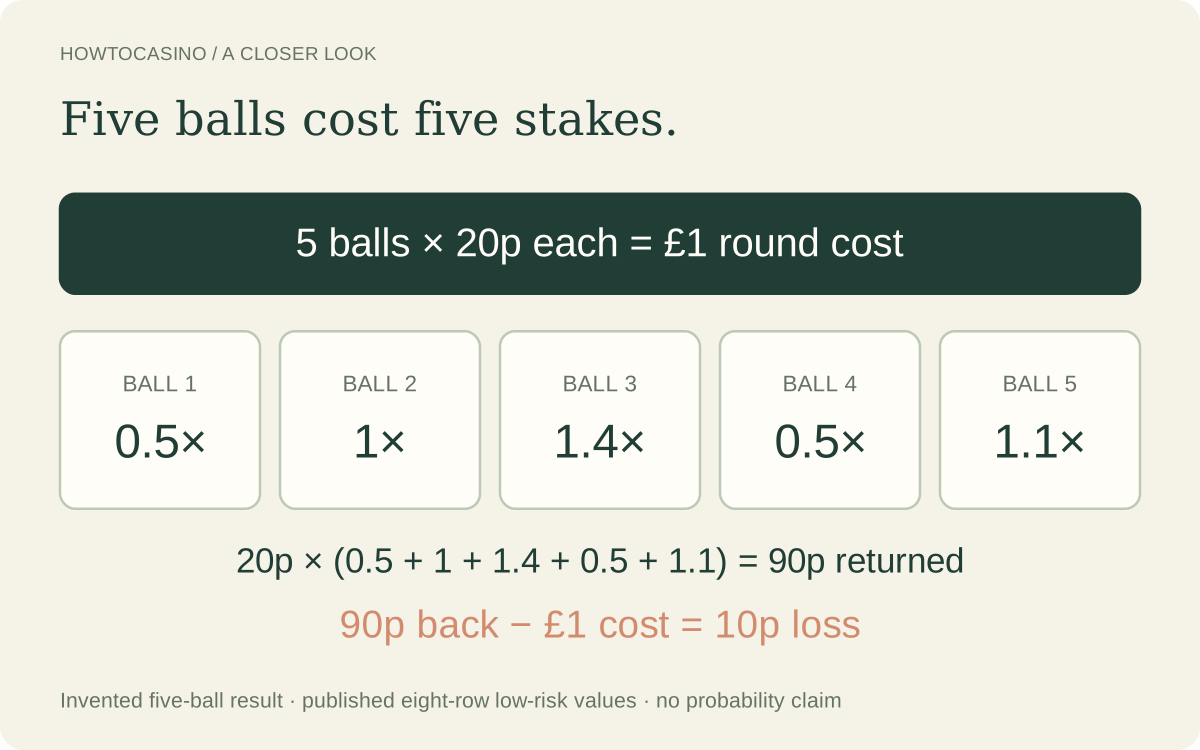
| 5 | 20p | £1 |
| 10 | 20p | £2 |
For a five-ball illustration, suppose the outcomes are 0.5×, 1×, 1.4×, 0.5× and 1.1×. All are values from the same published eight-row, low-risk table. This is an invented result sequence, not a sample of actual play.
| Ball | Pocket value | Amount returned |
|---|---|---|
| 1 | 0.5× | 10p |
| 2 | 1× | 20p |
| 3 | 1.4× | 28p |
| 4 | 0.5× | 10p |
| 5 | 1.1× | 22p |
| Total | Multipliers sum to 4.5× one ball stake | 90p |
The five balls cost £1 and return 90p, giving a 10p loss. Multiplying the full £1 by 4.5 would incorrectly report £4.50 back. Every ball paying something also does not make the round profitable.
Use this calculation only where the selected game charges per ball in this way. A different title may display a total-round amount or apply another pricing rule. Check the accepted transaction before interpreting its results, and read any maximum-payment condition separately.
What do the row count and risk setting change?
In Plinko+, the supplier describes 8–16 lines and three risk settings. Its larger boards have more prize pockets. A setting changes the prize layout you are buying into; it does not let you select the final pocket after the bet.
| Published eight-row Plinko+ example | Centre pocket | Each outermost pocket |
|---|---|---|
| Low risk | 0.5× | 5.5× |
| Medium risk | 0.4× | 12.6× |
| High risk | 0.2× | 27.6× |
This small comparison shows why the largest printed prize is an incomplete comparison: the central payment changes too. It does not supply the probability of any pocket. The supplier advertises a possible 1,000× value for Plinko+ overall, which is not the value of every edge pocket at every setting.
Low risk is a label within that product, not a guarantee against a losing round. A deeper board or larger outer prize is also not evidence of a higher theoretical return. Compare the selected rules and payout information together.
Do all Plinko games have the same RTP?
No. For example, 1X2 Network lists 96%, 94% and 92% RTP variants for Plinko GO. A supplier catalogue can describe several available models without telling you which model an operator has enabled. Do not assign a universal 99% RTP to the word Plinko.
RTP describes an expected relationship between total stakes and returns under a defined model. Calculating it needs each outcome’s probability as well as its payment. The number of pockets and the highest displayed multiplier do not supply those probabilities.
Consider an invented three-outcome example, not a Plinko paytable: a 40% chance of returning 0.5×, a 50% chance of returning 1× and a 10% chance of returning 2.5×. The weighted return is 0.40×0.5 + 0.50×1 + 0.10×2.5 = 0.95, or 95%. Every outcome pays something, yet only the 10% outcome makes a profit on that single stake.
That example separates payment frequency, profit probability and RTP. It is not a forecast for any product named on this page. Our casino-odds guide explains the same distinction across other game formats.
A ball has no obligation to reach an outer pocket after several central results. A theoretical return is also not an amount that a particular session must eventually repay.
Can timing the drop or watching the bounces predict the result?
The cited Plinko+ rules expressly describe the falling balls as a visual representation of randomly awarded prizes, rather than the physics of a real device. Treating that animation as a physical experiment can therefore give you the wrong model.
A formula for an ideal board with independent 50/50 left-or-right steps does not become a particular casino game’s probability table merely because its screen resembles a triangle. You need the game’s actual model. Equally, the same number printed on two pockets does not establish that the pockets are equally likely.
The Gambling Commission’s RTS 7 requires acceptably random outcomes and the game’s mapping to agree with its described probabilities and payouts. It does not certify an unidentified app merely because its screen shows pegs.
A timing pattern, paid signal or a claim that an edge result is due is not evidence of a reliable winning method. Increasing the stake after losses changes the money exposed; it does not establish a better probability for the next pocket.
Is a Plinko app the same as a casino game?
A shared name or similar board is insufficient. A phone app can be a social game, an advertising-led product, a prize promotion or a gambling service. Virtual coins, an amount shown in an app and money accepted for withdrawal under an operator’s terms are different things.
Before paying, identify the legal service, exact domain or app publisher, actual entry price and applicable rules. A screenshot of someone else’s displayed balance does not establish that the same product pays cash to GB customers. Our licence-check guide explains how to verify a casino service.
Pragmatic Play labels Plinko+ as an arcade title, while other products place a ball feature inside a reel slot. A website menu label or a URL containing slots does not by itself settle the game’s complete rules or legal classification.
Promotional slot free spins are also not automatically credits for a Plinko drop. A promotion must expressly include the exact game and type of play before you can treat it as eligible.
What should a player in Great Britain check?
- Verify the casino’s exact domain and relevant Gambling Commission permissions.
- Identify the complete game and supplier, and read the help for the version actually supplied.
- Check denomination, per-ball versus round pricing, accepted ball count and total amount at risk.
- Read pocket values, risk settings, RTP information and maximum-payment rules for that configuration.
- Keep the round identifier and recorded stakes and returns if a result needs explaining.
For GB online gaming, RTS 8 requires a separate commitment to each game cycle. International instructions showing autoplay do not establish a permitted GB control. Several balls priced within one accepted round and an automatically repeated series of later rounds are different questions; do not infer one from the other.
RTS 14 also restricts result-speed controls and sets cycle requirements by product scope. Do not assume an international turbo button, overlapping-round option or quoted two-second round applies to a GB service. The exact game classification and supplied controls matter.
If a payout is unclear, separate the completed game result from any casino withdrawal request. A pocket award is a game credit; receipt in a bank or e-wallet is a later account process. Our rules-reading guide helps identify the amount and conditions being compared.
Related questions
Is Plinko a slot machine?
The basic casino format is a ball-drop game with pocket-based settlement. A reel slot can also contain a Plinko-style bonus. Identify the full title and rules; a menu category or shared name does not make those products identical.
Does every ball landing in a paying pocket mean I profit?
No. In the multiplier example here, 0.5× returns half of the relevant stake and 1× returns the stake with no profit. Compare the amount credited with the full amount charged.
Does a five-ball game cost the same as one ball?
Not in the per-ball-priced example. Five 20p balls cost £1. Each ball’s pocket multiplier applies to its own 20p stake, and those returns are added. Another game may label its stake field differently.
Does high risk mean a higher RTP?
The label describes that game’s selected risk or prize configuration. It does not prove a higher theoretical return. Read the exact RTP information; the highest printed pocket value alone cannot establish it.
Can a Plinko strategy guarantee real-money winnings?
No guarantee follows from the random pocket format described here. A stake progression or a claim that an edge result is due does not establish a predictive method. Check the rules and service permissions rather than paying for a supposed winning signal.
Do Plinko games all pay 1,000× at the edges?
No. The published eight-row Plinko+ example has different edge values at different risk settings, and other suppliers use different tables. A maximum advertised for the whole product is not the payment for every edge pocket.