Which Clover Casino does this review cover?
This review covers clovercasino.com and its contract with Jumpman Gaming Limited. The Gambling Commission’s register lists that exact domain as White Label under account 39175, while the company’s Remote Casino activity is Active. These are separate entries: White Label describes the domain’s relationship to the operator, rather than a separate licence category or a quality rating.
Names such as Golden Clover or Clover Hit in a search result do not establish a connection to this domain. Match the website address and operator before using another person’s account of a withdrawal, app or promotion to assess Clover Casino. The licence-checking guide explains that process.
Clover’s public homepage advertises slots and Slingo as well as table and live casino games. Some review pages describe a slots-only service. We have not opened game sessions or counted the available catalogue, so neither a complete live-game list nor a precise game total is established here. Check the particular title and its in-game rules if that determines your choice.
What does Clover say about protecting your balance?
The contract retrieved on 3 November 2026, marked last updated 16 October 2026, describes customer funds held in a formal trust account, separate in law and practice from Jumpman’s affairs and subject to an independent trustee’s controls. It identifies the arrangement as High Protection.
This is the operator’s description of its insolvency arrangements. The Gambling Commission explains that operators assess and disclose their category; the category should not be presented as Commission approval. It concerns money held for customers if the business fails. It does not insure gambling losses, decide a disputed bonus or promise a particular withdrawal speed.
Why do Clover withdrawal-time claims differ?
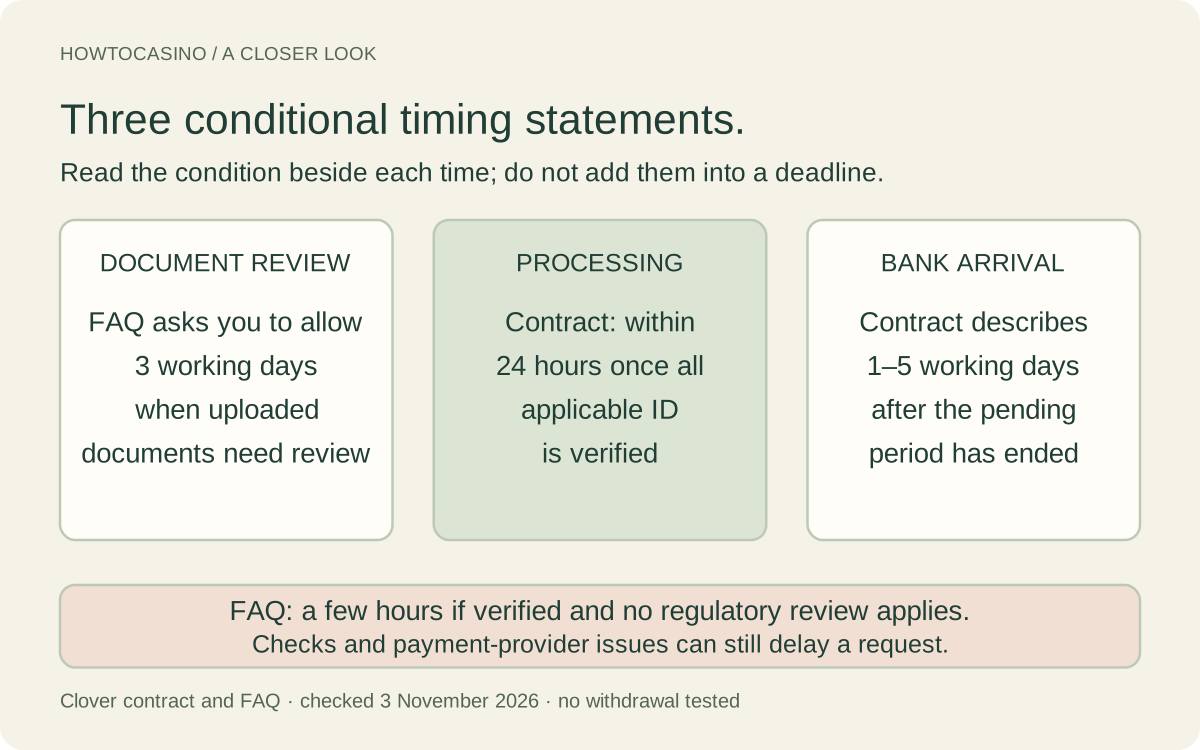
Clover’s FAQ says a verified account with no regulatory obligation or review should receive funds within a few hours. Its contract separately describes pending withdrawals being processed within 24 hours once all applicable ID documents are verified, and bank processing taking 1–5 working days after the pending period. These statements describe different conditions and stages. They do not establish one guaranteed time from pressing Withdraw to receiving the money.
| What you are checking | Published position | What to keep in mind |
|---|---|---|
| Document review | The FAQ asks customers to allow three working days for uploaded documents to be reviewed. | This applies when documents need review; it is not a compulsory three-day wait on every withdrawal. |
| A verified pending request | The Banking Policy says processing is within 24 hours after all applicable ID documents have been verified. | Additional due-diligence, account-activity or regulatory checks can affect a request. |
| Payment reaching the bank | The contract states 1–5 working days after the pending period; the FAQ describes a few hours where its conditions are met. | The FAQ’s shorter statement is conditional. We have not measured a payment or verified a separate timing for each method. |
We found no fixed 72-hour withdrawal holding period in the checked Banking Policy. The contract does use 72 hours for an ordinary account-closure request after support confirms submission. That closure provision should not be copied into a payout-time claim. Nor should the three document and payment statements above be added into a promised maximum.
For a delayed request, save its reference, amount and submission time, your verification status and any request for information. Ask whether the request is awaiting documents, under review, processed or already sent to the payment provider. The guide to withdrawal delays explains why those stages need different follow-up.
Which payment directions and fees are actually documented?
Clover’s Banking Policy is in GBP and sets a general £10 minimum deposit per transaction. It lists Visa Debit, Mastercard Debit, Maestro, Paysafecard, Pay by Mobile, PayPal, Neteller and Skrill for deposits. That general minimum does not establish an individual minimum for each method, so those method-specific amounts remain unknown in our comparison.
| Route | Deposit evidence | Withdrawal evidence |
|---|---|---|
| Registered debit cards | Explicitly listed in the Banking Policy. | The contract says withdrawals can be paid to registered cards. |
| PayPal, Skrill and Neteller | Each is explicitly listed for deposits. | The checked Clover text does not separately confirm a payout facility for each wallet. |
| Paysafecard | Explicitly listed for deposits. | No separate withdrawal direction established by the checked public text. |
| Pay by Mobile | Explicitly listed; Clover also explains phone-bill and prepaid-credit deposits. | The contract explicitly says withdrawals cannot be sent to Pay by Mobile. |
The £2.50 transaction-fee wording appears inside the Pay by Mobile deposit entry. It does not establish a £2.50 charge on every withdrawal. Because the sentence says all deposits within that entry, establish the fee shown for your chosen deposit before confirming it; this review does not turn the wording into a verified fee schedule for every payment method.
The Banking Policy gives a right to withdraw the full Real Money balance, subject to its checks, but does not state a numerical withdrawal minimum or a separate small-balance exception. We therefore do not invent a £5 or £10 cash-out threshold, require another deposit to reach one, or promise that every method accepts any amount. All payment methods must belong to the account holder. Using a phone to request a withdrawal is also different from receiving a payout to a phone bill.
Can a bonus prevent withdrawal of your own money?
The current welcome page describes a first-deposit 50% match up to £100, with a £10 minimum fund and 10x wagering on Bonus Funds. This is a dated description of published terms, rather than confirmation that an individual account qualifies. Bonus Policy 1.1 gives the specific promotion’s terms priority where they conflict with the general policy.
Your Real Money and Bonus balances are separate. Real Money is spent first, and real-money wagers do not clear the bonus target. On a 10x promotion, £10 awarded as Bonus Funds requires £100 of eligible bonus-funded wagers. Finishing the target does not guarantee any balance remains.
For a customer who has deposited, the general conversion limit is the lowest of the remaining eligible Bonus balance, lifetime deposits and £250, or a lower specific offer limit. With no deposit, the general ceiling is £50. The policy also removes Bonus Funds and pending offers after three consecutive inactive days unless the particular promotion says otherwise. That bonus expiry is separate from the dormant-account rule below.
You may request your Real Money before finishing bonus wagering. Under clauses 1.6 and 1.9, the withdrawal remains subject to banking and required checks, while the active bonus, its restricted winnings and associated outstanding benefits are cancelled. The general description of a card-registration Free Spins offer does not establish that a particular no-deposit offer is available to you. The wagering guide explains how to read a target and a conversion cap separately.
What happens if you leave the account unused or close it?
After 365 consecutive days without logging in, the contract treats the account as inactive. It says notice is sent beforehand, the remaining Real Money balance is suspended, and £5 is deducted every 30 days until the balance is exhausted or restored following reactivation. The balance may therefore disappear from view without being the same thing as a lost entitlement: contact support to restore any remaining amount, subject to possible identity checks.
An ordinary closure request is reversible and takes effect 72 hours after support confirms submission; logging in before closure cancels the request. The contract also says closure waits until a pending withdrawal is fully processed. For a gambling-related block, use Take a Break or self-exclusion instead. The terms describe Take a Break as brand-specific, while self-exclusion applies across Jumpman accounts within 24 hours. The FAQ says these tools remain available during verification.
GB deposit limits count gross deposits: a withdrawal does not replenish the amount you can deposit during that limit period. The terms say limits apply across identified accounts on participating Jumpman websites, and the site states it is integrated with GAMSTOP. Moving to a sister site should not be treated as a way around a limit or exclusion.
Which complaint deadline and escalation route should you use?
Both the contract and FAQ direct complaints to complaints@jumpmangaming.com, but they give different submission periods: six months in the contract and three months in the FAQ. Raise the issue promptly and keep a dated copy of both provisions. An older unresolved case should not be abandoned solely because the shorter FAQ period has passed; ask for the applicable policy and a written response.
The contract names eCOGRA for UK Alternative Dispute Resolution and describes a free route after deadlock or no satisfactory resolution within eight weeks of making the complaint. Another sentence starts its investigation target when all requested information is provided. The Commission’s guidance puts the overall clock at first receipt, while allowing justified pauses where a customer does not engage promptly; a reasonable information request does not simply restart a fresh eight weeks.
Send a short chronology, account and withdrawal references, relevant terms or offer screenshots, the information already supplied and the resolution you want. If a term is used to refuse payment, ask which clause and transactions support the decision. Do not send unmasked card details in a public review. The FAQ lists live chat at 6am–9pm BST daily and aims to answer emails within two business days; BST is the page’s published label, rather than a verified winter GMT schedule. We have not tested a response time.
Does a current licence mean a clean regulatory history?
The current account’s actions page says no regulatory actions have been recorded for the business. Separately, the Commission’s news release of 17 May 2022 reports a £500,000 regulatory settlement by Jumpman Gaming after social-responsibility and anti-money-laundering failures. The release concerns the operator, rather than a finding about a particular Clover account.
The settlement should not be described as a current suspension, and an empty current actions list should not erase the dated announcement. The Commission says historic public statements are available online for three years. Its live activity register remained Active at this review’s check.
What this review establishes
This is a review of public documents and the register checked on 3 November 2026. We did not register an account, play, contact support, test an app or make a deposit or withdrawal. Customer-funds wording in the directly retrieved contract differs from older search-extracted copies; the current contract’s High Protection description is the one reported here. Individual complaint outcomes and current account eligibility remain untested.
Related questions
Does Clover Casino have a GB licence?
The Gambling Commission listed clovercasino.com as a White Label domain under Jumpman Gaming Limited, account 39175, with Active Remote Casino permission on 3 November 2026. A licence does not guarantee a particular account’s withdrawal outcome.
Does Clover Casino charge £2.50 for every withdrawal?
The checked Banking Policy puts the £2.50 transaction-fee sentence in its Pay by Mobile deposit entry. It does not establish a blanket £2.50 withdrawal charge. Confirm the fee for your chosen deposit method before authorising it.
Can I withdraw to my phone bill?
No. The contract explicitly excludes Pay by Mobile withdrawals. A withdrawal request made through a phone browser still needs a supported payout route.
Is Clover Casino part of GAMSTOP?
Its terms state that Jumpman Gaming is integrated with GAMSTOP. They also say a Jumpman self-exclusion applies across accounts with that operator within 24 hours. This is different from an ordinary reversible account closure.