Which Bonus Poker and Double Double Bonus rules are compared?
This comparison uses Evolution’s published First Person Video Poker rulebook, with metadata dated E2 14 November 2024, alongside its current product description. It compares two selectable paytable names in that product, rather than combining payouts from unrelated video poker machines.
A First Person Video Poker entry was visible in BetVictor’s public GB catalogue on 2 November 2026. That establishes the named parent listing, not that either individual schedule is enabled for a particular account or that the published PDF is the installed rules revision. Check the game’s own Help and Paytable.
For the basic deal, hold and draw process, use our video poker guide. This article starts with completed five-card hands and explains how the two schedules award them; it is not an optimal-hold strategy chart.
What changes in the published paytables?
Each figure below is a listed return multiple of the stake on one hand. The highest qualifying row pays once: a four-of-a-kind hand does not receive the three-of-a-kind award as an extra payment. The numbers apply to the selected Evolution schedules, not every game carrying a similar name.
| Final hand | Bonus Poker | Double Double Bonus |
|---|---|---|
| Royal flush | 800× | 800× |
| Straight flush | 50× | 50× |
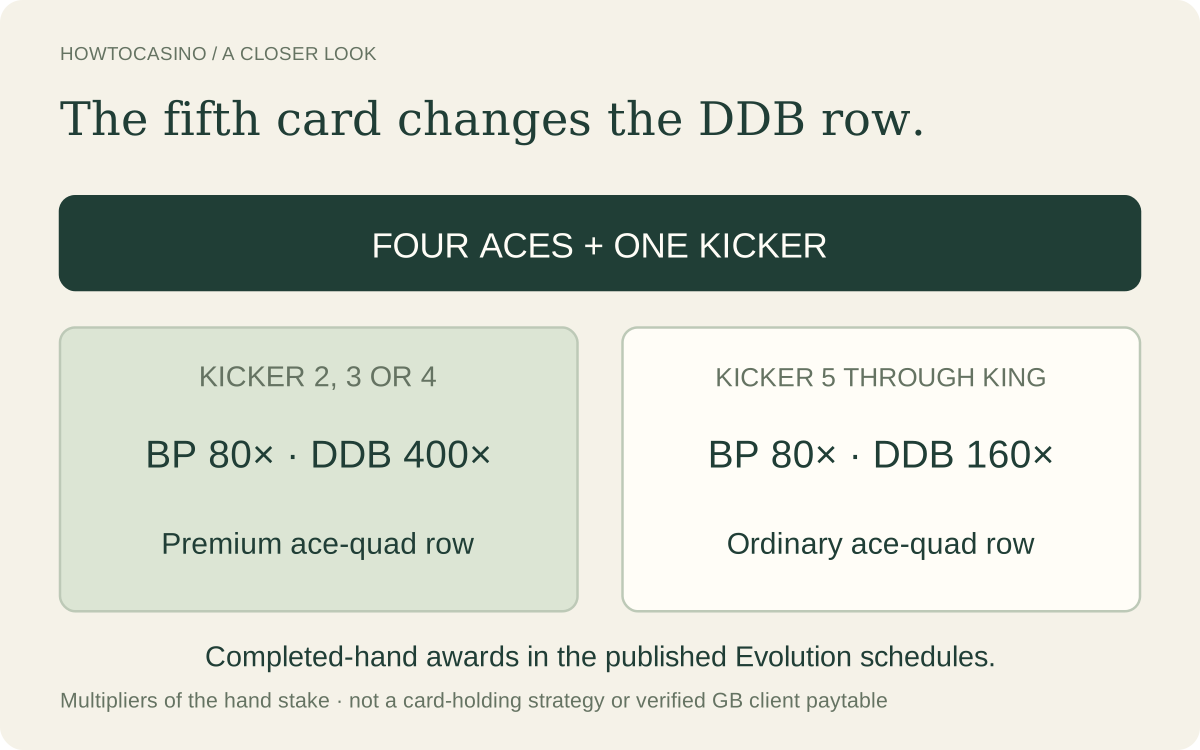
| Four aces + 2, 3 or 4 | 80× | 400× |
| Four aces + 5 through king | 80× | 160× |
| Four 2s, 3s or 4s + an eligible A, 2, 3 or 4 | 40× | 160× |
| Four 2s, 3s or 4s + 5 through king | 40× | 80× |
| Four 5s through kings, any fifth card | 25× | 50× |
| Full house | 8× | 9× |
| Flush | 5× | 6× |
| Straight | 4× | 4× |
| Three of a kind | 3× | 3× |
| Two pair | 2× | 1× |
| One pair of jacks or better | 1× | 1× |
| No qualifying category | 0 | 0 |
Double Double Bonus increases the selected quad awards but reduces two pair. It also pays more for full houses and flushes in this comparison. “All ordinary hands pay less” would therefore be wrong. The largest number alone does not tell you which schedule returns more over time or how your session will end.
What is a kicker, and which fifth cards qualify?
Here, the kicker is the single card left beside four equal-ranked cards. It is not a wild card and does not substitute for a missing member of the four of a kind. Its rank determines the relevant Double Double Bonus row.
| Completed hand | Relevant boundary | DDB return multiple |
|---|---|---|
| A♠ A♥ A♦ A♣ 2♠ | A 2 is a qualifying kicker beside four aces | 400× |
| A♠ A♥ A♦ A♣ 5♠ | A 5 is outside the 2/3/4 premium range | 160× |
| 2♠ 2♥ 2♦ 2♣ A♠ | An ace qualifies beside four 2s | 160× |
| 2♠ 2♥ 2♦ 2♣ 5♠ | A 5 is outside the low-quad premium range | 80× |
| 5♠ 5♥ 5♦ 5♣ A♠ | Four 5s stay in the ordinary-quad row | 50× |
The two premium rules are different. Four aces require a 2, 3 or 4 kicker. Four 2s, 3s or 4s can qualify with an ace or another physically possible low kicker. Four aces cannot have an ace kicker: all four aces are already in the hand. For the same reason, four 2s cannot be followed by a fifth 2.
These examples classify the finished result. They do not tell you whether to hold a kicker during a draw. That decision depends on the full paytable and the cards dealt; a qualifying final hand is not a strategy proof.
What do those multipliers mean on a 50p hand?
The examples use a hypothetical 50p stake on one hand, read the listed multiplier as the total return credited, and assume no bonus or deduction. They are conditional arithmetic for this supplier model, not a statement of a GB operator’s accepted minimum or a recommended stake.
| Same completed hand, 50p staked | Bonus Poker: return; net result | Double Double Bonus: return; net result |
|---|---|---|
| Four aces + 2 | £0.50 × 80 = £40; +£39.50 | £0.50 × 400 = £200; +£199.50 |
| Four aces + 5 | £40; +£39.50 | £80; +£79.50 |
| Four 2s + ace | £20; +£19.50 | £80; +£79.50 |
| Two pair | £1; +£0.50 | £0.50; £0 net |
| Full house | £4; +£3.50 | £4.50; +£4 |
| One pair of jacks | £0.50; £0 net | £0.50; £0 net |
| One pair of tens, no other qualifying category | £0; −£0.50 | £0; −£0.50 |
A 1× return is the stake back, with no profit on that hand. A 400× total return is not 400:1 profit odds and not automatically £400: the monetary result depends on the hand stake. Do not add the 50p again after multiplying by the stated return.
For the ace-plus-2 example, the £160 difference between £200 and £40 comes from the different schedules applied to the same completed hand. It does not mean that selecting Double Double Bonus creates that hand, or that its highest award is the most likely result.
Can a paid hand still leave the round losing?
Yes. In the documented multi-hand format, the selected bet applies to each hand. Four hands at 50p cost £2 in total. Suppose just one of those hands finishes with two pair and the other three return zero.
| Schedule | Total round stake | Return from the one paying hand | Net round result |
|---|---|---|---|
| Bonus Poker | £2 | £1 | £1 − £2 = £1 loss |
| Double Double Bonus | £2 | £0.50 | £0.50 − £2 = £1.50 loss |
The Double Double Bonus hand returned its individual stake, but the round did not break even. More hands add paid stakes; do not compare one hand’s return with the price of only one hand while ignoring the other three.
Shared initial cards in a multi-hand format also do not turn the hands into several independent copies of an unrelated single-hand session. This example adds actual stakes and returns; it makes no probability or risk-ranking claim.
What about five coins, Double Bonus or Bonus Poker Deluxe?
The Evolution schedule used here expresses the royal flush directly as 800× the stake on that hand. It does not tell you to activate that row by betting five coins. A separate coin-based game can display a different royal-flush award in its maximum-coin column; that game’s rules must be read on their own.
For example, PokerStars’ global coin-based Double Double Bonus table shows 250, 500, 750, 1,000 and 4,000 credits across its one-to-five-coin columns. That is a different documented model, not evidence of a current GB offer or a reason to convert every Evolution stake into five coins.
Double Bonus is a separate paytable name from Double Double Bonus. Games Global’s supplier title list also names Bonus Poker Deluxe separately from Bonus Poker. Do not shorten these names when matching a game to a payout table.
Our Jacks or Better guide covers that other payout structure. Deuces Wild uses a different wild-card rule; its treatment of 2s must not be transferred into these two schedules.
What should you compare before selecting a version?
- Exact game title, provider and currently selected paytable.
- All rows, including two pair, full house and flush, not only the biggest quad award.
- The eligible fifth-card definition for each four-of-a-kind category.
- Stake per hand, number of hands and total round cost.
- Whether payouts are total returns, profit odds or credit-column amounts.
- The exact Help and payout limit in the game being offered to your account.
We have not reproduced an optimal strategy or a complete mathematical model for these schedules, so we do not rank their RTP or quantify their variance here. A larger possible award and a smaller two-pair award explain a trade-off in the table; neither proves that one game is a better personal choice.
If a result looks wrong, save the five final cards, selected schedule, hand stake and round reference. Our wrong-payout guide shows how to reconcile an award without treating a displayed credit as net profit.
Related questions
Does any low kicker qualify with four aces?
In the selected Evolution Double Double Bonus schedule, four aces need a 2, 3 or 4 kicker for the 400× row. A 5 through king uses the 160× row. There cannot be a fifth ace in a standard single deck.
Does Double Double Bonus pay double on every hand?
No. In these schedules two pair returns 1× rather than Bonus Poker’s 2×, while full houses, flushes and some quad awards differ in other ways. Read each row instead of treating the name as a multiplier for the whole table.
Is a bonus kicker a wild card?
No. It is the actual fifth card beside four of a kind. These completed-hand bonus categories do not make 2s wild or allow an extra ace to replace another card.