Is Keno the same as a reel slot?
The phrase Keno slots is often used when someone means a casino number-draw game on a screen. The documented game here is won by matching chosen numbers with drawn numbers. It does not use a fixed-payline combination of fruit or card symbols as its deciding rule.
Online casino Keno, a Keno-branded national lottery, a live venue draw and a physical machine can have different providers, procedures and paytables. This guide explains one fully identified published HTML5 rule model; it does not supply controls or winning conditions for every physical terminal or lottery product.
The primary example is Danske Spil’s public English Keno help for HTML5 phone and pad formats, last modified 14 October 2019 and still available when checked 31 October 2026. It is an international published rules example, not a current GB casino recommendation or evidence of British account access.
Our game-rules guide explains how to identify the actual wager and payout units. A page filed under Slots does not itself establish that Keno has paylines or uses another slot’s winning mechanism.
What do picks, draws and hits mean?
| Count in the example model | Meaning | Do not confuse it with |
|---|---|---|
| 80 available numbers | The pool from which you can select and the game can draw. | Eighty simultaneous wagers. |
| 1–15 selected numbers | Your chosen set, sometimes called picks or spots. | The twenty numbers the game draws. |
| 20 drawn numbers | The result set produced for one game. | Twenty automatic player hits. |
| Hits or matches | Numbers appearing in both your selected set and the drawn set. | All drawn numbers, or the number of selected spots. |
The maximum possible hits cannot exceed your selected count or the draw count. If you selected five numbers, your possible hit counts are zero through five, although the game draws twenty numbers. Selecting fifteen changes the relevant table and the range of outcomes; it does not make all fifteen appear.
How do you follow a single game?
- Open the exact title’s information panel and read its number pool, draw size and permitted picks.
- Set the total stake for the next game and confirm what the Bet display represents.
- Select the required numbers. In this published model, a selected number can be deselected before play, and Clear removes the selection.
- Read the paytable that corresponds to the number of spots selected. Changing the pick count changes the applicable table.
- Start one accepted game. The documented model draws twenty numbered balls from the eighty available.
- Count the selected numbers appearing in the completed draw, then use that hit count in the selected paytable.
- Check the final Paid amount against the stake and the published multiplier convention.
This is the described single-game procedure, not an instruction to use every control shown in the international help. Its autoplay and Turbo sections should not be imported as GB controls. The current UK gaming standard requires a customer to commit to each game cycle individually. A repeat with the same chosen numbers is still another game and stake when accepted.
How do five picks become a two-hit result?
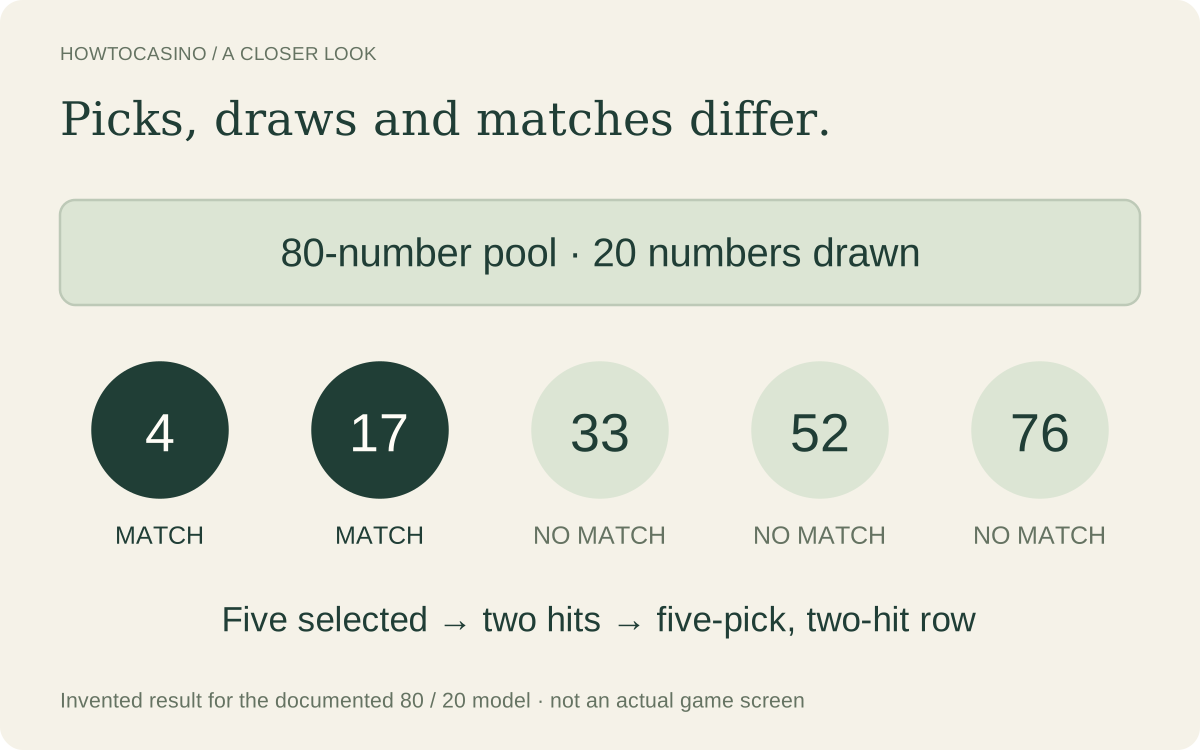
Consider an invented selection of 4, 17, 33, 52 and 76. Suppose the twenty drawn numbers are 1, 4, 8, 11, 16, 17, 22, 28, 31, 35, 40, 44, 49, 55, 61, 63, 68, 72, 74 and 79. The sets overlap at 4 and 17 only.
| Part of this invented result | Numbers or count |
|---|---|
| Selected set | 4, 17, 33, 52, 76: five picks. |
| Matches | 4 and 17: two hits. |
| Selected but not drawn | 33, 52 and 76. |
| Paytable lookup | Five-pick table, two-hit row. |
Do not choose the two-pick table because there were two matches. The pick count selects the table first; the hit count then selects the outcome within it. Nor does a match pay again merely because its number is shown in both the result animation and the final history.
The result is a set comparison. In the cited model, choosing 4 before 17 does not create a separate order-of-draw wager. A different game can sell different conditions, so read its actual table if it refers to order, special balls or another side feature.
Does a 1.5× Keno payout mean 1.5× profit?
Not in the cited payout example. The published help expressly uses a five-pick, two-hit result with a 1.5 multiplier: a £5 stake gives a £7.50 payout. That multiplication gives the total paid, rather than £7.50 profit plus another return of the £5 stake.
| Illustrative stake under that same 1.5× convention | Total paid | Net result of one game |
|---|---|---|
| £1 | £1 × 1.5 = £1.50 | 50p profit. |
| £2 | £2 × 1.5 = £3 | £1 profit. |
| £5 in the source’s own example | £5 × 1.5 = £7.50 | £2.50 profit. |
These are conversions of one documented table entry, not a currently verified GB stake menu. A ratio written 1.5:1 as profit odds in another product would be a different convention: a £1 winning stake would return £2.50 there. Do not silently transfer that convention into this Keno example.
The published Bet display is the total bet per game. In its five-pick example,£5 is not multiplied by five selected spots to create a £25 stake. Another product may price several boards, tickets or draws separately, so confirm its accepted total rather than extrapolating from the number of marks.
What must a complete Keno paytable tell you?
The described model has fifteen paytables, one for each permitted number of picks. Each contains the payout multipliers for the applicable hit counts. The single 1.5× entry above does not establish the awards for three, four or five hits, or whether a particular other row pays anything.
- The number of picks to which the table applies.
- The exact number of matches for each listed outcome.
- The award multiplier and whether it is total returned or profit odds.
- Any extra feature, stake condition, maximum award or aggregate limit.
- The total cost if several games or boards are accepted together.
An unlisted hit count should not be given an invented award. Some Keno products can have deliberately different low-hit or zero-hit prizes, so neither the word match nor a memory of another game supplies the row. The worked payment above covers only the five-pick/two-hit row. For other results, read the applicable current table.
The maximum-win guide explains why a ceiling also needs its scope. A top prize, an individual symbol amount and the total return over several accepted games are different figures.
What do 80 numbers and 20 draws tell you about the odds?
For a mathematical illustration, assume a uniform draw of twenty distinct numbers from eighty, with no replacement within that draw. One particular chosen number then has a 20/80 chance of appearing:25%. That is a match probability for one number, not a statement that every game has a 25% chance of paying a prize.
For five selected numbers, all five being drawn has probability C(20, 5) ÷ C(80, 5), where C means the number of ways to choose that many items without order. The result is about 0.0645%, roughly one in 1,551 draws under those assumptions. It is a probability calculation, not a guarantee of one such result in each block of 1,551.
Exactly two matches among five selections has a different probability: C(20, 2) × C(60, 3) ÷ C(80, 5), about 27.05%. The first factor chooses two drawn numbers and the second chooses three numbers outside the draw for the five-number set. The payout still comes from the separate two-hit row.
Those calculations do not reconstruct the complete RTP. That requires every outcome’s probability and payment, including any special condition or cap. The number of hits, chance of any award and expected return are separate measures.
Choosing more spots changes both the possible hit pattern and its table. It is therefore not enough to compare the largest printed payout or assume that more marked numbers automatically gives a better-value wager.
Can hot numbers or a betting system beat Keno?
The cited game rules describe random outcomes whose odds do not change because of previous wins or losses, stake value, time of day or account balance. A number that has not appeared recently is not documented as being due.
Under the uniform-draw illustration, one particular five-number set has the same match distribution as any other particular five-number set. Choosing a neat pattern or a scattered pattern does not alter that distribution. A random-selection control chooses a set; it is not a promise of a better-paying draw.
Increasing the stake after a losing game increases the money at risk on the next accepted game. It does not turn the earlier losing numbers into a contractual right to a later award. This guide provides no guaranteed method for beating casino Keno or a physical Keno machine.
Our casino-odds guide explains how payout rules and probabilities combine. A positive animation, a large possible prize or a short winning sequence is insufficient evidence of a profitable long-term system.
Can I apply these rules to every Keno terminal or lottery?
No. A different product may use another number pool, draw size, selection range, payout chart or set of optional features. A physical terminal also has its own credit, confirmation and collection procedure. Do not infer those controls from this HTML5 help page.
Likewise, a lottery called Keno may involve a scheduled draw, different ticket conditions and another operator or jurisdiction. This casino explainer does not establish any lottery’s current ticket rules, tax treatment or eligibility. The quiz-style question about which game Keno historically resembles is a separate intent from operating the described digital game.
For a real-money service used in GB, identify the exact operator and permission separately. A foreign public rule document can explain a mathematical model without establishing permission to serve British customers.
What should you keep if a Keno payment looks wrong?
- The exact game title and round reference.
- The total accepted stake and any separate board or draw charges.
- Your selected numbers and the complete final drawn set.
- The pick count, hit count and applicable paytable row.
- The final Paid figure and its return-versus-profit convention.
- Any cap or feature clause relevant to that result.
An early animation frame may show only part of the twenty-number draw. Use the completed result when checking matches. If the recorded total still disagrees, ask the operator to explain the accepted wager and rule row rather than repeating paid games to try to reproduce it.
Related questions
How many numbers do you choose in online Keno?
In the published HTML5 model described here, between one and fifteen numbers from a pool of eighty. Twenty numbers are drawn per game. Other products can use different settings.
Do five picks mean five numbers are drawn?
No. Picks are your selected set. In this model, the game draws twenty numbers regardless of that five-pick example. The intersection of the two sets gives the hit count.
Which paytable applies if I choose five numbers and match two?
Use the five-pick table and its two-hit row. Do not switch to the two-pick table merely because two numbers matched.
Does a 1.5× payout include the Keno stake?
In the source’s explicit example, a £5 stake multiplied by 1.5 gives £7.50 total paid, so the profit is £2.50. Read the specific convention; profit odds and total-return multipliers are different.
Can I use this table for every Keno slot machine?
No. This guide explains an identified online HTML5 model and one verified payout example. A physical machine, another online game or a lottery can have different rules and prices.
Are numbers that have not appeared recently more likely next time?
The cited game rules say prior wins and losses do not change the outcome odds. A history display is not a promise that an absent number is due.