Which Big Bass Splash rules does this guide explain?
This guide uses the original Big Bass Splash supplier model, identified as vs10txbigbass in the consulted overview. It is separate from Bigger Bass Splash, Big Bass Splash 1000, Big Bass Bonanza and other similarly named games. Check the complete title before applying these instructions.
We read the supplier’s published overview and rule sheet, and checked the current Pragmatic Play product description. Virgin Games also had a public GB listing on 31 October 2026. We did not launch a game or establish which supplier build and RTP configuration was deployed for a particular account.
Some worldwide documentation includes controls unavailable in GB play. The explanation below concerns the ordinary game and its naturally triggered feature; it does not supply international feature-purchase or speed-control instructions.
How do the reels, lines and stake work?
The published model has five reels, three visible rows and ten paylines. A line combination begins on the leftmost reel and continues across adjacent reels. Read the marked line path: symbols scattered anywhere on the screen do not automatically form an ordinary line win.
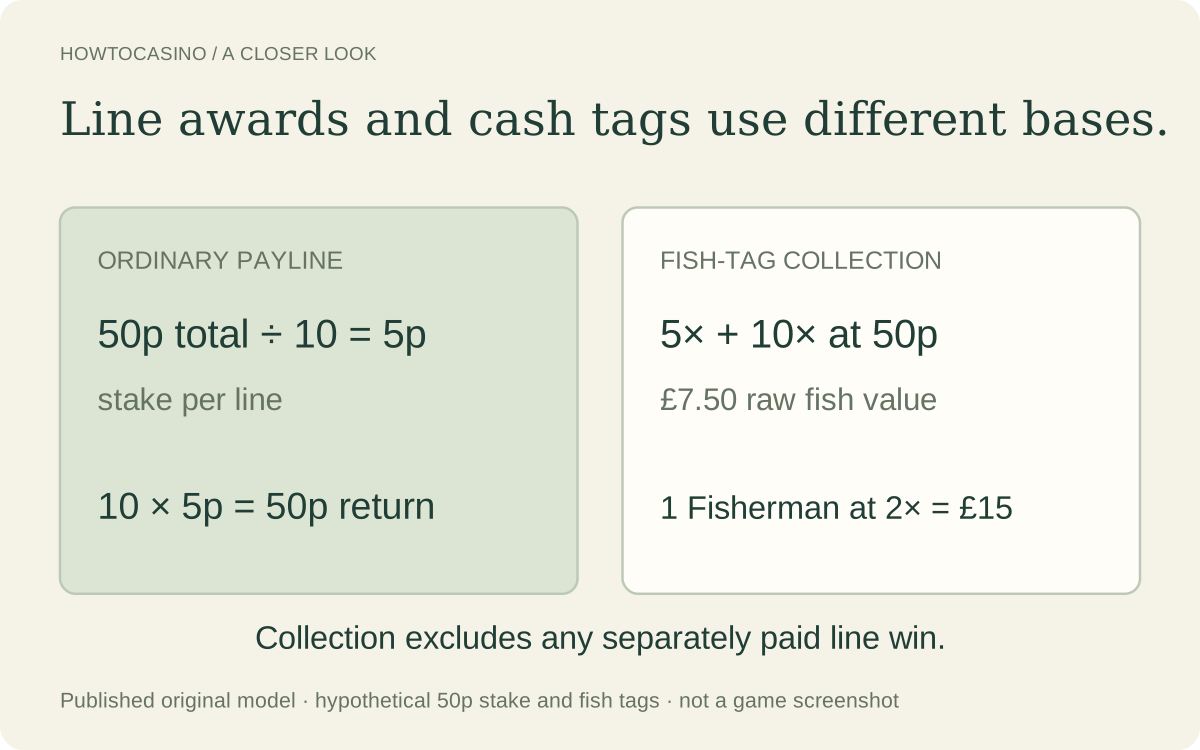
Paytable multipliers for ordinary symbols use the stake per line. At a hypothetical total stake of 50p covering ten lines, each line has a 5p stake. Multiplying a line-paytable number by the whole 50p would overstate that award tenfold.
Only the highest qualifying combination pays on a particular line; wins on different lines are added. For the complete payable combinations, use the paytable displayed for the selected game. The examples here illustrate units rather than reproduce every entry.
Our payline guide explains how line paths work, while the credits-and-coins guide explains why a displayed multiplier needs a cash base.
Do all symbols need three matches to pay?
No. In the consulted model the truck has a two-symbol award. That is an exception to a simple three-matching-symbol summary. Fish can also form ordinary paying line combinations; their money tags are an additional mechanism, rather than the only way a fish can contribute to a return.
The supplier overview shows a worked configuration with a $2.10 total stake: ten lines, seven coins per line and a $0.03 coin value. That makes $0.21 per line. Its displayed $1.05 two-truck, $2.10 three-fish and $420 five-truck awards give the 5×, 10× and 2,000× line multipliers used below. These ratios are independently calculated from that publication; its currency and stake menu are not presented as GB options.
| Constructed line result | Published line multiplier | Return at a 5p line stake |
|---|---|---|
| Two trucks on a qualifying line | 5 × line stake | £0.25 |
| Three fish on a qualifying line | 10 × line stake | £0.50 |
| Five trucks on a qualifying line | 2,000 × line stake | £100 |
The £100 example assumes a qualifying five-truck combination on one line and the stated 50p total round stake. It is the return for that line, not a predicted outcome or a claim about the amount a session will make. Other qualifying lines would be assessed separately.
How do you trigger the free spins?
Three, four or five Scatters award 10, 15 or 20 initial free spins respectively in the published model. A separate random +2 Spins modifier can add to those counts. Scatters use their feature-trigger rule rather than needing the ordinary left-to-right payline pattern.
The model also describes a random second chance when two Scatters land. That animation is not a promise of the third Scatter and supplies no evidence that another paid spin is due to trigger the feature. A near miss is not progress saved towards a guaranteed bonus.
Naturally triggered free spins are part of the paid game cycle. They are different from a casino promotion awarding free-spin credits. Our free-spins guide explains the separate offer conditions that apply to promotional spins.
How do fish money values and Fisherman Wilds pay?
During free spins, each Fisherman Wild collects the displayed fish money values. The Wild also substitutes for ordinary paying symbols, excluding Scatters. Keep the collected cash-tag award separate from any ordinary line wins on the same result.
For a constructed example, assume a 50p total stake and fish tags worth 5× and 10× that total stake. The raw money value is (5 + 10) × £0.50 = £7.50. This is an invented set of tags for calculation, rather than a claim that they appear with a particular frequency.
| Assumed feature result | Collection calculation | Collected return |
|---|---|---|
| One Fisherman; 1× collection stage | £7.50 × 1 × 1 | £7.50 |
| One Fisherman; 2× collection stage | £7.50 × 1 × 2 | £15.00 |
| Two Fishermen; 2× collection stage | £7.50 × 2 × 2 | £30.00 |
These amounts exclude any separately qualifying line award. Fish money tags without a collecting Fisherman do not themselves create this collection award; a fish line combination can still pay under its own rule. Do not add the same cash-tag amount a second time simply because a fish also lies on a payline.
How do the extra spins and multipliers progress?
In the normal Level 1 start, collected Fisherman Wilds accumulate towards retriggers. Each fourth Wild adds ten spins and advances the collection multiplier for the additional batch: first 2×, then 3×, then 10×. After the third retrigger, the feature cannot retrigger again in the consulted model.
The supplier overview says the added spins are played after the previous batch ends. For an uncomplicated example, place the fourth Fisherman on the last spin of the initial batch. The queued additional spins then use 2× collection. That progression does not retrospectively double the returns already settled in the opening batch.
With a three-Scatter, normal Level 1 start and all three retriggers reached, the nominal count is 10 + 10 + 10 + 10 = 40 spins. If the +2 modifier applies to the initial and each retriggered batch, that calculation becomes 12 + 12 + 12 + 12 = 48. Both examples assume the necessary Wilds appear and no early cap ends the round.
Those totals are conditional examples, not a promised bonus length. A random Level 2 start changes the starting feature state; do not apply the normal-start arithmetic to it without checking the selected game’s own instructions.
What do the modifiers and helper animations change?
The supplier describes up to five randomly awarded modifiers before the feature: more fish, more Wilds, more helper features, a Level 2 start and two extra spins. A player does not select a guaranteed set by choosing a particular moment to start a spin.
The published rules also describe helper animations that can bring fish or a Fisherman into a result, or alter symbols. Our consulted supplier and GB operator summaries conflict over one helper’s name and triggering situation. We therefore do not present an exact Dynamite/Hook trigger list as verified behaviour of the GB client.
Read the selected help if a particular animation is the reason you are checking the game. A helper remains a random game event; its appearance does not establish a reliable method for forcing another collection.
What do the maximum win and RTP tell you?
The consulted model limits the round return to 5,000 times the total stake and ends remaining features or spins when that ceiling is reached. At a hypothetical 50p stake, 5,000 × £0.50 is £2,500. A maximum is a conditional ceiling, not a probability or a likely return.
Pragmatic’s product page publishes 96.71% RTP. That supplier figure does not establish the configuration used by a particular GB service. Check the selected game’s own help rather than assuming that the global percentage applies to every deployment.
RTP describes a theoretical long-run return under a stated model. It does not tell you how many spins remain before a feature, how long a balance will last or what the next result will be. The RTP and volatility guides explain those distinct concepts.
Which checks matter for a GB player?
Virgin Games’ named public listing was checked separately from Gamesys Operations Limited’s GB permission. Account 38905 had active Remote Casino permission, and virgingames.com was listed as White Label. That establishes a dated public example and service relationship; it is not a tested session or endorsement.
GB online-slot stake limits are £2 per game cycle for ages 18–24 and £5 for ages 25 and over. Account or operator controls may be lower. These are upper limits, not recommended stakes, and the worldwide document’s foreign-currency range should not be used as a GB menu.
Global rules mentioning autoplay, turbo or paid feature entry are not suitable GB instructions. The GB product-design rules and the Commission’s feature-buy case must be read separately. If a round appears interrupted, preserve the game and round reference and use the interrupted-slot guide rather than placing another wager to test it.
Related questions
How many paylines does original Big Bass Splash have?
The consulted original supplier model has ten paylines over five reels and three rows. Ordinary paytable multipliers use the line stake; a hypothetical 50p total stake means 5p per line.
Can two matching symbols pay in Big Bass Splash?
The truck has a two-symbol line award in the consulted model. A blanket statement that every paying symbol needs three matches would miss that exception.
Do fish only pay when a Fisherman lands?
Fish can form ordinary line wins. Separately, during free spins, a Fisherman Wild collects their printed money values. A fish-tag collection and an ordinary line award use different rules.
How many Scatters trigger free spins?
Three, four or five Scatters award 10, 15 or 20 initial free spins in the published original model. Random modifiers and successful retriggers can change the total; a two-Scatter animation does not guarantee entry.
Does the 2× retrigger double earlier winnings?
The supplier overview assigns the multiplier to the additional retriggered spins after the preceding batch. It does not retrospectively multiply previously settled returns.
Is Big Bass Splash always 96.71% RTP in the UK?
The supplier publishes 96.71%, but that does not verify a particular GB operator’s deployed configuration. Read the selected game’s current help and keep similarly named sequels separate.