What kind of Big Wheel are you looking at?
Big Wheel, Big Six and money wheel are used for related formats, rather than one universal set of casino rules. A traditional physical wheel has repeated result labels and a betting area. An online live show can add multiplier spaces, bonus rounds or rules about wagers carrying into another spin.
For a concrete GB-facing reference, Victoria Gate Casino’s public Big Wheel explainer describes a physical wheel with 52 sections, including 24 labelled 1. We use only the facts it actually publishes. Its page does not provide a complete section-by-section inventory, an issue date or current table limits, and we have not visited or played the table.
That scope matters when another guide describes 54 sections. Neither number can be silently transferred to a different wheel. The full layout, repeated labels and applicable paytable are needed before deriving all outcome probabilities.
The live casino game-show guide explains broader formats and bonus features. This page focuses on reading a traditional wheel’s results and reconciling its accepted stakes and returns.
How does a traditional round work?
- Read the exact layout, available results, prices and table limits. Identify whether a displayed number is a result label, profit odds or a total-return multiplier.
- Wagers must be accepted within the game’s betting period. A selected chip or an intended click alone does not establish what was accepted.
- The wheel is spun and its pointer or clapper identifies the final result under the particular game’s stopping and valid-spin rules.
- Matching wagers are paid and other wagers lose, subject to any separate special rules. Add the whole round’s stakes and returns before describing the result as a profit.
A repeated label covers several possible stopping sections. “20” does not mean 20 sections or a one-in-20 chance. It also does not mean an ordinary roulette number: a money wheel has its own inventory and prices. If the pointer rests ambiguously or the spin is declared invalid, use that game’s published procedure; do not import another jurisdiction’s respin rule.
Does a 20:1 payout include the winning stake?
Victoria Gate’s description gives a clear example: £1 backed on 20 receives £20 in profit plus the original £1. That is a £21 total return. It also describes separate red and black 50:1 results. These named examples are not a complete paytable or a claim that every 50 label or colour has the same meaning elsewhere.
| Invented accepted single wager | If the backed result wins | If it loses |
|---|---|---|
| £1 on 20 at 20:1 profit | £20 profit + £1 returned stake = £21 | £0 returned; net −£1 |
| £2 on 20 at 20:1 profit | £40 profit + £2 returned stake = £42 | £0 returned; net −£2 |
If an interface instead quotes a total-return multiplier, the stake may already be included. Check the definition before adding it again. A special result paying 50:1 is also a different mechanism from a “2x” space that multiplies a later award; the printed labels alone do not establish settlement.
Can a winning label still leave the round down?
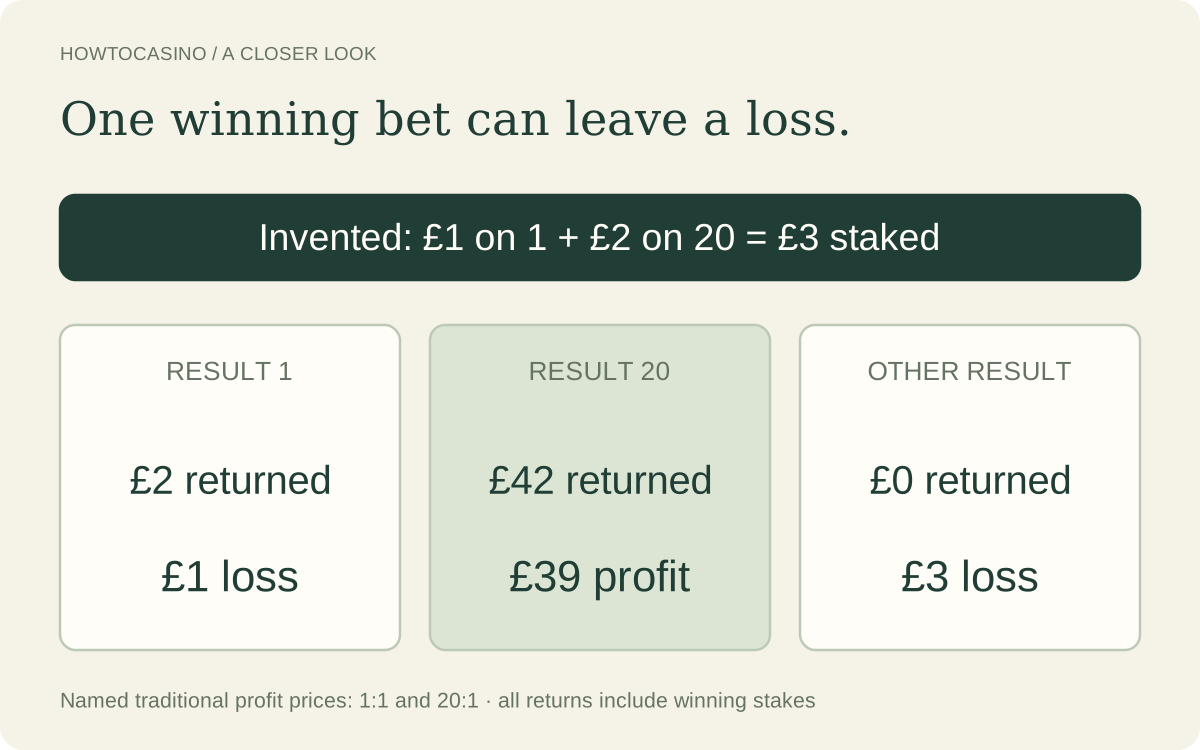
Yes. Suppose a fictional round accepts £1 on 1 at 1:1 profit and £2 on 20 at 20:1 profit. The round costs £3. These are explanatory stakes using the stated traditional prices, not an offer or a verified table minimum.
| Wheel result | Return from £1 on 1 | Return from £2 on 20 | Total return | Net on £3 total stake |
|---|---|---|---|---|
| 1 | £2 | £0 | £2 | −£1 |
| 20 | £0 | £42 | £42 | +£39 |
| Another ordinary losing result for both wagers | £0 | £0 | £0 | −£3 |
When 1 wins, the £1 bet makes £1 profit, but the other £2 wager loses. The combined round therefore loses £1. Count the losing wagers as well as the payment beside the winning label. Covering more labels changes the money at risk and the set of covered results; it does not make the combined stake profitable on every outcome.
Why do the number of sections and price both matter?
The venue page says 24 of its 52 sections show 1 and publishes a rounded 7.7% house edge for the 1 bet. Under the explicit mathematical assumption that all 52 sections are equally likely, the chance of 1 is 24/52 = 6/13, about 46.15%.
At 1:1 profit, a winning £1 wager returns £2 including the stake. The expected return is therefore £2 × 24/52 = about £0.9231 for each £1 staked. The corresponding expected loss is 1/13 of the stake, about 7.69%, which agrees with the page’s rounded figure.
A less frequent label can pay more while still having a house edge. To calculate a different bet’s expectation you need its own winning-sector count and actual return. The printed 20:1 price alone does not reveal how often 20 occurs. Rounded house-edge summaries are not a reliable substitute for an unpublished full inventory.
How do other wheels differ?
For a clearly separate comparison, Pennsylvania’s published default Big Six rules specify 54 sections and their full inventory, subject to their own provisions for alternatives. Those are US rules, not evidence that the GB wheel above has 54 sections or that its special results pay the same prices.
An online multiplier format adds a different issue. LeoVegas’ UK-facing money-wheel explanation describes multiplier outcomes that keep wagers in place for another spin. Evolution’s dated 7 February 2017 Dream Catcher launch described 2x and 7x multiplier spaces alongside numbered results. That historical supplier description is not a complete current GB help file.
| Before transferring a rule | Check in the named game |
|---|---|
| A sector count | Complete inventory, repeated labels and any approved alternative layout |
| A number or special symbol | Whether it settles a wager, multiplies a later award or triggers a feature |
| Another wheel movement | Whether the original wager remains active or another paid round is being placed |
| A price or maximum headline | Profit versus total return, eligibility, caps and the exact rule version |
A historical global mention of autoplay does not establish that the feature is permitted in a current GB game. Keep game identification and current market controls separate from a general description of what money wheels can do.
Can past results or a stake progression guarantee a win?
A history display does not establish the next outcome probability or show that a missing label is due. The expectation calculation above assumes an equal-sector model; it is not a method for predicting a dealer’s spin or measuring a real wheel. No winning guarantee follows from the rules examined here.
For an unclear settlement, preserve the exact game and provider, round time or identifier, accepted stakes by result, final result, shown prices and credited returns. Compare the full cash total with the rules before attributing a difference to a missing payment. A further wager is not needed to check the earlier record.
If your question concerns a roulette wheel instead, use its own wheel-mechanics and payout guides. Roulette labels, coverage and settlement rules do not describe Big Wheel.
Related questions
Does every casino Big Wheel have 54 sections?
No universal count follows from the name. Victoria Gate’s public GB description states 52, while Pennsylvania’s separate default Big Six rules specify 54. Read the exact wheel’s inventory.
How much does £1 on 20 return?
In Victoria Gate’s described traditional convention, a winning £1 on 20 returns £21: £20 profit plus the £1 winning stake. This is an attributed example, not every wheel’s paytable.
Can a round lose money when one wager wins?
Yes. In the invented example, £1 on 1 and £2 on 20 cost £3. If 1 wins at 1:1 profit, only £2 returns, leaving a £1 loss overall.
Is a 20 label a one-in-20 probability?
No. A label and its price do not supply the number of winning sections. You need the exact inventory and a justified probability model.
Is a multiplier space the same as a 50:1 result?
No. A multiplier can affect a later settlement or keep a wager active under that game’s rules. A traditional result can settle immediately at stated profit odds. Read the named format.
Does the 7.69% calculation prove the real wheel is fair?
No. It is the expectation of one stated bet under an equal-section assumption, using 24 winning sections out of 52 and 1:1 profit odds. It is not a measured test of a venue or a whole-game RTP.