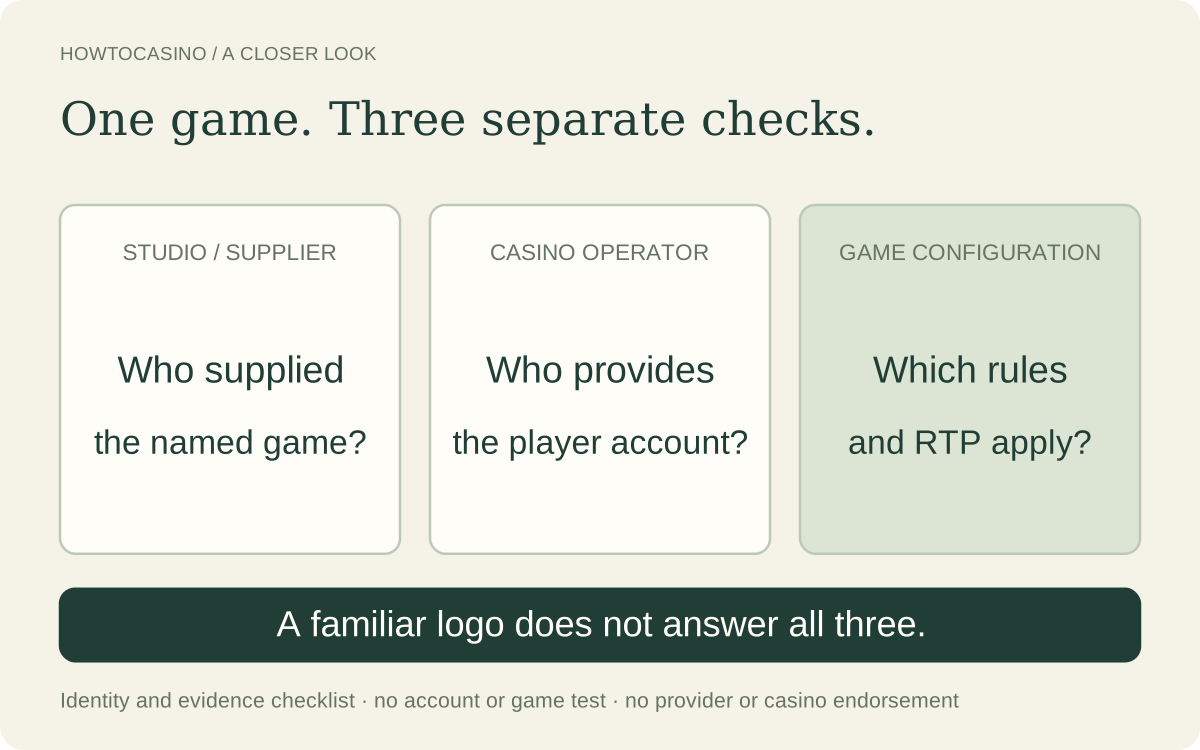
Is the slot provider the same company as the casino?
A studio supplies a game’s design and software: its symbols, winning mechanism, features and mathematical model. The casino operator provides the player account through which you deposit, place accepted wagers and request withdrawals. Software suppliers, hosting businesses and casino operators can have different roles, even where a corporate group owns more than one business.
| Name or record | Question it helps answer | What it does not establish |
|---|---|---|
| Game studio or provider | Who supplied this named game? | Who holds my casino account or what every version returns |
| Legal casino operator | Which business supplies the account service? | Whether every title has one universal RTP |
| Game title, identifier and configuration | Which rules and return model apply? | That a short losing or winning sample proves the whole model |
| Test-house report, where available | What product and scope were assessed? | That a copied logo authenticates a deployment or guarantees a payment |
UKGC guidance on gambling software describes software involved in accepting and recording transactions, determining results and calculating wins. It also recognises cases where a software business hosts games and needs further operating permission. The roles should therefore be checked from the actual records, rather than inferred from a simple “maker versus shop” slogan.
How can you identify who made a particular slot?
Start with the complete title in the selected game’s information, rules or loading screen. Record the provider label and any version or game identifier. Compare them with the supplier’s own product page. A casino’s provider filter can help locate a title, but a lobby label alone is not a complete technical record.
| Dated public supplier example, checked 30 October 2026 | What the primary page identifies | Important boundary |
|---|---|---|
| NetEnt’s Starburst product page | The named Starburst slot and its supplier presentation | Does not identify the RTP loaded by every GB casino |
| Blueprint’s Fishin’ Frenzy Megaways product page | The exact title and a Megaways mechanism licensed from Big Time Gaming | A mechanism licensor and the supplier of the finished game need not be the same name |
A series name can cover several different games. Fishin’ Frenzy, Fishin’ Frenzy Megaways and a later Big Catch edition are not interchangeable titles. Likewise, a branded theme or a parent-group name does not, by itself, identify the legal business holding a particular software licence.
The Starburst and Fishin’ Frenzy Megaways guides use named rules to explain those games. Questions about physical Dragon Link or Huff N Puff machines need their own exact manufacturer, product and market checks; this online-provider guide does not supply those machine-family rules.
How do you check a slot provider’s licence?
- Find the legal supplier name and any licence or account number in its official legal information. Keep that separate from a game trademark or group brand.
- Search the Gambling Commission’s public business register and match the legal identity and relevant activity, rather than relying on a badge copied to a website.
- Read the licence status and any restrictions. An old or ended record is not the same thing as current permission; the register retains ended licence records for a period.
- Separately identify the casino’s legal operator, exact domain and relevant GB remote-casino permission. A software-supplier entry does not supply those missing details.
UKGC guidance says licensed remote operators must source gambling software from Commission-licensed software businesses. Precisely which activities need which permission depends on what a business does. This is a reader’s verification route, not a claim that a named company’s current entry has been tested here.
The casino-licence guide gives the separate operator and domain check. If names or permissions cannot be matched, leave that uncertainty unresolved rather than treating the studio’s popularity as a substitute.
Does a software licence mean every game is guaranteed fair?
Licensing, testing and an individual round record are different kinds of evidence. UKGC’s testing framework includes independent assessment of relevant random-number outputs, game maths and implementation, alongside licensee testing and monitoring. A test house needs approval for the relevant area; a general test-house logo is not the actual report for a particular version.
The Commission’s live RTP monitoring guidance also recognises that faults can escape testing. A licence or assessment therefore does not promise that software can never malfunction or that an individual dispute is already settled. The game’s applicable rules and deployment record still matter.
For remote random games, RTS 7 prohibits adaptive compensation. That is not permission to infer a game’s unseen probability distribution from a few spins, or to assume that every legitimate feature state has identical rules. The slot-fairness guide separates testing obligations, possible faults and evidence for a complaint.
Can the same provider offer different RTP versions?
Yes. Blueprint’s global Fishin’ Frenzy Megaways page, read on 30 October 2026, lists base-game configurations with different returns. The following is an attributed supplier record, not a comparison of tested GB accounts.
| Supplier-listed configuration | Published base RTP | Scope |
|---|---|---|
| BP_FishingFrenzyMegaways, Low | 95.02% | Supplier global product data |
| BP_FishingFrenzyMegaways, High | 96.10% | Supplier global product data |
| BP_FishingFrenzyMegaways92 | 92% | A separately suffixed supplier game identifier |
The same page also includes global bonus-buy descriptions and stakes above current GB limits. Its UK jurisdiction icon does not establish that every listed feature, price or configuration is offered or permitted in a particular GB account. Read the selected game’s applicable help; do not copy the global maximum into a UK recommendation.
A version difference is a different issue from secretly changing probabilities in response to one player’s losses. Keep the published configuration, any rule-defined feature state and a claimed personal adjustment separate. The slot-comparison guide explains what belongs in a useful record of the exact game.
Does the house edge tell you how much the provider earns?
No. Consider a purely theoretical £1,000 of total stakes under each of the base RTP figures above. Expected returns would be £950.20 at 95.02%, £961 at 96.10% and £920 at 92%. The corresponding theoretical differences are £49.80, £39 and £80.
Those calculations describe modelled game returns on turnover. They are not observed casino revenue, a software supplier’s fee, a contractual revenue split or profit after costs. We have not examined a supplier contract, so a claim that the studio receives a fixed percentage of each player’s loss would be unsupported.
There is also no single “best provider” established by its best-known game or the largest catalogue. Compare exact rules, total cost, relevant return information and verifiable records. RTP is an expectation across the model, not a promise about your next round; a provider-wide favourite cannot replace that game-level check.
What should you record if a game result looks wrong?
- The full game title, provider label, version or identifier, and displayed RTP if provided.
- The casino operator and domain, plus the applicable help or paytable consulted.
- The round identifier or time, complete accepted stake, outcome and credited return.
- The exact mismatch: for example, an award unit, omitted combination, unresolved feature or unexplained credit.
Raise an account or settlement query with the casino service and ask it to investigate the named game and round. A developer’s global marketing page is useful context, but it does not replace the operator’s transaction record or resolve which configuration was supplied.
No account, game, demo or withdrawal was tested for this guide. The public examples explain identity and evidence; they do not certify a list of recommended providers or casinos.
Related questions
Who makes Starburst?
NetEnt publishes the named Starburst product page used here. The game brand identifies the supplier presentation; the casino account and exact deployed configuration need separate checks.
Does Megaways mean Big Time Gaming made the whole slot?
Not necessarily. Blueprint’s Fishin’ Frenzy Megaways page identifies its own title and says the Megaways mechanism is used under licence from Big Time Gaming. A mechanism licence does not make every Megaways title the same game.
Does a provider licence cover every casino using its games?
A software-business licence does not establish another business’s casino permission or domain. Check the supplier’s relevant activity and the casino operator separately on the current register.
Does a test-house seal guarantee a payout?
No. The product, version and assessment scope matter, and faults can escape testing. A copied seal does not authenticate a deployment or decide an individual settlement query.
Does a studio name tell you the exact RTP?
No. The named Blueprint supplier page lists more than one base RTP configuration for Fishin’ Frenzy Megaways. Record the selected version’s applicable information instead of assuming one provider-wide return.
Is the difference between stakes and expected returns the studio’s profit?
No. A theoretical game margin is not a supplier fee or profit after costs. The contract and actual financial records would be needed; neither is established by the RTP alone.