Does this mean the original game or Megaways?
This guide concerns the classic five-reel, three-row, 20-line Gonzo’s Quest. The sources are NetEnt’s current product overview, operator-hosted Gonzo’s Quest Touch rules and a NetEnt-authored game sheet dated 1 November 2017. The old sheet is an explicitly Norwegian-market copy on a third-party host.
Its dated screenshots help identify the classic multiplier ladder; its Norwegian money limits are not UK terms. The undated Touch document also contains old interface options, so it is used for the stated avalanche and round rules rather than present-day GB availability.
Gonzo’s Quest Megaways and Gonzo’s Quest II are separate titles. This review has not verified a current logged-in GB listing of the original and does not recommend another release as an identical substitute.
Does each avalanche charge another stake?
The Touch rules describe a winning line starting an avalanche: winning symbols disappear, replacements fall into the gaps, and evaluation continues until no more wins remain. The documented round includes these successive evaluations rather than treating each animation as a newly purchased spin.
| Event | How to read it |
|---|---|
| Initial accepted paid round | The round cost is committed. |
| A paying combination | Its award is evaluated under the current rules. |
| Replacement blocks fall | The current round continues; movement alone is not evidence of another debit. |
| No further paying result | The sequence ends and the multiplier resets as specified. |
This distinction matters when checking a balance history. Count accepted paid wagers, not every block drop in a video. A later deliberate new paid round is a separate cost.
A payline result is also different from a cluster of touching symbols. The classic rules use active lines; the general payline guide explains that position check.
What are the classic multiplier stages?
The dated NetEnt sheet’s interface illustrations show the classic base-game ladder of 1×, 2×, 3× and 5×, and the Free Fall ladder of 3×, 6×, 9× and 15×. The Touch rules state the respective 5× and 15× caps and continuation at the maximum until no new wins remain.
| Stage in the illustrated classic meter | Base game | Free Fall |
|---|---|---|
| Initial evaluation | 1× | 3× |
| Next evaluation after a win | 2× | 6× |
| Next | 3× | 9× |
| Fourth and later in the continuing sequence | 5× | 15× |
These are the documented classic meters, not a claim that every similarly named game or current account uses them. Read the exact meter and game help before applying the table. A short summary saying “increase by one” does not supply the full sequence shown here.
The factor belongs to the relevant evaluation. Reaching 5× does not mean every earlier award in the round should be recalculated at five times, or that 1, 2, 3 and 5 should be multiplied together.
How do you add avalanche awards correctly?
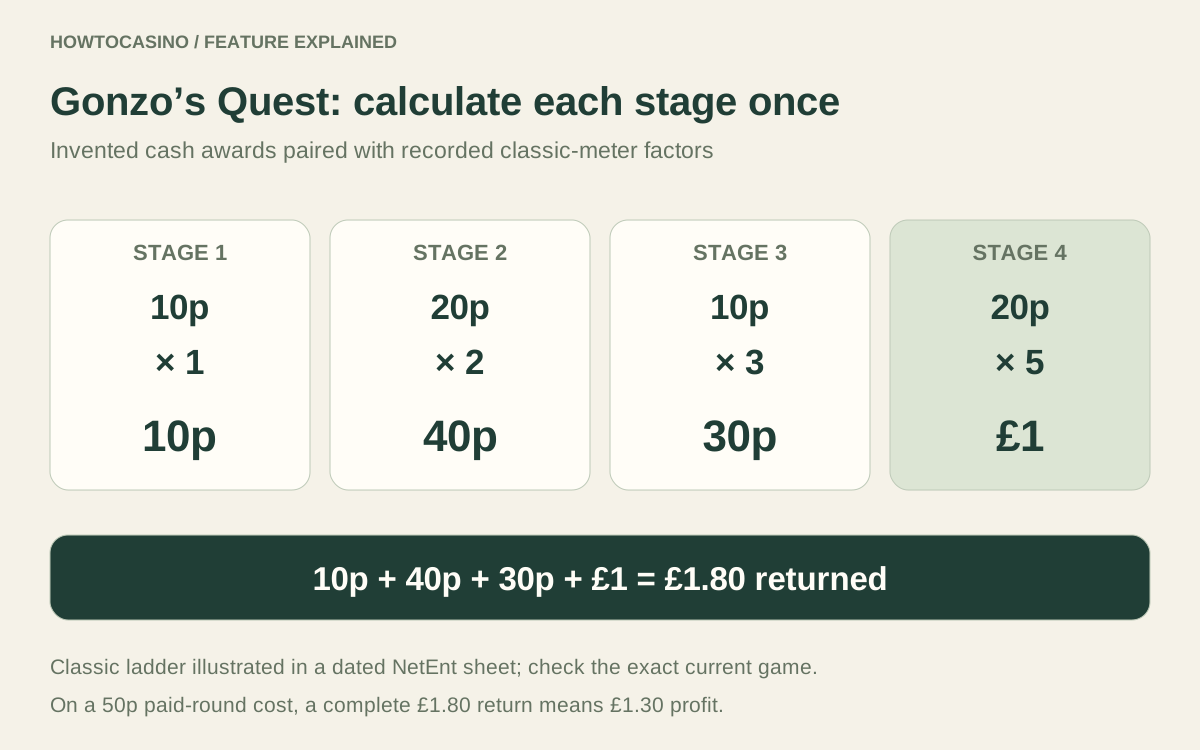
Use an invented recorded sequence with pre-multiplier cash awards of 10p, 20p, 10p and 20p, paired with recorded classic factors of 1×, 2×, 3× and 5×. Assume no other awards or adjustments.
| Evaluation | Pre-multiplier award | Factor | Returned amount |
|---|---|---|---|
| One | £0.10 | 1× | £0.10 |
| Two | £0.20 | 2× | £0.40 |
| Three | £0.10 | 3× | £0.30 |
| Four | £0.20 | 5× | £1 |
| Combined return | Each stage evaluated once | — | £1.80 |
The pre-multiplier awards sum to 60p, but multiplying that subtotal by the final 5× would give £3 and overstate this record. The correct method is to multiply each stage by its applicable factor and then add the resulting awards.
On an illustrative 50p paid-round cost, a complete £1.80 return gives £1.30 profit. If the first 10p award were the only win before the sequence ended, the round would instead lose 40p. A paying avalanche therefore does not guarantee profit on the whole wager.
If a history entry already records the final multiplied stage return, add that recorded amount once. Do not multiply it again merely because the meter remains visible.
Are three Free Fall symbols anywhere enough?
The Touch rules are more specific: Free Fall symbols occur on reels one, two and three, and a qualifying line of three starting at the left awards ten Free Falls. It is not an “any three anywhere” instruction. The dated sheet also describes multiple qualifying lines awarding more than one set.
The documented feature retains the triggering bet settings and permits additional Free Falls. At its end, feature winnings are added to the triggering round’s other wins. A count of ten included feature spins is not ten additional paid stakes.
Keep the current feature spin and its continuing avalanches separate from the next feature spin. The 15× cap is not a promise of a 15× factor throughout every remaining Free Fall.
The scatter guide explains why a feature symbol can still have position conditions. A name or illustration is not a universal trigger rule.
Does a 5× multiplier mean the game’s maximum win is 5×?
No. The multiplier cap limits the award factor in that stage; a whole-round total can include multiple awards and a feature. It is not the same field as a maximum game win or a regulatory monetary limit.
Likewise, the current supplier overview’s RTP describes its published product figure, not the return of the invented sequence above or a verified setting in every casino. The avalanche mechanic alone cannot identify an account’s RTP or bonus frequency.
A recently ended sequence also creates no entitlement to a longer next sequence. The meter communicates a game state; it is not a forecast. Our prediction guide covers that separate misunderstanding.
What should GB readers check in their exact game?
- Read the full title and suffix; confirm the classic layout before using this guide.
- Inspect the current multiplier ladder, reset point and eligible line conditions.
- Keep ordinary awards, already-multiplied returns and feature totals in their stated units.
- Verify the licensed operator and actual game access separately; a supplier page or historical document does not establish current casino availability.
The legacy documents mention autoplay and other options. UKGC RTS 8 requires individual commitment to each game cycle and prohibits autoplay; do not use old interface instructions as current GB permissions. Our game-rules guide explains how to separate the exact help from a generic overview.
For a settlement query, retain the round identifier, stake, current game state, each stage’s recorded factor and its credited amount. That is more useful than comparing the final screen with a highlight from another Gonzo release.
Related questions
Does every Gonzo’s Quest avalanche cost another bet?
The documented classic round includes successive avalanches within the accepted wager. A new block drop alone does not establish a new paid stake.
Do I multiply every earlier win by the final multiplier?
No. In the stage-by-stage model, each evaluation uses its applicable factor. Add the resulting awards; do not apply the final factor again to earlier wins.
Is 15× carried through every remaining Free Fall?
The cited rules limit the continuing sequence and describe its reset. Reaching the cap does not establish a permanent 15× award for every later feature spin.
Are three Free Fall symbols anywhere a trigger?
The cited classic Touch rules require a qualifying line on reels one, two and three starting from the left. Check the exact release rather than applying an any-position trigger.
Does this article confirm where I can play the original in GB today?
No current in-account GB availability was verified for the original. It explains explicitly scoped classic rules and does not treat a Megaways or sequel listing as proof of the original.