What starts a win and a cascade in Reactoonz?
The original game has a 7 × 7 grid. At least five matching symbols must connect horizontally or vertically, without gaps, to form a paying cluster. They do not have to start at the leftmost reel. Diagonal contact alone is not the required connection.
Winning symbols are removed, replacements drop in and the new grid is evaluated. Several awards can therefore belong to one paid round. An animation, a replacement drop and an extra Wild are different events; none should be counted automatically as an additional stake or a cash payment.
The original supplier page describes this cluster-and-cascade structure. The rules-and-paytable guide explains how to distinguish a winning pattern from a displayed prize unit.
What do the five Quantum Leap meters measure?
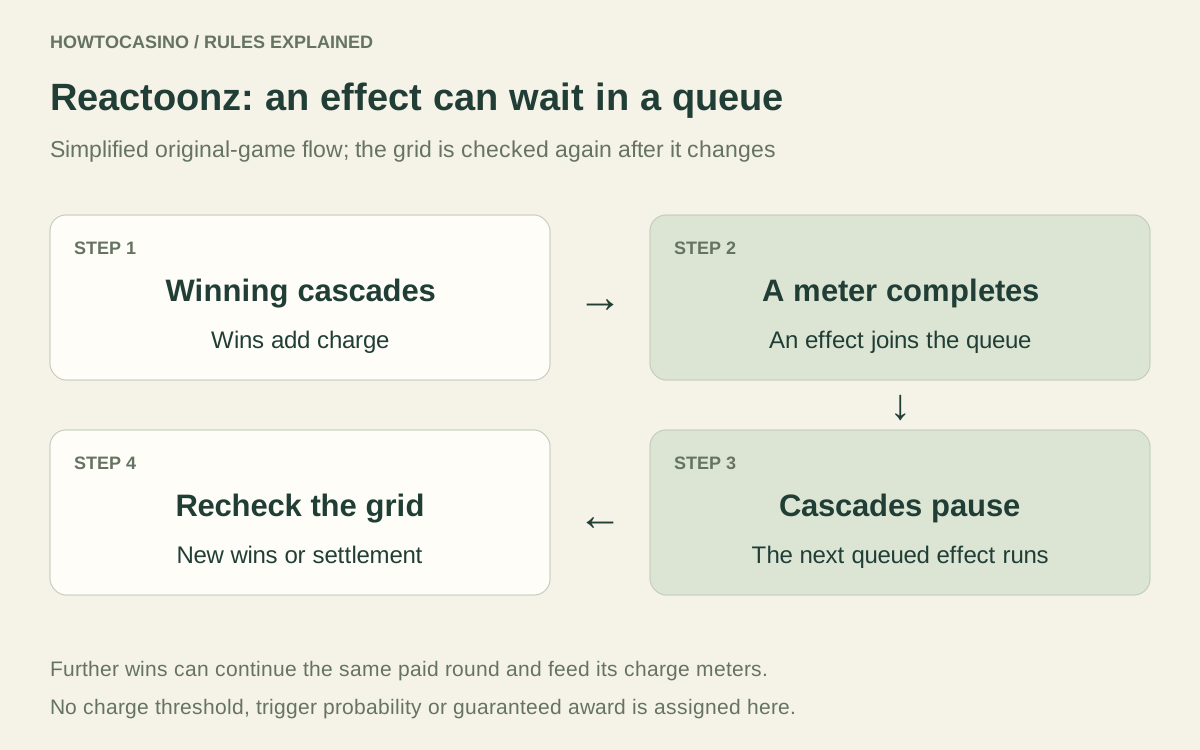
Wins during the round contribute to the meters one after another. A completed meter adds a randomly selected Quantum effect to the queue. Filling all five also adds the Gargantoon feature. The queue records something earned but not necessarily already performed.
A partially filled meter is not a cash balance, an RTP display or a promise that another paid spin will complete it. The charge state belongs to the current round; the rules reset it when that round has no remaining winning combinations or feature processing.
This guide does not assign an invented number of symbols or wins to each threshold. A statement that wins add charge does not justify converting every meter segment into a fixed number of future paying events.
Why can a feature wait after its meter fills?
- A qualifying cluster pays and its removal changes the grid.
- Further ordinary winning cascades are resolved; the round can gain charge.
- When no more ordinary winning clusters are available, the next queued effect is applied.
- The changed grid is evaluated again. New wins can create further cascades and charge.
- The round settles after the relevant cascades and queued effects have been processed.
An effect appearing in the queue is therefore different from the effect visibly changing the grid. The flow diagram describes that distinction; it does not simulate how much charge a particular invented cluster would earn.
What do Implosion, Alteration, Demolition and Incision do?
| Quantum effect | Change described by the original rules |
|---|---|
| Implosion | Creates three to six Wild positions and removes neighbouring symbols. |
| Alteration | Selects a one-eyed symbol type and transforms matching symbols; the rules give an available-symbol fallback if none is present. |
| Demolition | Removes one-eyed symbols and their matching symbols, allowing replacements. |
| Incision | Places a central Wild and creates two crossing diagonal lines containing the same selected symbol. |
A feature drawing diagonal lines is not a change to the ordinary cluster rule. The resulting arrangement still has to be evaluated using the relevant connections and Wild rules. Likewise, destroying symbols is not the same as paying for all destroyed symbols.
The four names describe different grid changes. Do not present them as four buttons a player can select at will, or assume that selecting a different stake guarantees a particular effect. Read the actual help when a displayed outcome seems inconsistent.
How does Gargantoon change the Wild blocks?
| Stage in the classic sequence | Wild arrangement |
|---|---|
| First | One 3 × 3 Wild block |
| Next, after its relevant cascades finish | Two 2 × 2 Wild blocks |
| Final arrangement | Nine 1 × 1 Wilds |
The rules describe new symbols dropping into the grid before each move. The sequence is tied to resolving the current cascades, not to buying three further paid spins. Wild locations and the surrounding symbols still affect what can form a winning combination.
The dimensions describe grid coverage. A 3 × 3 block is not automatically a 9× cash multiplier, and nine single Wilds are not nine separately guaranteed prizes. The payout still needs the actual resulting cluster and the selected paytable.
Do not carry this ordering into Reactoonz 100. Its separate rules describe an arrangement starting with eight single Wilds and later building towards a 3 × 3 block. The similar name and graphics do not make the two feature sequences identical.
Are Gargantoon, Giantoonz and Fluctuation the same feature?
No. The classic rules separately describe Giantoonz: four matching ordinary symbols in a square form a larger symbol. A winning combination involving one or more of these has a doubling rule. That is a different condition from Gargantoon placing a giant Wild block.
The Fluctuation rule marks a one-eyed symbol type for the spin. When the marked type participates in a winning combination, the rules provide two Wilds. This is another route to changing the board, rather than a name for filling every Quantum meter.
There is also a possible random Wild drop on an initial result without a win. Its possibility does not make every initially unsuccessful round recover its stake. Keep the cause of a Wild, its substitution role and the resulting paid award separate.
How do you calculate the return from a long round?
Use credited cash awards rather than counting animations. For an invented 20p paid round, suppose the game record shows three separate cash awards of 10p, 40p and 20p. Assume those are settled amounts after any applicable feature calculation, and that there are no other payments or costs.
| Invented ledger item | Amount |
|---|---|
| First credited award | £0.10 |
| Later credited award | £0.40 |
| Final credited award | £0.20 |
| Complete round return | £0.70 |
| Single paid-round cost | £0.20 |
| Net round result | £0.50 profit |
The queue’s activity does not add a second paid stake to this example. Equally, do not add a displayed final total of 70p to the three component amounts again. If the only credited return had been 10p, the same 20p cost would instead leave a 10p loss. With no credited return, the loss would be 20p.
The example uses assumed cash awards, not symbol prices. Check whether your history shows separate awards or cumulative totals before adding entries. Our payout-frequency guide explains the difference between a paying event and a profitable round.
Which Reactoonz version does this cover?
This walkthrough covers original Reactoonz, the supplier’s 2017 release. Reactoonz 100 has separate rules and a different Gargantoon progression.
The third-party-hosted rules document dated 19 August 2025 has a paytable export error. We use its feature descriptions, not that broken paytable, to explain the sequence. The cash example uses assumed awards; this page establishes no installed RTP or maximum payout.
Check the full title and actual GB listing using our named-slot finder. Public descriptions and licence records do not confirm that a particular account can open the game.
How the rules and GB references were checked
On 2 November 2026 we compared the supplier description, the original rules document and Betfred and indexed BetVictor GB descriptions. The separate Reactoonz 100 document was used only to check the version difference.
We matched betfred.com to Petfre (Gibraltar) Limited, account 39544, and betvictor.com to BV Gaming Limited, account 39576. Both records showed active Remote Casino activity. Direct BetVictor access was unavailable; its indexed text is corroboration. No game-launch, account or payment test was performed.
Historical or international help can show autoplay. Current GB RTS 8 requires individual commitment to each game cycle; the mechanical explanation does not establish current GB controls or limits.
Related questions
Does a full Quantum meter instantly pay a cash prize?
It earns a queued effect. The effect changes the grid when its turn arrives, and any resulting award still depends on a qualifying winning combination.
Why has the meter filled but the feature not started?
Ordinary winning cascades can still be resolving. The classic rules queue the effects and use them when no more ordinary winning combinations are available.
Does a 3 × 3 Gargantoon mean a 9× multiplier?
No. It describes a Wild block’s dimensions on the grid. The resulting combination and paytable determine any cash award; size alone is not a payout multiplier.
Is Gargantoon the same as Giantoonz?
No. Gargantoon is the queued giant-Wild sequence. Giantoonz are larger ordinary symbols formed under a separate square-matching rule with its own doubling condition.
Do the meters keep filling across unrelated paid spins?
The classic rules reset the charge state at the end of the game round. Cascades and queued effects within that round are different from starting a new independent paid round.
Does Reactoonz 100 use the same Gargantoon order?
No. Its separate rules use a different Wild-block progression. Identify the full title before applying this original-game walkthrough.