What does hit frequency actually count?
Virgin Games’ published slots glossary describes hit frequency as the percentage of spins on which a winning outcome occurs, separately from the amount of the win. It is useful terminology, but a glossary does not supply the complete mathematical definition for every game or feature.
Before comparing two figures, establish what the provider counts: a paid round with any return, an individual winning combination, an internal cascade, a feature trigger or another specified event. Also establish the denominator and whether bonus states or paid options are included. A percentage without that scope can answer a different question from the one you intended.
| Measure | Question it answers |
|---|---|
| Hit frequency under its stated definition | How often does the counted event occur? |
| Profitable-round frequency | How often does the complete return exceed the complete paid stake? |
| RTP | What theoretical share of total stakes is returned under the specified model? |
| Volatility | How widely can results vary around the average? |
The RTP and volatility guides explain those measures in more detail. Neither one can fill in a missing hit-frequency figure merely because a game has a high return or a low volatility label.
Can four paying rounds out of ten still lose money?
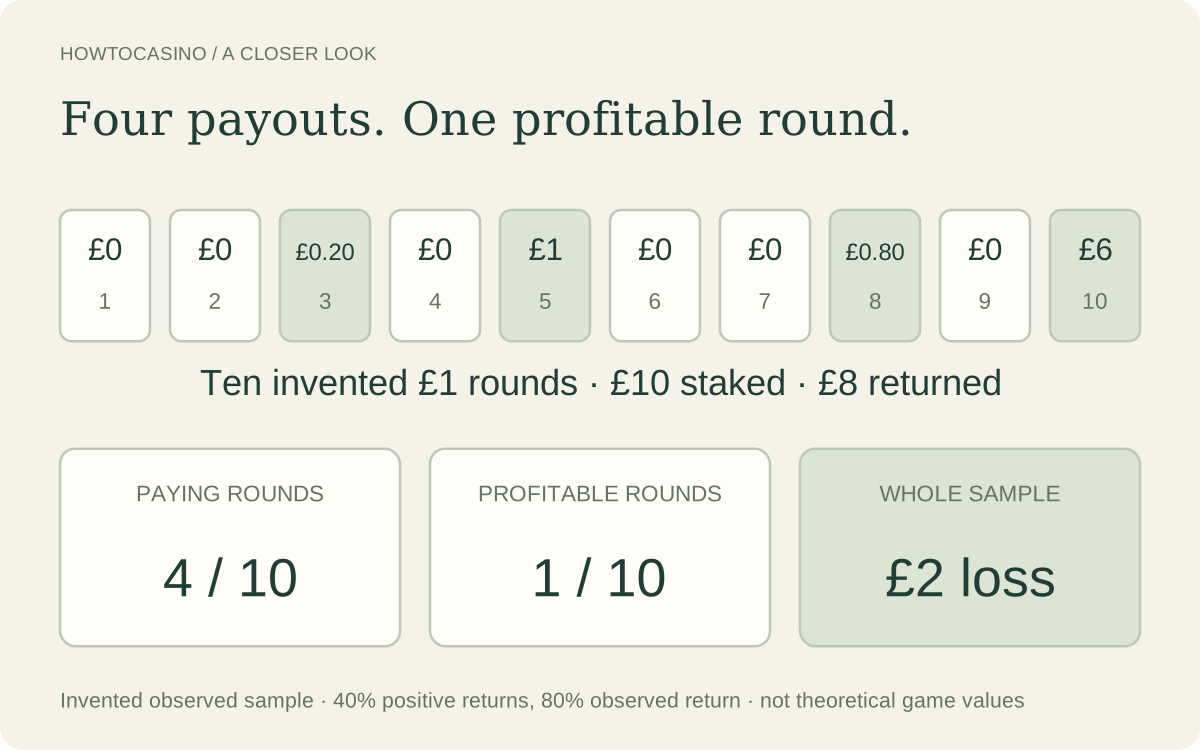
Yes. Consider ten invented completed rounds, each costing exactly £1. There are no extra charges, promotional funds or separate side wagers. For this sample only, a hit means a round with a positive total return. Returns below include any money returned from the stake.
| Round | Paid stake | Total return | Net result |
|---|---|---|---|
| 1 | £1 | £0 | −£1 |
| 2 | £1 | £0 | −£1 |
| 3 | £1 | £0.20 | −£0.80 |
| 4 | £1 | £0 | −£1 |
| 5 | £1 | £1 | £0 |
| 6 | £1 | £0 | −£1 |
| 7 | £1 | £0 | −£1 |
| 8 | £1 | £0.80 | −£0.20 |
| 9 | £1 | £0 | −£1 |
| 10 | £1 | £6 | +£5 |
Rounds 3, 5, 8 and 10 return something, so the observed paying-round frequency is 4/10 = 40%. Only round 10 returns more than its stake: the observed profitable-round frequency is 1/10 = 10%. Round 5 breaks even, while two paying rounds still lose part of their stake.
The complete sample stakes £10 and returns £8, leaving a £2 loss. Dividing £8 by £10 gives an observed return of 80% for these ten outcomes. It does not establish a slot’s theoretical RTP, underlying hit frequency or fairness. The example counts what happened in an invented sample; it is not a forecast for ten real spins.
This is why the number of payment animations, winning symbols or highlighted combinations is not a substitute for a cash ledger. If one paid round contains several internal awards, add its returns and compare them with its entire cost before calling that round profitable.
Does one hit in four spins mean every fourth spin must pay?
No. To make the distinction precise, suppose an invented model has a fixed 25% chance of a positive return on each round and the events are independent. These are explicit mathematical assumptions, not a verified model for the named supplier example below or for every stateful slot.
In this model, the mean waiting time to the first hit, including the hitting round, is 1/0.25 = 4 rounds. That average does not limit the wait. The probability of four consecutive misses is 0.75⁴ = 31.64%; for ten misses it is 0.75¹⁰ ≈ 5.63%. A mean of four and a possible ten-round dry run are therefore compatible.
After a run of misses, the next-round chance in this particular fixed, independent model is still 25%. The model has no debt to repay. In an actual slot, read any rule-defined feature state rather than assuming every possible state has identical odds; the compliant random outcome must still follow the relevant rules.
UKGC RTS 7 prohibits adaptive compensation in remote random games. It does not make a personal losing run into a countdown. The slot-prediction guide explains the difference between a published feature state and a claim that a game is due.
What does a real supplier profile show?
Nolimit City’s global Six Feet Under page, consulted on 30 October 2026, displays the following separate labels. This is a supplier publication, not a tested GB casino configuration or a recommendation to play the game.
| Published label on that page | Published figure | What it must not be substituted for |
|---|---|---|
| Hit Frequency | 21.90% | A personally verified chance of round profit |
| RTP | 96.05% | The next-spin hit probability |
| Free Spins | 1 in 233 | The frequency of every ordinary paying result |
| Max Win Probability | 1 in 93 million | A personal waiting counter or jackpot timetable |
The page does not provide a complete definition of every denominator, mode and population behind those headlines. Its global feature and price descriptions also do not establish which controls, stakes or configuration are permitted at a particular GB operator. Do not combine the numbers with rules from another title or assume that a similarly named version must match.
A maximum-win probability, a free-spin frequency and a normal hit percentage concern different events. Even where a provider publishes all three, one cannot be used as the other. Where a necessary figure is not stated for the exact version, keep it unknown.
Do bonus spins, cascades and jackpots use the same frequency?
Not automatically. A paid game cycle may contain several visible stages, while a frequency table may count a particular kind of stage or trigger. Ten cascades within one funded round are not ten newly paid £1 rounds in the sample above. The definition must say what was counted.
An ordinary paying combination can occur without a bonus trigger. A bonus trigger can lead to further uncertain awards. A promotional free-spin allocation has separate eligibility and credit rules. None of these labels proves how often the largest prize will be paid.
Jackpots need their own trigger and eligibility rules. A growing progressive total is not a personal balance or a universal time-to-win signal. A game’s maximum payout is also a ceiling, rather than a probability. Use the progressive-jackpot and max-win explanations for those separate questions.
The remote rules require accessible game descriptions and relevant likelihood information. They do not establish that every game publishes a dedicated table of hit, bonus and jackpot frequencies. An absent number is not a reason to manufacture an average from a short demo or a streamer’s highlights.
Do physical slot machines follow the same rules as online slots?
Keep the product and jurisdiction clear. UKGC’s physical gaming-machine guide distinguishes random machines from compensated machines, where the design can vary prize chances in response to previous results. That explanation must not be imported as permission for adaptive compensation in a GB remote random slot.
A question about a pub machine, betting-shop terminal or casino machine may therefore need its own category and rules. This article concentrates on interpreting online-slot frequency and clearly stated mathematical examples. It does not diagnose a physical machine or supply a timetable for emptying one.
Nor does changing the animation speed reveal a missing payout schedule. The GB slot-controls guide explains cycle timing and unavailable autoplay features as separate product-design rules.
How should you check a hit-rate or payout claim?
- Identify the exact title, supplier, operator and configuration where available.
- Check the definition of a counted event and the population of spins or rounds behind the figure.
- Separate ordinary awards, feature triggers, jackpot events and complete-round profit.
- Reconcile total paid stakes with actual returns; retain round identifiers if a credit seems missing.
- Treat a short observed sample as a record of that sample, rather than a certificate of the mathematical design.
The regulator’s performance-monitoring guidance distinguishes observed results from the game’s designed return and calls for appropriate investigation when performance appears outside its expected range. Ten outcomes do not carry out that investigation. If a specific payment is disputed, the actual accepted wager and settlement records matter more than whether the overall session felt quiet.
GB responsible-design rules also prohibit win-style celebration of returns at or below the total stake. That does not prohibit the small payout itself, or turn it into a profitable round. If trying to reach a supposed average is becoming a reason to keep spending, stop: the published percentage does not create an entitlement to a later payment.
Related questions
What is slot hit frequency?
It is a frequency measure for an event defined by the game or source, commonly a spin with a winning outcome. It does not, by itself, say how large the return is or whether the whole round makes a profit.
Can a spin count as a hit while losing money?
In a definition that counts any positive return, yes. A £1 round returning 20p has a positive payout but loses 80p. Always compare the entire return with the complete paid stake.
Does a 25% hit rate guarantee a payout within four spins?
No. In an invented independent model with a fixed 25% hit probability, the mean wait is four rounds, but four misses have a probability of about 31.64%. That model is an illustration, not a forecast for a named slot.
Is a hit frequency the same as RTP?
No. Frequency counts qualifying events; RTP concerns a model’s theoretical return on total stakes. The ten-round sample here has 40% positive returns and an observed return of 80%, with a £2 loss; those sample figures are not the game’s theoretical metrics.
How often do slot machines pay jackpots?
There is no universal frequency for every jackpot or maximum award. The exact trigger, eligibility, configuration and any published probability are needed. An ordinary hit rate or growing pool alone does not supply them.
Can a few demo spins establish the real hit rate?
A few spins can record observed outcomes, not establish the whole probability distribution or certify the cash version’s configuration. Keep the exact version and any published mathematical definition separate from the short sample.