Does every slot spin have to finish in exactly 2.5 seconds?
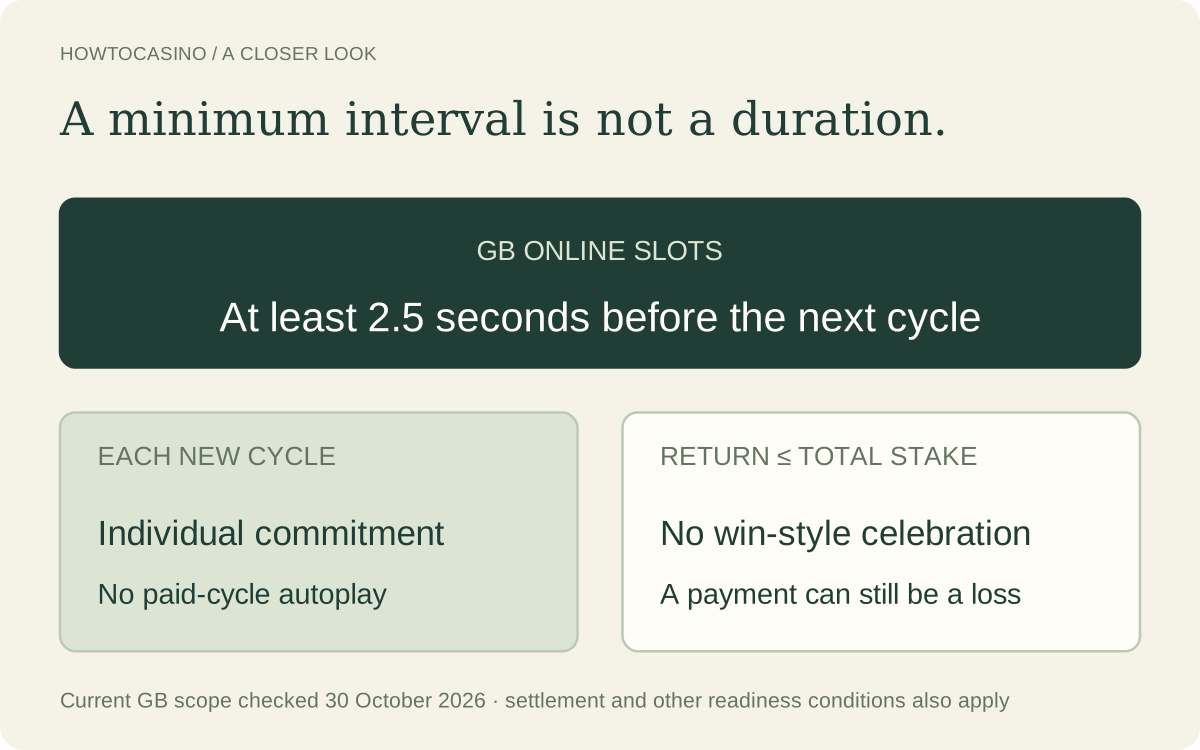
No. Current RTS 14D sets a minimum interval from game initiation until the next cycle can be commenced. Its cycle definition includes the stake and awards reaching their settled or collectable state and the start control becoming available again. This is not a promise that every reel animation lasts exactly 2.5 seconds.
| Fictional state after a start at time zero | Earliest next start under this timing illustration |
|---|---|
| All settlement and other readiness conditions complete at 1.8 seconds | No earlier than 2.5 seconds |
| Those conditions complete at 4.2 seconds | No earlier than 4.2 seconds |
| A technical delay leaves the round unresolved until 12 seconds | Not before resolution at 12 seconds; check the issue separately |
The rows illustrate a lower timing bound and readiness, not tests of a real operator or a declaration that a particular delayed wager has settled correctly. If something else is still required, satisfying the timer alone does not make another game available.
Slowness can therefore mean several things: a normal game presentation, an unfinished feature, an acceptance or settlement step, or a connection problem. Identify which state applies before treating the delay as a software fault or evidence of a changed payout rate.
Why is autoplay unavailable?
Autoplay normally means a control that commits further paid game cycles without the customer starting each one separately. Current RTS 8 requires individual commitment to each cycle for gaming, including bingo. RTS 14D also prevents continued contact with a start control from simply starting another slot cycle.
A global supplier page, old help screenshot or an overseas version can describe features that are unavailable in a compliant GB implementation. That does not establish that a missing repeat-play control is a broken account preference. The applicable GB restriction still governs the game offered to a GB customer.
An internal animation or feature sequence is not necessarily a new paid game cycle. Read whether an additional stake is being committed and which rule is being described. Likewise, automatically settling an existing wager in a different game is not the same action as repeatedly placing new paid wagers.
Why are turbo, quick spin or slam stop missing?
RTS 14E prohibits controls that reduce the time until a result is presented, with examples including turbo, quick spin and slam stop. A visual stop button would not give the player knowledge of a random result or a proven way to choose it.
The guidance has specific exceptions, including bonus or feature games where no additional stake is wagered. This is the scope of that result-speed requirement, not permission to autoplay new paid cycles. A feature label alone also does not establish that a stage is unstaked; read the actual total charge and rules.
The rules separately state a five-second minimum for casino games excluding slots and peer-to-peer poker. Do not substitute five seconds for the online-slot rule or assume every product with moving graphics is a slot. Product names, presentation and legal classification are different details.
A longer animation does not itself establish a better or worse mathematical return. The hit-frequency guide explains why time between spins, the frequency of awards and the probability of a profitable round are separate questions.
When were these slot-design changes introduced?
The Gambling Commission announced its online-slot design package on 2 February 2021, with implementation required by 31 October 2021. The stated purpose was to reduce play intensity and strengthen player protections. It included speed restrictions, removal of autoplay and misleading win celebrations, together with information about session results and time.
That announcement explains the history. The current technical standards determine the present requirements and their product scopes. A later update to a standards page is not, by itself, the date on which every individual restriction was first introduced.
The protection aims do not guarantee that a particular person will avoid harm or that a session will lose only a small amount. A lawful cycle speed remains a speed at which paid gambling can consume money. No timer makes a stake safe or turns a game into a reliable source of income.
Are the £2 and £5 stake caps part of the speed rule?
They are separate limits on the amount staked. Under current GB online-slot guidance, the maximum total stake per game cycle is £2 for adults aged 18–24 and £5 for those aged 25 or over. The £5 limit initially took effect for adults on 9 April 2025, followed by the lower younger-adult limit on 21 May 2025.
A displayed stake range can be lower because of the game, operator or account conditions. The legal maximum does not create an obligation to offer that amount, and it is not a recommended budget. Count the full game-cycle charge, rather than only a smaller base value shown beside an optional cost.
The regulator’s guidance expressly distinguishes online slots from other casino games such as roulette and blackjack. A £2 roulette-table display should not be explained automatically by the age-based online-slot cap. The total-stake beginner guide and age-check guide cover those separate questions.
Why do some payouts have no win celebration?
Current responsible-design rules prohibit win-style celebration where the return is at or below the total amount staked. That is different from prohibiting the payout itself. A game can display a small award and transfer it to the balance without presenting a losing or break-even result as a win.
For an invented completed round, suppose a £1 base charge and a permitted 20p additional charge make a £1.20 total stake. A £1.10 total return leaves a 10p loss. With a £10 opening cash balance, £10 − £1.20 + £1.10 = £9.90 remains. Comparing the return only with the £1 base would incorrectly describe the round as profitable.
Those amounts explain accounting, not the availability or permission of a particular extra-cost mode. A cancelled or unresolved charge would need its own record; the example assumes both charges were accepted and the round completed.
RTS 2E requires a clear session net position. RTS 13C requires elapsed-time information for the covered casino session. These displays help identify what has happened over the session; the latest payout on its own cannot show the complete result. A time display is also not a universal maximum session length.
How do you distinguish normal timing from a frozen game?
| Observation | Useful next check |
|---|---|
| Autoplay or turbo absent | Check the GB product-design rule and exact game help. |
| Next game not ready while a feature continues | Check the accepted cycle and whether settlement is complete. |
| Screen freezes or connection drops | Preserve the round identifier, message, stake and account history. |
| Return differs from the expected rule | Compare the exact accepted wager, paytable and all debits and credits. |
Do not keep submitting paid actions merely because the display is slow. First check whether the earlier wager was accepted and whether an outcome or credit is already recorded. Closing the tab or clearing browser data does not, by itself, prove that an accepted bet was cancelled.
The interruption standard requires fair policies with different treatment for different game states. It does not promise a refund for every connection failure. Keep the game name, version, operator, time, round reference and any error message, then ask support which state and rule applied.
The frozen-slot guide provides the detailed evidence workflow. For a payment that remains disputed, the unpaid-casino guide explains complaints and escalation. If the practical problem is feeling unable to stop, use the site’s independent support links rather than trying to restore faster controls.
Related questions
Why are UK online slots slower than some overseas videos?
Games offered in Great Britain must meet the applicable GB timing and control rules. Global supplier videos or another market’s interface do not establish which controls are permitted here. This guide concerns GB remote slots, not every gambling product.
Is the slot rule exactly 2.5 seconds for every animation?
No. It is a minimum interval from initiating a game until the next cycle can begin. Settlement, features or technical delays can make a round take longer. The illustrated readiness times are not measurements of a real operator.
Can I switch paid autoplay back on as a preference?
Current RTS 8 requires individual commitment to each game cycle. A global help file mentioning repeat betting does not establish that it is a permitted GB account setting. No bypass instructions are provided.
Do feature-stage speed exceptions permit new paid autoplay?
No. The no-additional-stake bonus/feature exception belongs to a specific result-speed provision. It does not remove the requirement to commit individually to new paid game cycles.
Does a slower spin mean the slot is due to pay more?
No payout entitlement follows from elapsed animation time. Read the exact game model and any rule-defined state; timing, RTP, hit frequency and round profit are different measures.
Does a frozen slot automatically refund the stake?
No universal refund follows from a frozen display or disconnection. Acceptance, game state, outcome generation and the applicable interruption policy matter. Preserve the round and account records and ask the operator to explain the treatment.