What is the object of Let It Ride?
You want the final five-card hand to qualify for a payment. The dealer manages the deal and settlement; there is no dealer poker hand to beat and no need to beat another player. Light & Wonder describes the game as five-card stud played against a paytable, with control over two of the three bets.
This guide explains the three-bet game using Maryland’s published Let It Ride Poker rules, Version 1.1, with its Paytable A as the main numerical example. The American document is a precise rules reference, not a UK licence or evidence that a particular GB casino currently offers the game. Paytables, side bets and table procedures must match the version you open.
The three cards in your hand do not make this Three Card Poker. In Let It Ride, all three of your cards and both community cards form the final five-card hand. Our Three Card Poker guide explains the separate ante, play and dealer-qualification structure.
Why do you place three equal bets?
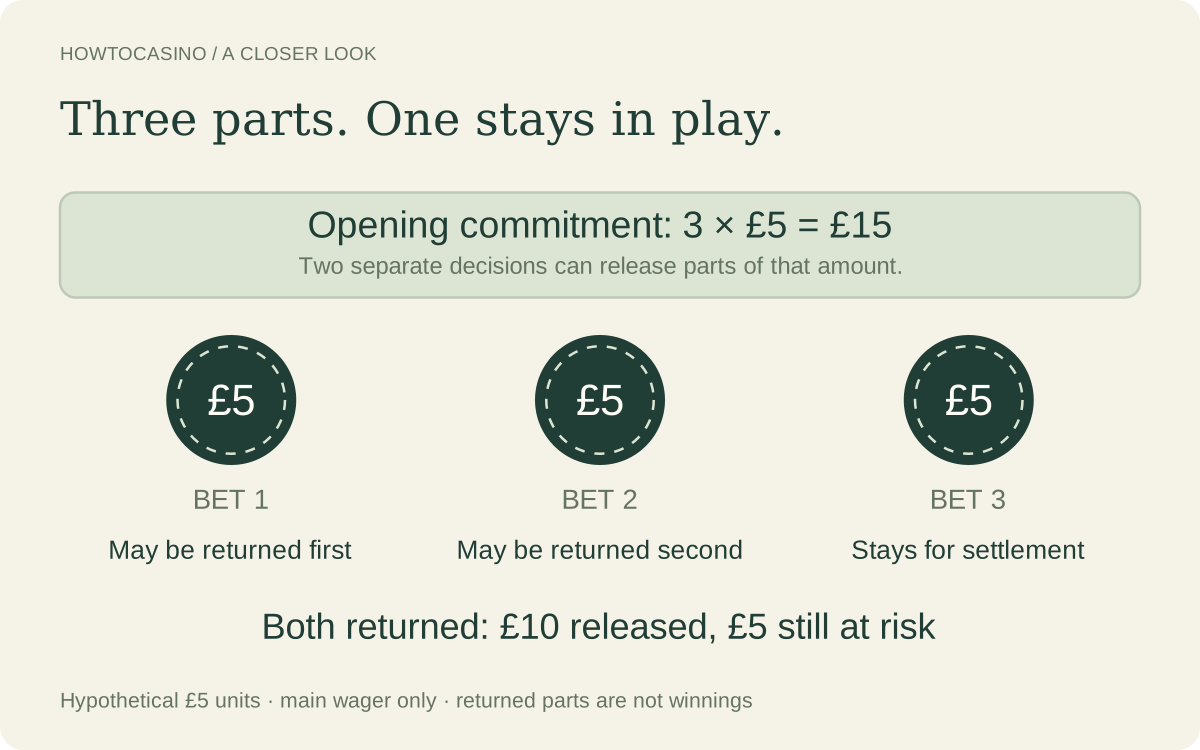
The three main wagers are equal in size and separate. Layouts commonly mark the first two as 1 and 2 and the last as 3 or $. The dollar symbol identifies the locked betting position; it does not mean the bet must be one dollar.
If your chosen unit is £5 per position, the initial main-game commitment is £15. You need to distinguish that opening amount from the money still at risk after permitted withdrawals. At least one £5 part remains exposed to the final hand; all three remain exposed if you leave both optional parts in play.
| Decision history | Main bets remaining | Returned before settlement | Still at risk |
|---|---|---|---|
| Neither part withdrawn | 1, 2 and 3 | £0 | £15 |
| One part withdrawn | Two £5 parts | £5 | £10 |
| Both parts withdrawn | Bet 3 only | £10 | £5 |
A table minimum may be stated per betting position or in another way on an interface. Read the displayed requirement before assuming a quoted minimum covers all three parts. Any bonus or progressive wager is an additional cost.
How does a complete Let It Ride hand work?
- Place the three equal main bets before betting closes, adding a side bet only if you separately choose one.
- Receive three private cards. Two community cards are dealt face down. The documented game uses one standard 52-card pack for the round.
- Look at your three cards and decide whether to withdraw bet 1 or leave it in play.
- The first community card is revealed. You now know four of the five cards that will form your hand.
- Decide whether to withdraw bet 2 or leave it in play. This decision is available whether you withdrew or retained bet 1.
- The second community card is revealed. Your three private cards plus both shared cards form the final five-card hand.
- Each main bet still in action receives the applicable paytable result. Optional wagers are settled under their own rules.
There is no draw or discard stage. You do not replace one of your original cards, choose five from seven or make a later raise. The two decisions reduce or preserve the original commitment.
Bet 1 is decided before the first community card appears. Leaving it in play does not create a later opportunity to reclaim it when that card disappoints. Bet 2 has its own decision point, and bet 3 is never available for this ordinary withdrawal.
Which hands pay, and how much?
The following is Maryland Paytable A, not a promise about every Let It Ride installation. Odds are profit on each remaining main bet. The winning stake is also returned. A £5 bet paid at 8:1 therefore produces £40 profit and £45 back from that betting position.
| Final five-card hand | Profit odds: Paytable A | Total returned on one £5 winning bet |
|---|---|---|
| Royal flush | 1,000:1 | £5,005 |
| Other straight flush | 200:1 | £1,005 |
| Four of a kind | 50:1 | £255 |
| Full house | 11:1 | £60 |
| Flush | 8:1 | £45 |
| Straight | 5:1 | £30 |
| Three of a kind | 3:1 | £20 |
| Two pair | 2:1 | £15 |
| One pair of tens, jacks, queens, kings or aces | 1:1 | £10 |
| One pair below tens, or a non-qualifying high-card hand | Loses | £0 |
Two low pairs still make two pair and qualify at 2:1 in this model. A lone pair of nines does not. A royal flush is the same-suit sequence 10-J-Q-K-A; an ordinary flush needs five cards of the same suit.
An ace can complete A-2-3-4-5 or the top 10-J-Q-K-A straight. It does not wrap around to make Q-K-A-2-3 a straight. Suits have equal ranking.
The same regulator publishes alternative main paytables. Its Table B reduces the royal to 500:1 but raises a full house to 15:1 and a flush to 10:1. Table C has another combination of payouts. A familiar game name does not identify a single return percentage, and a larger payment on one row does not establish the overall value of the table.
What do returned bets and winnings look like in pounds?
These hypothetical settlements all begin with three £5 main bets, so £15 initially leaves your available stack or balance. They exclude side bets, additional charges and any relevant payout limit. The choices illustrate cash movement, not a recommended strategy for an unknown hand.
| What happens | Parts returned early | Final payment, including winning stakes | Total back from the original £15 | Net hand result |
|---|---|---|---|---|
| Both optional bets returned; final hand does not qualify | £10 | £0 | £10 | −£5 |
| One optional bet returned; final hand is a qualifying pair | £5 | 2 × £10 = £20 | £25 | +£10 |
| Both optional bets returned; final hand is a flush | £10 | 1 × £45 = £45 | £55 | +£40 |
| All three parts remain; final hand is a flush | £0 | 3 × £45 = £135 | £135 | +£120 |
The £10 reclaimed in the first row is your own money being released, not £10 of winnings. In the last row, £135 is the amount returned from settlement and £120 is the profit after subtracting the original £15. Those figures describe the same result using different units.
If Q♣, Q♦ and 6♠ are your private cards, the final hand already contains at least a pair of queens whatever the shared cards are. By contrast, 9♣, 9♦ and 6♠ need improvement to reach this paytable: a final board of 2♥ and 4♣ leaves only a non-paying pair of nines. A board of 6♥ and 4♣ instead produces two pair and qualifies.
Does taking a bet back change the cards or guarantee a profit?
Withdrawing a permitted part changes how much money is exposed to the final result. It does not improve the hand, change the next community card or remove the locked third bet. A weak final hand can still lose the amount left in action.
A strategy decision concerns the value of leaving that particular part exposed, using the cards already visible and the exact paytable. A made paying pair and an unfinished draw are different situations. A guide to how the game is played should not turn every attractive-looking draw into a universal instruction to keep betting.
Likewise, a single house-edge figure is incomplete unless it states the paytable, decision strategy and denominator. The initial three-unit commitment, the unavoidable final unit and the average amount left in play are different bases. We do not label this game with one universal RTP. Our house-edge explanation shows why expected loss and one-hand outcomes differ.
Increasing the unit after a loss changes the pounds at risk. It does not turn a pair below tens into a winning hand or make the community cards compensate for earlier results. Budget for the full opening three-part wager and any extras rather than only the part that might remain.
Is the Three Card Bonus part of the main game?
It is a separate optional wager. The documented Three Card Bonus uses the three cards originally dealt to you, rather than your completed five-card main hand. Its own ranking and payout table apply. Other named options can use five cards or a progressive pool, so the word bonus alone does not specify what is being measured.
For example, three private hearts can qualify as a three-card flush under an applicable bonus table. If the two community cards have different suits and do not create another paying main hand, that does not give you a five-card flush. The side bet and main bets can consequently have different results.
Returning bet 1 or bet 2 does not automatically refund a bonus wager. Check its qualifying cards, amount staked, settlement rules, jackpot conditions and limits separately. A fixed advertised prize is also different from odds per unit. Do not multiply a stated cash award by your three main bets.
A payout cap can also limit the cash actually payable from an otherwise large table result. The rules and displayed limits must explain that treatment; the uncapped mathematical amounts above are examples, not a quoted jackpot offer.
What should a player in Great Britain check?
This is an explanation of a named game, not a current list of GB casinos that carry it. Confirm the exact casino domain and permitted service, then check its current catalogue and the actual game help. A supplier product page or an American rulebook does not establish that a GB account can open a particular version.
- Confirm the complete title and whether the game uses the three-part main wager described here.
- Read the minimum per betting position, the total initial commitment and any optional side-bet cost.
- Check the final-hand threshold, every payout row, returned-stake convention and maximum payment.
- Find the two decision controls or ask for the table’s permitted signals before making a wager.
- Check how interrupted hands and displayed balance changes are treated. A game result and an operator withdrawal request are separate events.
For GB remote casino games within its scope, the Gambling Commission’s RTS 14G requires at least five seconds from the start of one game cycle until the next can begin, with a separate action to start each cycle. That is a minimum design requirement, not a claim that a whole hand with decisions must finish in five seconds.
RTS 3 also requires accessible, accurate rules and information on the game’s winning outcomes and payouts before a customer commits to gamble. Our guide to reading game rules explains how to check those fields in context.
Related questions
Can you take back all three bets in Let It Ride?
No. In the model described here only bets 1 and 2 can be returned at their designated decision points. Bet 3 stays in action until the final five-card hand is settled.
Can I withdraw bet 2 after leaving bet 1 in play?
Yes. The second decision is separate. It happens after the first community card is exposed, and determines bet 2 only. It does not reopen the earlier decision on bet 1.
Do you have to beat the dealer in Let It Ride?
There is no dealer poker hand to beat in this game. The final five-card player hand is checked against the applicable paytable. In the example model, a pair of tens is the lowest qualifying one-pair hand.
Does a pair of nines ever win?
A final hand containing only one pair of nines loses on the main table shown here. If it also contains another pair, it is two pair and qualifies. A separate bonus wager can have different qualifying cards and rules.
Does 8:1 mean I get eight times my stake back?
It means eight units of profit for each winning unit on that betting position. The winning stake is also returned: a £5 bet paid at 8:1 produces £45 back, of which £40 is profit.
Is Let It Ride the same as letting blackjack winnings ride?
No. Let It Ride is the name of a specific five-card casino poker game. The everyday phrase can also mean leaving a stake or winnings in play in another game, but that does not introduce Let It Ride poker rules.