What kind of poker game is Pai Gow Poker?
It is a casino card-comparison game. You arrange two hands from your own seven cards rather than building one hand from shared community cards. There is no requirement to beat every other person at the table: the relevant comparison is with the bank.
Pai Gow Poker uses playing cards. Pai Gow Tiles is a different game played with Chinese dominoes. A page or table labelled only Pai Gow can therefore refer to the wrong game.
This guide explains the traditional seven-card, semi-wild-joker model using published regulator and casino rules. Our worked cash example assumes a 5% commission on a main-bet win. Rules cited from the United States explain their named models; they do not establish a current GB game listing. The variant checks below matter before applying the example to a particular table.
How does a traditional Pai Gow Poker round work?
- Place the main wager before the deal. Any optional side bet is a separate stake.
- Receive seven cards from a standard 52-card pack with one joker added.
- Set a high hand containing exactly five cards and a low hand containing exactly two. Use each card once.
- Check the relationship between your own two hands before confirming the arrangement.
- In the traditional face-down procedure, the dealer exposes and sets the bank’s cards after players have set theirs.
- Compare high against high and low against low. Resolve the main bet from both results, then account for any commission and separate side bets.
The point of setting is to divide the seven cards. It does not involve drawing replacement cards, doubling the main stake or adding a later call wager. That makes the round different from the ante-and-play procedure in Three Card Poker.
What do high hand and low hand mean?
High means the five-card hand; low means the two-card hand. Low does not mean that the lowest cards win. In the two-card comparison, a pair beats any unpaired hand, and a higher pair beats a lower pair. Two suited cards do not form a flush, and two consecutive cards do not form a straight.
The Maryland traditional rules expressly require the five-card hand to rank equal to or higher than the two-card hand. Seneca’s traditional instructions use the same condition. Other published variants use stricter wording, so follow the selected table’s exact setting rule rather than assuming every game treats the boundary identically.
An ordinary invalid split would place a pair of kings in the two-card hand while leaving only a pair of queens in the five-card hand. The low hand would outrank the high hand. Having a good hand in both boxes does not cure that error.
Which poker hands count, and where does A-2-3-4-5 rank?
| Five-card category, strongest first | Meaning |
|---|---|
| Five aces | All four aces plus the joker. |
| Royal flush | A-K-Q-J-10 of one suit, with a permitted joker substitution where applicable. |
| Straight flush | Five consecutive ranks of one suit. |
| Four of a kind | Four cards of one rank. |
| Full house | Three of one rank and a pair of another. |
| Flush | Five cards of one suit. |
| Straight | Five consecutive ranks. |
| Three of a kind | Three cards of one rank. |
| Two pair | Two different pairs. |
| One pair | Two cards of one rank. |
| High card | No qualifying combination; compare the ranked cards. |
Do not import the usual wheel ranking without checking. The Massachusetts rules put A-2-3-4-5 second among ordinary straights by default, but expressly allow an operator to adopt the wheel-low alternative. They also specify the corresponding straight-flush variation. An unsuited wheel is therefore not universally the weakest straight or universally the second strongest one.
For our card examples below, no straight or flush is involved, so this ranking variation cannot change their results. When two hands share a category, compare the relevant ranks and remaining cards in order; an exact match after those comparisons is a copy.
Is the Pai Gow Poker joker a fully wild card?
In the semi-wild model described by Bally Bet, the joker can complete a straight, flush, straight flush or royal flush. Otherwise it acts as an ace. It cannot simply become whichever rank would produce the most convenient pair or three of a kind.
| Illustrative cards | Permitted reading in this model |
|---|---|
| Joker with A♠ in the two-card hand | A pair of aces. |
| Joker, 9♥, 8♣, 7♦, 6♠ in the five-card hand | A straight, with the joker completing the sequence. |
| Joker, 9♥, 9♣, 7♦, 3♠ in the five-card hand | A pair of nines with an ace; the joker does not become a third nine. |
| A♠, A♥, A♣, A♦ and the joker | Five aces. |
A joker used to complete a flush does not turn every remaining card into that suit. The completed five-card hand must meet the actual combination. Also check the joker rule for any separately priced seven-card bonus rather than assuming its awards are the same as the main comparison.
Can you show a legal five-and-two split?
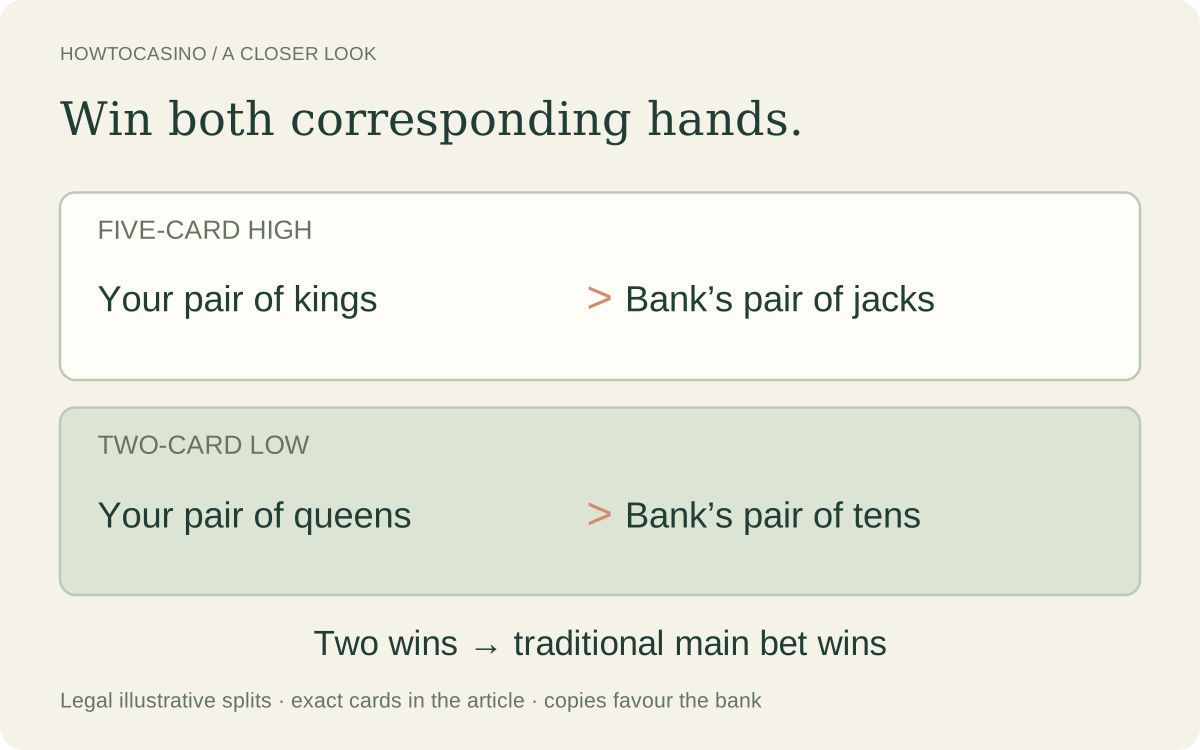
Suppose your seven cards are K♠, K♥, Q♣, Q♦, 9♠, 5♣ and 2♦. One legal arrangement puts K♠ K♥ 9♠ 5♣ 2♦ in the high hand and Q♣ Q♦ in the low hand. Kings in the high hand rank above queens in the low hand.
| Hand | Your cards | Illustrative bank cards | Comparison |
|---|---|---|---|
| Five-card high | K♠ K♥ 9♠ 5♣ 2♦ | J♠ J♥ 10♣ 8♦ 3♠ | Your pair of kings beats the bank’s pair of jacks. |
| Two-card low | Q♣ Q♦ | 10♥ 10♦ | Your pair of queens beats the bank’s pair of tens. |
You win both comparisons, so the main bet wins in the traditional model. All fourteen cards shown are distinct. No shared board, hidden eighth card or reused queen is needed to make the example work.
Keeping both pairs in the high hand would leave a weaker unpaired low hand. That would be a different legal arrangement, but it would not produce the two pair-versus-pair comparisons shown here. This example demonstrates setting and settlement; it is not an optimal-strategy rule for every two-pair hand.
Reversing the displayed split is different again: queens in the high hand and kings in the low hand breaks the setting condition. A stronger two-card hand is not useful if the whole arrangement is foul.
What happens if one hand wins, loses or copies?
Resolve each corresponding comparison first. A copy is an equal-ranked comparison, and the bank wins that comparison. Only then decide whether the complete wager wins, pushes or loses. A copy is not automatically a push of the whole bet.
| Your high-hand result | Your low-hand result | Traditional main-bet outcome |
|---|---|---|
| Win | Win | Win. |
| Win | Lose | Push. |
| Win | Copy | Push. |
| Lose | Win | Push. |
| Copy | Win | Push. |
| Lose | Lose | Lose. |
| Lose | Copy | Lose. |
| Copy | Lose | Lose. |
| Copy | Copy | Lose. |
For a concrete copy, retain your kings-and-queens split above. Now set the bank’s five-card hand as K♣ K♦ 8♣ 4♥ 3♦ and its two-card hand as Q♥ Q♠. Both arrangements are legal and all fourteen cards are distinct. Your kings with a nine kicker beat the bank’s kings with an eight kicker, while your Q♣ Q♦ copy the bank’s Q♥ Q♠. You win one comparison and copy the other, so the main bet pushes.
If the bank instead has a winning high hand and the low hands copy, you have won neither comparison. The main bet loses. This is why a high-hand loss plus a low-hand tie must not be shown as money returned.
A push of the main bet also says nothing about a separately staked bonus. That other wager may already have lost under its own conditions.
How does a 5% commission affect the payout?
Maryland’s published traditional model pays a main-bet win at 1 to 1, then deducts 5% of the amount won as commission. The percentage applies to the winnings, not to the stake plus winnings. The operator’s rounding rules can also matter; the rules expressly provide a rounding option in their local currency.
Here is a pounds illustration using an exact 5% deduction, no rounding, no side bet and no special-variant override. It is a calculation example rather than a quoted GB table price.
| Outcome on a £20 main stake | Winnings before commission | Commission | Stake plus winnings returned | Net result |
|---|---|---|---|---|
| Win both comparisons | £20.00 | £1.00 | £39.00 | +£19.00 |
| Push | £0.00 | £0.00 | £20.00 | £0.00 |
| Lose | £0.00 | £0.00 | £0.00 | −£20.00 |
For the win, £20 × 5% = £1, leaving £19 profit. Adding back the original £20 stake gives £39 returned. Deducting 5% from £40 would charge £2 and would use the wrong base for this example. Winning the main bet is not the same as receiving £39 profit.
These three outcomes do not have equal probabilities. A table with three outcome labels cannot establish a one-in-three win rate, an RTP or an expected loss. Those require the full dealing, setting, copying and fee model.
What is the house way, and must you use it?
The house way is the prescribed procedure for arranging the bank’s seven cards. In the Massachusetts rules, the casino submits the manner in which its dealer’s hands must be set. The player is responsible for arranging their own cards and may request an explanation of the dealer’s required arrangement.
That is different from a universal best-play chart. A setting instruction can be valid for one casino’s house way without establishing the strongest possible decision against every dealer policy. In particular, do not treat always split two pairs or always keep a full house as rules of the game.
A useful beginner check is procedural: count five and two; confirm that the high hand satisfies the selected setting condition; apply the joker correctly; then compare corresponding hands. An automatic arrange option, where supplied, should be read against that game’s instructions. It is not a promise of a win.
The bank is also a role rather than a guaranteed synonym for the casino dealer in every live game. Some rulebooks permit player banking with extra responsibilities. Our examples assume the house is the bank; they do not explain a player-banking strategy or imply that every online version offers it.
Is Face Up Pai Gow Poker the same game without a fee?
No. The Venetian’s published Face Up rules expose and set the dealer’s cards before players arrange theirs, pay a main-bet win without 5% commission, and make all main wagers push when the dealer has the specified ace-high Pai Gow hand. Removing the commission while keeping every traditional outcome unchanged would describe a different mathematical game.
Fortune, progressive and other bonus names also need care. Bally’s published bonus description assesses the initial seven-card holding before it is split. That is a separate condition from winning both main-hand comparisons. A premium seven-card holding does not automatically pay a bonus on the main wager; the applicable separate bonus wager must have been placed.
- Check whether the dealer’s cards are hidden or exposed before you set yours.
- Check the main-bet price, any commission, rounding and special automatic-push rule.
- Check how the joker and wheel straight rank in this exact version.
- Read the separate stake and paytable for each optional bonus.
- Check whether player banking exists, rather than importing a live-table option into a digital game.
What should a UK reader check before using a game?
Use the exact game title, supplier and in-game rules to identify what is being offered. A general casino page mentioning Pai Gow Poker does not prove that a particular version is currently available to your GB account.
Check the operator’s exact domain and permissions using our casino-licence guide. If you cannot verify a current GB listing, treat the material here as a rules explanation, without assuming that a foreign version is available to your account.
Before staking, you should be able to explain your five-and-two setting, the copy-hand rule and the amount returned on a win. If a result or a commission remains unclear, read the game rules and ask the operator to clarify it. Our guide to reading game rules provides a checklist for the details that change between titles.
Related questions
How many cards do you get in Pai Gow Poker?
You receive seven cards and use them once each to make a five-card high hand and a two-card low hand. The traditional pack contains 52 ordinary cards plus one joker. There are no community cards in the model explained here.
Does low hand mean the lowest cards win?
No. Low is the name for your two-card hand. A higher pair wins against a lower pair, and any pair beats an unpaired two-card hand. Two-card flushes and straights do not count. Your own five-card hand must still satisfy the table’s setting rule.
Who wins a tie or copy in Pai Gow Poker?
The bank wins the copied comparison. If your other hand wins, the main wager pushes. If your other hand loses or also copies, the main wager loses in the traditional model. A copy does not automatically return the full bet.
Can the joker make three of a kind?
In the semi-wild model, it acts as an ace unless completing a permitted straight or flush combination. It can therefore join aces, but it cannot simply become a third nine. Check the selected game before applying this model to another product.
Do you pay 5% commission on a push?
In the traditional example, no: the commission is charged on a winning main wager. A £20 win produces £19 profit after an exact 5% deduction and returns £39 including the stake. A main-bet push returns the £20 stake, with no winning-main-bet commission. Separate side bets still settle independently.
Is A-2-3-4-5 always the second-highest straight?
No. The Massachusetts traditional rules use that ranking by default but expressly allow a wheel-low alternative. Do not assume either rule from the game’s name. Read the selected table’s straight and straight-flush rankings.