What is casino craps?
Craps is a dice game with several kinds of bets. The simplest way to understand the main round is to follow one Pass Line stake from its first roll to settlement. The outcome is the total of two dice, from 2 to 12; the individual faces matter for some other bets, but the basic line bet follows the total.
This guide uses the public rules for the Roxor Craps game on Virgin Games’ GB page, checked on 30 October 2026. It is a rules example, not an endorsement, an account test or a promise that the game is available to every reader. The actual game’s help and table limits remain the relevant terms.
A live table may use a dealer or a dice launcher, while another online version generates the dice result electronically. A physical-table description involving a player throwing the dice should not automatically be applied to an online game. The rules below explain settlement rather than throwing technique.
How does the Pass Line work?
- A Pass Line wager is placed before the come-out roll, which begins that line cycle.
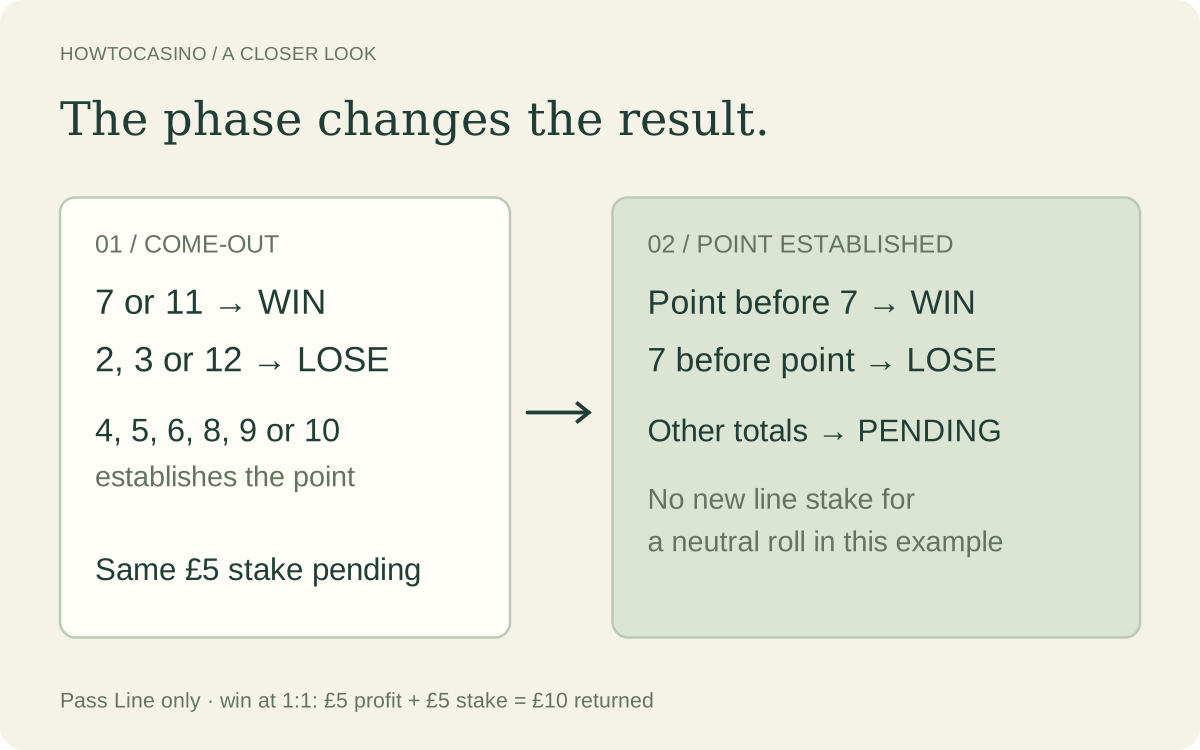
- On the come-out roll, 7 or 11 wins at 1:1. A 2, 3 or 12 loses.
- A 4, 5, 6, 8, 9 or 10 establishes that total as the point. The line stake has not won or lost yet.
- With a point established, the same point total before 7 wins at 1:1. A 7 before the point loses.
- Every other total leaves this Pass Line bet pending. Once the line cycle ends, the next come-out begins a new cycle.
| Phase | Dice total | Pass Line result |
|---|---|---|
| Come-out | 7 or 11 | Win |
| Come-out | 2, 3 or 12 | Lose |
| Come-out | 4, 5, 6, 8, 9 or 10 | That total becomes the point; wager pending |
| Point established | The point total | Win |
| Point established | 7 | Lose |
| Point established | Any other total | Still pending |
A £5 Pass Line example, roll by roll
These are fictional cash examples with no side bets, extra odds or bonus conditions. A £5 stake is an arithmetic example, not a minimum, a suggested amount or an actual account result.
| Roll | What happens | Status of the same £5 Pass stake |
|---|---|---|
| 6 | The come-out establishes point 6 | Pending |
| 11 | Neither 6 nor 7 | Pending; no new line stake in this example |
| 2 | Neither 6 nor 7 | Pending; no new line stake in this example |
| 6 | The point rolls before 7 | Win: £5 profit plus the £5 stake, £10 total return |
If the last roll in that sequence were 7, the £5 line stake would lose and the total return would be £0. The neutral rolls do not create extra Pass Line wins, losses or mandatory new £5 stakes. They also do not make the point due.
For comparison, a single come-out 7 immediately produces the same £10 total return on a £5 winning Pass bet. A come-out 12 immediately loses it. A displayed return and a profit are different amounts: at 1:1 the profit equals the stake, while the total returned includes the stake as well.
How does Don’t Pass differ?
In the bar-12 model used here, Don’t Pass wins on a come-out 2 or 3, loses on 7 or 11, and pushes on 12. A push returns the stake without profit. If a point is established, Don’t Pass wins when 7 arrives before the point and loses if the point arrives first.
| Phase | Pass | Don’t Pass, bar 12 |
|---|---|---|
| Come-out 7 or 11 | Win | Lose |
| Come-out 2 or 3 | Lose | Win |
| Come-out 12 | Lose | Push |
| Point before 7 | Win | Lose |
| 7 before point | Lose | Win |
| Other roll after point | Pending | Pending |
For a fictional £5 Don’t Pass stake, a come-out 12 returns £5 with £0 profit. If point 6 is established and then 11, 2 and 7 roll, the 11 and 2 leave the line pending and the 7 settles it as a win: £10 total return, including £5 profit.
Why is 7 more common than 12?
With two independent fair six-sided dice there are 36 equally likely ordered face pairs. Six pairs total 7; only the pair 6+6 totals 12. The possible totals are therefore not equally likely.
| Total | Ways out of 36 | Chance on one roll |
|---|---|---|
| 2 or 12 | 1 for each total | 1/36 each |
| 3 or 11 | 2 for each total | 2/36 each |
| 4 or 10 | 3 for each total | 3/36 each |
| 5 or 9 | 4 for each total | 4/36 each |
| 6 or 8 | 5 for each total | 5/36 each |
| 7 | 6 | 6/36 = 1/6 |
After point 6 is established, five combinations make 6 and six make 7. Ignoring rolls that settle neither side, the chance of 6 arriving before 7 is 5/11. The other totals can prolong the wait; they do not reset the point or change that fair-dice calculation.
For a complete Pass Line wager under these assumptions, the win probability is 244/495, about 49.29%. With wins paying 1:1, the calculated house edge is 7/495, about 1.41% of the initial line stake. For Don’t Pass with a come-out 12 push, it is about 1.36% per initial stake including pushes. These figures concern these line rules, not every bet on a craps layout.
A house edge is a long-run mathematical expectation, not a charge deducted from every wager or a forecast for a session. Actual results vary. The house-edge guide explains the difference between a winning probability, a payout and an expected loss.
What are Come bets and odds bets?
A Come bet has its own first roll and can establish its own point after the table point already exists. Its point can therefore differ from the main Pass point. Do not settle every wager using only the table’s point marker. Don’t Come follows its own corresponding rules, including the stated barred total.
Taking odds is a separate, additional wager associated with an established Pass or Come point. In the stated model, profit odds are 2:1 for point 4 or 10, 3:2 for 5 or 9, and 6:5 for 6 or 8. Laying odds on the corresponding Don’t wager uses the inverse profit prices. The game may impose permitted increments and limits.
For example, an extra fictional £5 odds stake behind a £5 Pass Line bet on point 6 would win £6 odds profit if 6 arrived first. Together, the line returns £10 and the odds returns £11: £21 total returned on £10 committed, for £11 net profit. If 7 arrives first, both stakes lose: £10 in total.
An additional true-odds component has zero house edge under the fair-dice assumptions, but increases the cash exposed and does not remove the base line’s expected loss. A lower combined percentage is not a reason to increase a stake. This example does not establish a table’s allowed odds multiple or minimum.
What should you check before reading a craps result?
- Identify the exact bet and its current phase. Pass, Come and one-roll wagers do not all settle together.
- Read the bar-2 or bar-12 condition for the Don’t bets.
- Separate the original stake, additional odds and optional side bets.
- Check whether a displayed figure is profit or total return, plus any stake increments and table maximums.
- Use the game’s own explanation for place, field, hardway or proposition bets; the line-bet percentages above do not describe them.
If a result looks wrong, preserve the game name, time, round reference and displayed settlement and use the operator’s complaint route. A portal diagram cannot establish what happened in an actual round. For GB play, check the exact domain and permissions in the Gambling Commission register.
Related questions
What is the point in craps?
A come-out 4, 5, 6, 8, 9 or 10 establishes that total as the point for the line cycle. Pass then needs that total before 7; Don’t Pass needs 7 before that total. Other totals leave those line bets pending.
Does 7 always win in craps?
No. A come-out 7 wins for Pass, but a 7 before an established point loses for Pass. Other wagers can have different conditions. Identify the phase and the bet before reading the result.
What happens to Don’t Pass on 12?
Under the bar-12 rules used here, a come-out 12 is a push: the stake returns without profit. Some other rule sets bar 2 instead, so the exact table rule matters.
Do you pay again on every roll?
A pending Pass Line stake does not require a new stake for each neutral roll in the example here. Additional wagers are separate commitments, and other types of bets may settle on a single roll.
What does 1:1 pay on a £5 craps bet?
A winning £5 wager at 1:1 produces £5 profit and returns the £5 stake, for £10 total return. A £5 push returns £5 with no profit; a losing £5 stake returns £0.
Can a craps system guarantee a profit?
No. Changing stakes or following earlier totals does not guarantee a winning result. The line calculations assume fair independent dice; extra bets add their own stakes and settlement conditions.