What is the difference between a payout, a withdrawal and a profit?
A game payout is money returned when an outcome settles. If it includes the original stake, the entire payout is not profit. A withdrawal moves eligible money out of the gambling account. Profit or loss requires accounting for money committed and money returned over a defined period.
| Measure | Example | Meaning |
|---|---|---|
| Gross game return | £18 returned from a £10 stake | Net gain on that settled bet: £8 |
| Withdrawal | £50 moved to a payment account | Could include original deposits as well as game gains |
| Whole-period game result | £120 returns minus £100 stakes | £20 gain before other specified costs or adjustments |
| A promotional headline | £50 bonus advertised | Not automatically £50 unrestricted cash or a £50 profit |
A person can withdraw £50 after depositing £100 and still finish down overall. Equally, leaving winnings in an account does not make them disappear from the result. Reconcile the opening balance, deposits, completed withdrawals and closing balance, with separate treatment of bonuses and fees.
The online-account explainer includes a complete cash ledger. Use its method to check which number a screenshot or advert actually shows, rather than assuming that an impressive transfer is an equally large gain.
What does a house edge imply about expected income?
Expected value weights the possible net results by their probabilities. For a specified game model, a house edge of 4% means an expected net loss of 4 p per £1 staked. It does not mean every £1 bet loses 4 p, or that a particular player will lose exactly 4% of a deposit.
The base is total stakes, including money returned and staked again. Under a fixed 4% edge, £100 of total stakes has an expected £4 loss; £500 has an expected £20 loss. Those are model expectations, not spending targets or predicted personal losses. Actual results can be much better or worse.
An account’s daily or monthly record does not reset the game’s mathematics. Calling an amount a daily target does not give the game a mechanism that supplies it. Nor does an operator’s ability to pay a genuine win establish that its customers can earn consistently.
Our game-odds guide compares probabilities and payouts under stated rules. An apparently small edge still needs to be read with stake size, total exposure, variation and any extra cost.
How can a losing-expectation game still have winning sessions?
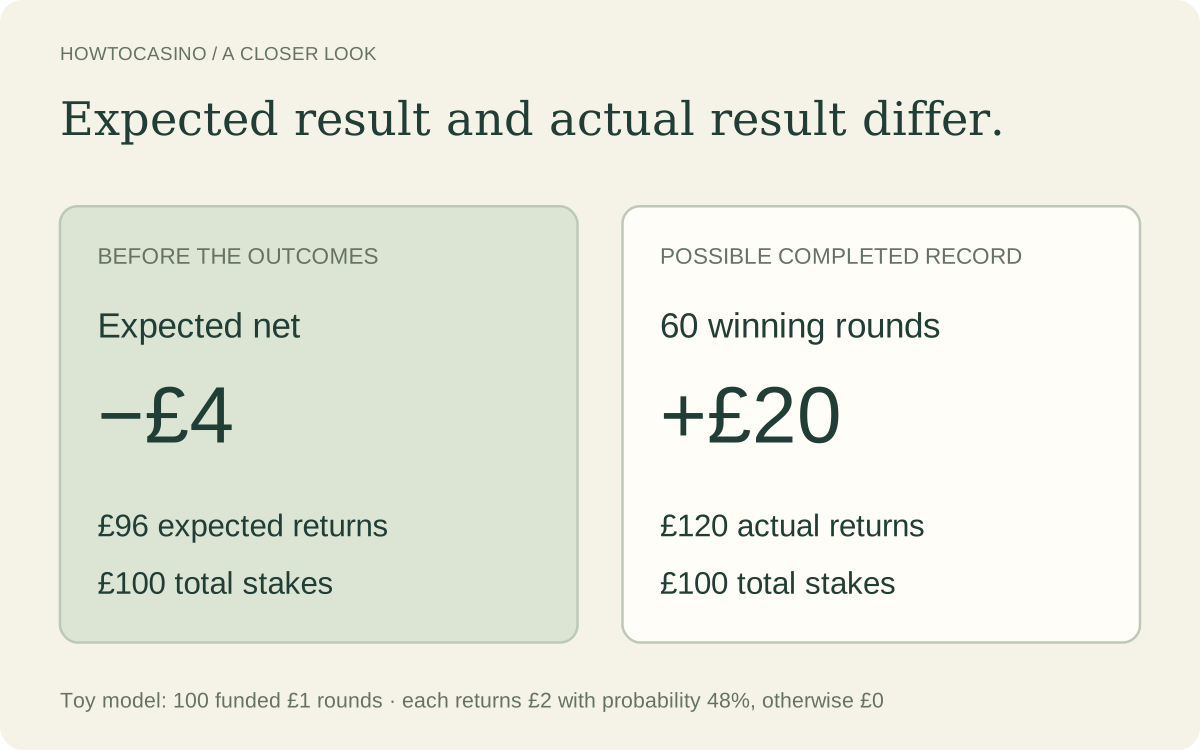
Use an invented game, not a real casino product. Each independent round costs £1 and returns either £2 with probability 48% or £0 with probability 52%. Returns include the stake. Assume exactly 100 rounds are funded and completed, with no fees, bonus or early stopping. The expected return per round is £0.96 and expected net result is −£0.04.
| Wins among 100 completed rounds | Gross game returns | Total stakes | Actual net result |
|---|---|---|---|
| 40 | £80 | £100 | −£20 |
| 48 | £96 | £100 | −£4 |
| 50 | £100 | £100 | £0 |
| 60 | £120 | £100 | +£20 |
The expected net for the 100-round block is −£4. A realised block with 60 winning rounds ends £20 up. Both statements can be true: expectation describes the probability-weighted result before the outcomes, while the table shows possible completed records.
A positive block needs at least 51 winning rounds. The binomial calculation gives a probability of approximately 30.82% for that event in this particular model. This is not the probability of achieving a regular income, a risk estimate for a real slot or a recommendation to play 100 rounds. A smaller bankroll or a stopping rule would define a different session model.
The example also shows why a winner’s story cannot establish an advantage. Some winning sessions are expected even in an unfavourable model. Judging the model from only the winning examples leaves out losses, failed attempts and the information needed for comparison.
Can a system, skill or a stop target make the result reliable?
Changing stakes changes how much is exposed. Under a game model that retains a negative expected result for each stake, a progression does not turn that stake into a favourable bet. Its larger losing branches and practical limits still matter; the roulette systems guide works through one bounded example.
Stopping after a gain can end a particular session ahead. It does not establish that every future session will reach the same target before a loss limit or bankroll limit is reached. A decision to stop is useful as a boundary on activity; it is not proof of income.
Skill can matter in games that allow consequential choices. Blackjack basic strategy compares actions for an exact rule set and can avoid costly mistakes. A positive value for one particular hand is not the same as a positive expectation across all the hands dealt. The strategy guide explains that distinction.
Do not extend this explanation to every conceivable gambling arrangement. Peer-to-peer games, additional information and special promotional terms can require different models. Any claim of an advantage needs its own valid assumptions, costs, eligibility and restrictions. That is a separate analysis, not evidence that ordinary house-edge play supplies a wage.
What evidence would an income claim need?
| Claim or item | What it leaves unanswered |
|---|---|
| A large payout screenshot | What was staked, on which rules, and what happened on other bets? |
| A withdrawal confirmation | How much was deposited and what balance remains? |
| A streak of winning days | How were days and failed attempts selected, and what is the complete period? |
| A return percentage | Which configuration and strategy does it describe, and does it include every cost? |
| A bonus or competition prize | Which conditions, eligible stakes, limits and cash restrictions apply? |
Records can establish what happened to an account over a defined period. They do not by themselves prove that a system caused it or that the same result will continue. The account-history standard helps identify the underlying transactions; do not share private statements with a public forum just to answer a claim.
A promotion requires a separate calculation. A face-value award, cash-equivalent value, credited bonus, turnover target and actual unrestricted cash prize can be different quantities. We explain these distinctions in the bonus-terms and tournament guides rather than assuming that an offer is either automatically profitable or automatically identical to ordinary play.
What if you are relying on a win to cover living costs?
Do not treat a hoped-for payout as money available for rent, bills or repayment. GamCare’s money guidance says gambling should not be viewed as a way to make money or overcome financial difficulties. It provides practical resources for tracking spending and protecting money.
If another deposit feels necessary to recover a loss or meet an income target, step back from the game comparison. The independent support links on this site provide a route to discuss the situation and account controls. A previous loss is not a reason that the next outcome must reimburse it.
Related questions
Can you win real money at an online casino?
A genuine settled result can leave a customer with cash winnings, subject to the applicable account and transaction process. That possibility does not establish a reliable income or make every payout a net profit.
Does the house always win every session?
No. A house edge describes a mathematical expectation, not the outcome of every session. The invented 100-round example has possible positive blocks despite its negative expectation.
Does a higher RTP make a monthly salary possible?
RTP does not provide a payment schedule or predict a personal session. A less negative expectation is not the same as a positive or reliable income.
Is withdrawing £100 the same as winning £100?
No. It can include deposited money or earlier funds. Reconcile the whole period and account balances to identify the actual gain or loss.
Can I use a stop-win target to guarantee profit?
A target can describe when you intend to stop, but does not guarantee that play reaches it before a loss or funding limit. Changing that rule also changes the session model.
Does this mean every gambling model has the same edge?
No. Rules, decisions, information, other participants and promotional conditions can require different calculations. This guide explains ordinary play on specified negative-edge casino models; it does not establish the result of every possible arrangement.