What does a roulette system change?
Separate the wheel from the staking rule. Under a fair equal-pocket single-zero model, red wins on 18 of 37 pockets, while black or zero accounts for the other 19. Changing the amount placed on red does not alter that distribution. The previous run does not make the next independent spin owe a particular colour.
A staking rule can nevertheless change the money attached to outcomes. Small frequent gains and occasional large losses can feel different from fixed stakes even when the underlying edge has not improved. “Most cycles won” therefore needs a definition of cycle and the amounts won and lost.
This article analyses a specified mathematical example. It does not establish the fairness of a particular wheel, recommend increasing stakes or promise a profitable session. Our roulette odds reference gives the conventional bet probabilities and profit prices separately.
What assumptions does a doubling example need?
Use a deliberately bounded example: one wager on red per spin, starting at £1; after each loss the next stated stake is twice the previous one. Stop at the first winning wager, or after six consecutive losses. Assume independent fair single-zero spins and conventional 1:1 profit, with no La Partage or other zero protection.
For the arithmetic, assume all six stakes are permitted and at least £63 is available. That is a model assumption, not a current casino minimum, maximum or invitation to allocate that amount. After a winning wager the cycle ends; we do not assume repeated new cycles are funded indefinitely.
| Wager in this model | Stake | Previous losses | Cumulative stakes if this also loses |
|---|---|---|---|
| 1 | £1 | £0 | £1 |
| 2 | £2 | £1 | £3 |
| 3 | £4 | £3 | £7 |
| 4 | £8 | £7 | £15 |
| 5 | £16 | £15 | £31 |
| 6 | £32 | £31 | £63 |
For wager number k from 1 to 6, the stake is £1 × 2^(k−1). Conventional 1:1 profit equals that stake. Earlier losses total one pound less, so a win at that point completes the cycle with net result +£1. The stake returned on the winning wager is not an additional profit: it belongs in the total return used for settlement.
If all six wagers lose, there is no recovery event. The loss is £1+£2+£4+£8+£16+£32=£63. A seventh progression stake would be £64, outside this model. A calculation that reports only the winning endings omits the expensive branch.
Can a system win most cycles and still lose in expectation?
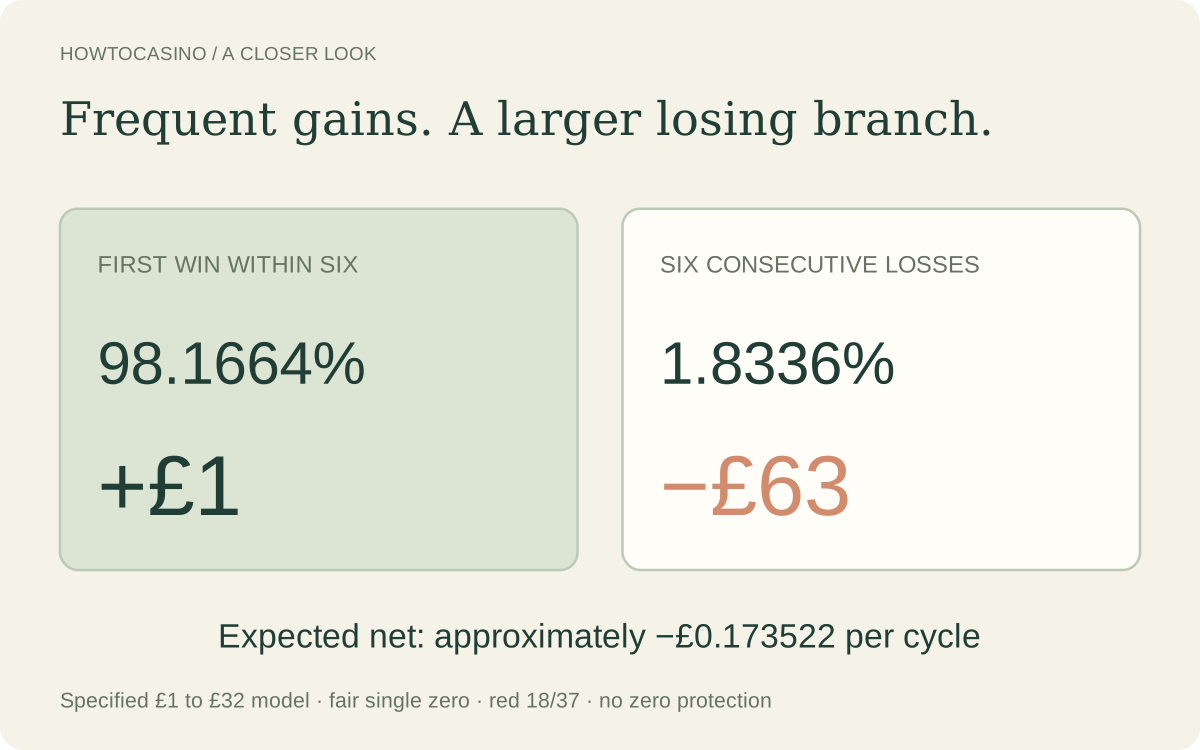
Yes. In this exact model, one spin loses with probability 19/37. Six consecutive losses have probability(19/37)⁶, approximately 1.8336%. A first win within the six wagers has the complementary probability, approximately 98.1664%. That is a bounded-cycle success probability, not the probability of winning each spin.
| Cycle ending | Probability under this model | Net cycle result |
|---|---|---|
| At least one win before the six-loss stop | Approximately98.1664% | +£1 |
| All six wagers lose | Approximately1.8336% | −£63 |
Weight the money as well as the frequency: expected net result = (1−q⁶)×£1−q⁶×£63=£1−£64q⁶, where q = 19/37. The result is approximately−£0.173522 per cycle. The many small positive endings do not outweigh the losing branch in expectation.
Expected total stakes are approximately £6.420314 per cycle, counting a later wager only when earlier losses reach it. The ratio of expected loss to expected stakes is 1/37, the same conventional single-zero edge. We checked the complete stopped paths with exact arithmetic; this is not a simulation, an account test or a forecast of your results.
For comparison, a single£1 red wager wins with probability 18/37, about 48.65%, and has expected net loss£1/37. The progression’s higher cycle-success percentage describes a different event with unequal money exposure; it does not improve the individual wager’s odds.
What happens when a table limit or available balance stops the progression?
A real progression needs every next stake to be both affordable and accepted. In the hypothetical six-loss ledger,£63 has already been lost and the next intended amount would be £64. A£32 table maximum or an exhausted£63 balance prevents that next wager. There is no requirement for a casino to accept a recovery stake outside its limits.
A smaller maximum can interrupt the sequence sooner. If an invented table maximum were£20, the£32 sixth wager would not be permitted after the first five losses had already cost £31. The arithmetic promise of a later+£1 ending depends on a win occurring before the applicable stop, not on unlimited access to the next amount.
Dividing a desired stake across positions does not remove its total cost or automatically preserve the assumed payout model. Inside wagers, neighbour packages and other selections have different coverage and settlement. The bet-types guide explains why chips and numbers covered are different counts.
A stop limit changes which paths can occur and how much can be lost. It is not an outcome predictor. Setting a limit and then extending it after losses is a different, larger-exposure process than the one originally described.
Do Fibonacci, positive progressions or following a colour avoid the problem?
A different stake ladder changes the amounts and timing of exposure. A rule that increases after wins changes a different set of paths from one that increases after losses. Neither action supplies information about the next independent pocket or changes the conventional profit price paid for a given wager.
For a fair independent wheel, stakes chosen from past results still face the current wager’s mathematical disadvantage. Under finite, well-defined stopping and exposure assumptions, the expected result can be calculated by weighting those stakes and outcomes. Do not silently replace a bounded model with unlimited credit or an indefinitely extended session.
A result-history display can describe a past cluster. It does not by itself establish that following a streak or opposing it forecasts the next spin. Roulette with different zero treatment or modified payouts needs a fresh model, not an unqualified claim that every betting system has one identical numerical edge.
What should a useful roulette-system explanation disclose?
- Specify the wheel model, the selected wager, its profit price and what happens on zero.
- State the complete stake rule, maximum exposure and stopping conditions.
- Count every accepted stake and distinguish returned stakes from profit.
- Include the losing branch, its size and the conditions that prevent a later wager.
- Separate a spin’s win probability, a cycle-success rate and expected net profit.
- Check the actual game rules and limits. A short winning record is not proof of a guaranteed system.
A half-stake-on-zero rule, where applicable, changes an eligible bet’s expectation. That is a real rule difference, not a benefit created by doubling. Our house-edge comparison shows how to keep rule changes separate from changes in stake size.
If a system is presented as a way to recover money already lost, consider the new amounts it requires before interpreting the promised ending. Losses do not become money owed by the game. Independent support is linked from the site’s safer gambling page.
Related questions
Can a Martingale-style progression guarantee a win?
No. A finite balance, permitted maximum or stopping rule can end the progression with accumulated losses. The stated six-wager example includes a−£63 ending.
Is roulette red or black a 50/50 bet?
Not in the fair single-zero model: red has 18 of 37 pockets and zero is neither red nor black. At conventional prices zero is part of the disadvantage.
Does98% cycle success mean a 98% chance on each spin?
No. In this model each red wager still wins with probability 18/37. The 98.1664% figure concerns at least one win before a six-loss stop and has unequal monetary endings.
Does La Partage make every roulette wager the same?
No. It is a specified rule for eligible even-money wagers on applicable tables. Other bets and modified tables need their own settlement model.
Does following the last winning colour predict the next spin?
A past result alone does not predict the next independent fair-wheel result. A history panel is a record, not a validated forecasting method.
Does a stop-loss remove the house edge?
It limits a defined process if followed; it does not change the wager’s payout or probability. Its effect on the distribution must be calculated with the full stopping rule.