What is Sic Bo, and which rules are used here?
Sic Bo is a dice game with a layout of different wager fields. One result can be described in several ways: the three individual faces, their sum, the number of occurrences of a chosen face, or whether the dice form a pair or triple. Those descriptions matter to different bets.
This guide uses the public Roxor Sic Bo descriptions on Bally UK and Virgin Games, checked on 30 October 2026. It is an explanation of that stated model, not an account test or a claim that every Sic Bo game uses those prices. Live tables, electronic games and multiplier versions can differ.
The numeric examples below express x:1 as profit odds: a winning stake is returned in addition to that profit. All £5 amounts are fictional arithmetic examples, not table minimums or recommended stakes. Actual game help, accepted stakes and applicable limits must be checked separately.
How does a Sic Bo round work?
- Identify the exact game and read its rules and paytable, including triple exclusions and the basis of each payout.
- Each selected field has its own stake. Add those stakes to identify the total committed to that result.
- The three dice are revealed. Evaluate every accepted field against that same result and its own winning condition.
- Add the money returned by all winning fields, then subtract all stakes to calculate the round’s net result.
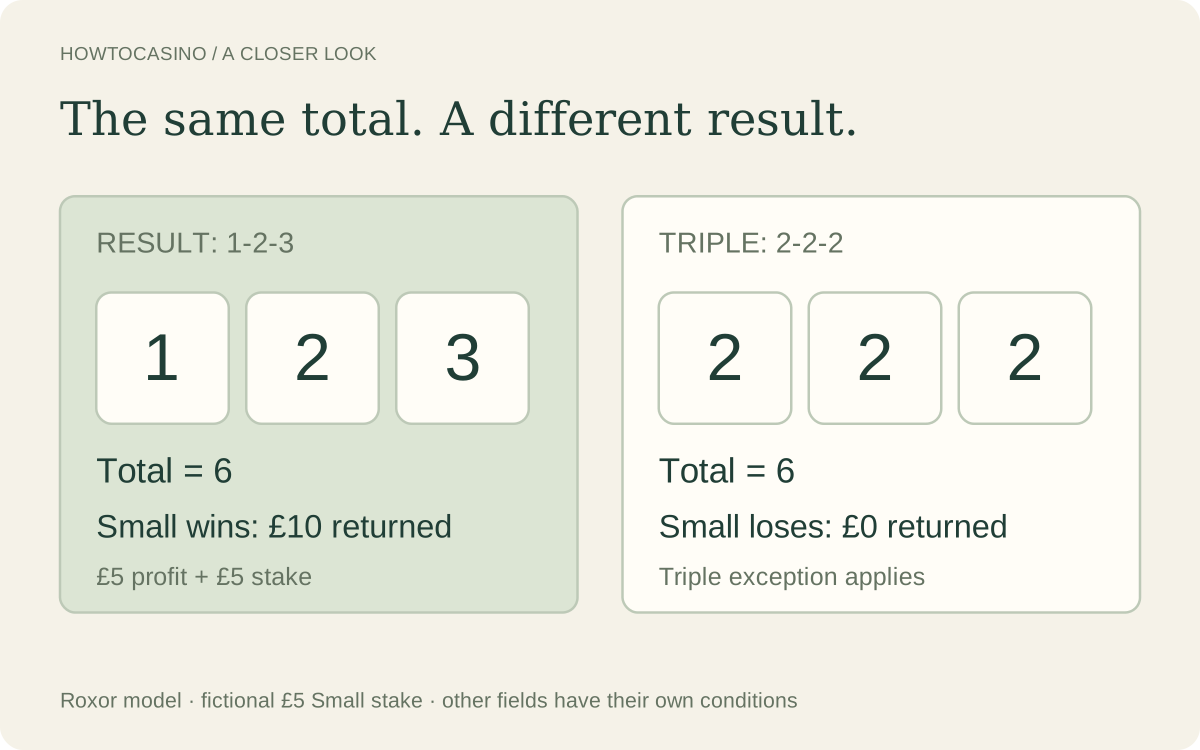
A sum is not enough to settle every wager. For example, 1-2-3 and 2-2-2 both total 6, but only the latter is a triple. A Small bet and a selected-number bet can consequently produce different outcomes on the same total.
Craps also uses dice, but it has a different procedure involving two dice, a come-out roll and possible points. Do not apply those phases to a Sic Bo wager.
How do Small, Big, Odd and Even work?
| Field in the stated model | Winning condition | Profit odds |
|---|---|---|
| Small | Total 4–10, except triples | 1:1 |
| Big | Total 11–17, except triples | 1:1 |
| Odd | An odd total, except triples | 1:1 |
| Even | An even total, except triples | 1:1 |
A fictional £5 Small stake on 1-2-3 wins £5 profit and returns the £5 stake: £10 in total. On 2-2-2, the total is still 6 but the triple exception applies, so Small loses and returns £0.
Likewise, 4-5-6 totals 15 and wins Big, while 5-5-5 totals 15 but loses Big. The words odd and even do not cancel their triple exception. A result must satisfy the complete condition, not just the most prominent label on the field.
What happens when you bet on one number?
A selected-number bet counts how many of the three dice show the chosen face. In this public Roxor model, one match pays 1:1, two matches pay 2:1 and three matches pay 14:1. The three-match price is model-specific; do not substitute another game’s commonly quoted 3:1 tier.
| Selected face: 2; fictional £5 stake | Matches | Profit or loss | Total returned |
|---|---|---|---|
| 1-3-4 | 0 | −£5 | £0 |
| 2-3-4 | 1 | +£5 | £10 |
| 2-2-4 | 2 | +£10 | £15 |
| 2-2-2 | 3 | +£70 | £75 |
The final row pays 14 × £5 = £70 profit, plus the £5 stake. That does not mean every triple pays £75: the selected face must match, and a different wager can have a different price. A bet on face 5 loses on 2-2-2.
How do doubles, triples and combination bets differ?
| Field | Condition in this named model | Profit odds |
|---|---|---|
| Selected double | At least two dice show the selected face; a matching triple qualifies | 12:1 |
| Selected triple | All three dice show the selected face | 209:1 |
| Any triple | All three dice show the same face, whichever face it is | 34:1 |
| Domino / two-number combination | Both of the two selected different faces appear among the three dice | 6:1 |
For example, selecting the double 2 wins on 2-2-4 and on 2-2-2 under the explicit at-least-two rule. A selected triple 2 wins only on 2-2-2. An any-triple wager also wins on 4-4-4, while the selected triple 2 does not.
A Domino bet on 2 and 5 needs both faces present, such as 2-5-6 or 2-2-5. Only one of those chosen faces is insufficient. It is a separate field, not a requirement to predict the complete ordered dice result.
Exact-total fields also exist. The checked public pages show an overall price range of 6:1–69:1 without a complete sum-by-sum mapping. We do not fill that gap from another version. Read the actual game’s paytable for the price attached to your selected total.
Can one winning field still leave a loss?
Yes. Assume three separate £5 stakes: Small, single number 5, and selected triple 6. The total committed is £15. If the dice are 1-2-3, Small wins and returns £10, while the two other fields return £0. The combined result is therefore £10 returned − £15 staked = a £5 loss.
The same principle applies when a result qualifies for several fields. Only fields actually staked receive their respective returns, and all accepted stakes count towards the net result. A hypothetical £5 on Small is not £5 automatically spread over every field described in this guide.
A payout notification can describe one winner without describing the overall result. Use the transaction or round record to distinguish the total stake, total return and net profit or loss. The game-rules guide explains why that distinction also matters for other casino formats.
What are the chances and house edge?
With three independent fair six-sided dice, there are 6 × 6 × 6 = 216 equally likely ordered results. The possible totals are not equally likely: only 1-1-1 totals 3, whereas 27 ordered results total 10.
Small has 105 winning results after applying its range and triple exception, so its winning probability is 105/216, about 48.61%. The remaining 111 results lose. With 1:1 profit odds, the expected net result per £1 is (105 − 111)/216 = −£1/36, giving a calculated house edge of about 2.78% of that field’s stake.
The selected double in this stated model has 16 winning results out of 216, including the matching triple. At 12:1 profit odds, its calculated edge is about 3.70%. A single percentage therefore should not be labelled the return of every bet or every version of Sic Bo.
These are mathematical calculations under the stated fair-dice assumptions and prices. They are not a prediction of a session, an amount taken from every stake or a test of a particular casino’s result generator. Our house-edge guide explains how probability and payout combine.
Can a system guarantee a Sic Bo win?
No. A wager wins when its stated condition occurs. Earlier totals, a run of triples or a change in stake do not make the next required fair-dice outcome due. Additional wagers increase the total committed and introduce their own settlement rules.
- Check the exact supplier/version, triple rules and payout for every field used.
- Read any special multiplier conditions separately; a Super Sic Bo description is not automatically this Roxor paytable.
- Count the complete stake and distinguish profit from the money returned.
- For GB play, check the exact domain and relevant permissions rather than treating a game-description page as a licence audit.
- If an accepted result or return is unclear, retain the game name, time and round reference and use the operator’s complaint route.
The licence-check and casino-payment dispute guides explain those final checks. No further bet is needed to collect the rules or ask the operator about an existing round.
Related questions
What is Sic Bo?
It is a game using three dice and a layout of wagers on outcomes such as total ranges, chosen faces and triples. Each wager has its own condition and price; a single dice result can settle several fields differently.
Does a total of 6 always win Small?
No. In the stated Roxor model, 1-2-3 wins Small but 2-2-2 loses because it is a triple. Apply the triple exception as well as the total range.
What does a single-number triple pay?
In this named model, three matches of the selected face pay 14:1 profit odds. A fictional £5 qualifying stake produces £70 profit plus the £5 stake, or £75 total returned. Other versions can use different prices.
Does a triple count for a selected double?
Under Bally UK’s published Roxor condition, yes: the selected double requires at least two dice of the chosen face. That is a specific model rule, not a condition to assume for every variant.
Is every Sic Bo bet about 2.78% house edge?
No. The edge depends on the exact winning condition and price. For example, the stated fair-dice model gives about 2.78% for Small at 1:1 and about 3.70% for a selected double at 12:1. These are calculations, not universal game RTP figures.
How do you win at Sic Bo?
A particular field wins when the dice satisfy all its conditions. There is no staking system that guarantees profit, and a winning field can still leave an overall loss after other stakes are counted.