What do you control when you Bet Behind?
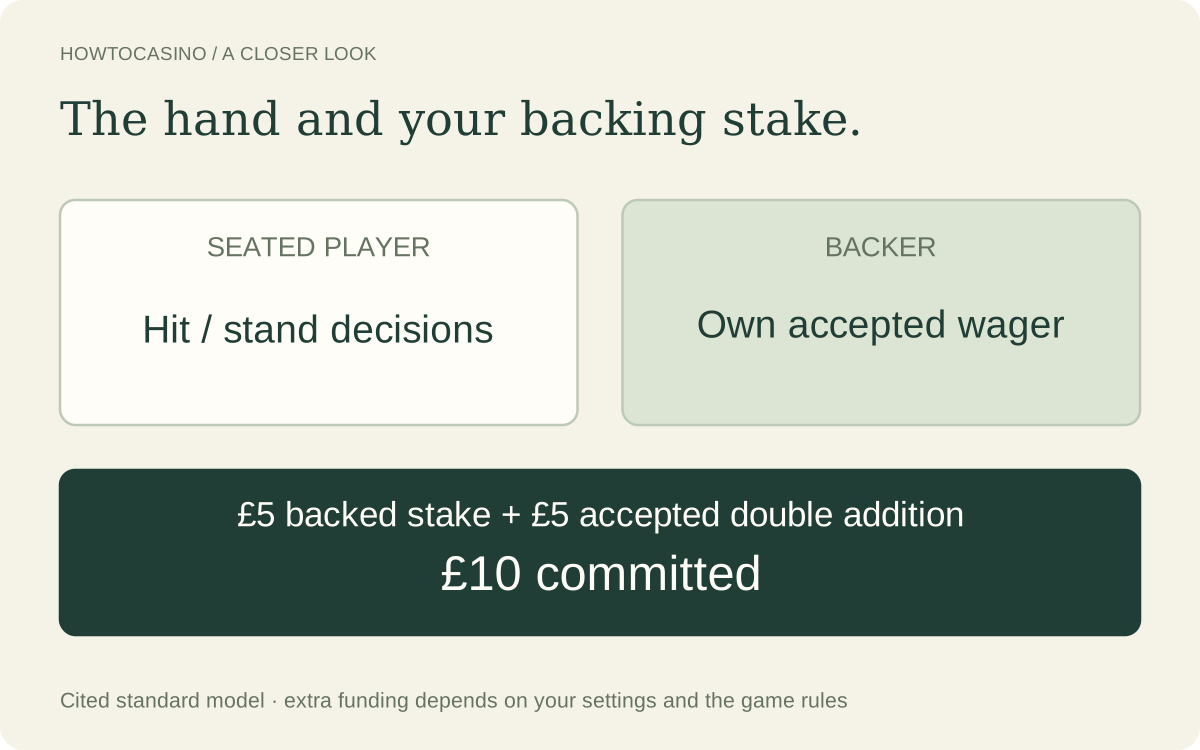
Backing a seat gives your wager the result defined for that seat under the game’s rules. You do not take over the seated player’s buttons. The GB-labelled LeoVegas standard Live Blackjack help gives the seated player the hand decisions, while allowing the backer separate insurance and extra-stake settings.
| Action | Who controls it in that published model? | What to check |
|---|---|---|
| Hit or stand | The seated player | You cannot make that player use your preferred strategy. |
| Choose your initial backed stake | You, within the accepted limits | It is additional to any other wager you place. |
| Add money when the player doubles or splits | Your Bet Behind setting | Confirm the selected option and its effect before the round. |
| Take insurance | You make a separate election | Insurance adds a separately settled wager. |
The help pages describe a standard model and warn that variants can differ. For example, a control to fund a split does not give you control over whether the seated player chooses to split at all.
Our double-down and splitting guides explain those main-game actions. Here the extra question is what your own accepted backing wager does when somebody else takes the action.
Do you receive a share of the seated player’s winnings?
Each backer has a separately funded wager. In the cited standard model, a backed wager uses the ordinary main-bet payout rules. Your return follows your accepted stake; it is not a percentage of the seated player’s cash prize.
For example, suppose your accepted backed stake is £5 and the lead player’s stake is £20. If both wagers receive an ordinary 1:1 win, your £5 wager returns £10 including stake. The lead player’s wager has its own return. Their larger stake does not enlarge yours.
Likewise, several spectators backing the same hand do not divide one shared prize pool. Read any side-bet controls separately; backing the main hand does not establish that you also bought every optional wager displayed beside that seat.
What happens if the main player doubles or splits?
The published GB help permits a backer to decide in advance whether to increase their stake when the lead player doubles or splits. An enabled setting can therefore commit extra money during the hand. Review it together with the amount already staked.
Assume your £5 backed wager accepts a further £5 when the lead player doubles. Your total committed amount becomes £10. If that accepted doubled wager then has an ordinary 1:1 win, it returns £20 and makes £10 profit. A loss of that wager loses the full £10.
For a split, check how each resulting hand is funded and followed. The public summaries we read do not identify which of the two split hands keeps your wager when you decline an additional stake. They also do not establish the action taken if the account cannot cover an enabled addition. Use the selected game’s help or ask the operator to clarify those points before backing a hand.
A player’s decision to split is not itself evidence that a second £5 was accepted from your account. The round record should show your actual additions and settlements. Do not calculate a £10 loss or return from the lead player’s actions alone.
How much does a £5 Bet Behind wager return?
This table uses the cited standard model: ordinary wins pay 1:1 and a qualifying winning natural pays 3:2. Assume a single £5 backed stake, no insurance, no side bets and no accepted additions.
| Settled result | Total returned | Net result |
|---|---|---|
| Ordinary 1:1 win | £10.00 | £5.00 profit |
| Qualifying 3:2 winning natural | £12.50 | £7.50 profit |
| Push returning the stake | £5.00 | £0 |
| Loss | £0 | £5.00 loss |
A hand totalling 21 is not always a qualifying natural, particularly after a split. The actual table determines that classification and whether the player or dealer wins. The table explains return units; it does not forecast a hand’s result.
Insurance has a separate cost and settlement. The same standard help describes insurance paying 2:1 when it wins. It should not be silently included in a main-hand return or treated as free cover.
Can you Bet Behind if seats are available or you are already seated?
Evolution describes backing one or more of the seven main seats, including while you are seated elsewhere at the table. The feature is not defined solely as a queue for a full table. Available backing spots, limits and betting cut-off still depend on the selected game.
The LeoVegas standard help says you cannot back your own hand. It also describes refunding the backing stake if the selected player decides not to participate in that round. That pre-round situation does not establish a general right to cancel an accepted hand after dealing starts.
If a seat or backing control is unavailable, check the game’s own instructions. Availability does not follow merely from a lobby page using the words live blackjack.
How do Bet Behind, Bet Behind Pro and Infinite Blackjack differ?
| Format | Who makes the relevant hand decisions? | Where the distinction matters |
|---|---|---|
| Conventional Bet Behind | The main player at the backed seat | You follow that player’s hand, subject to your allowed funding and insurance settings. |
| Grosvenor’s named Bet Behind Pro | Automated bots, according to its public description | Do not assume every game called Bet Behind follows a human player. |
| Evolution Infinite Blackjack | Each participant makes their own decisions after a shared opening hand | A common start does not mean you surrender your decisions to another customer. |
| Multi-hand blackjack | You control the opening positions you fund under its rules | Several wagers you play yourself differ from backing another seat. |
The multi-hand and Infinite explanations cover their exact formats in more detail. Product names and a shared starting pair do not establish identical stake exposure or settlement rules.
A recent winning streak is a record of past results, not proof that a player or bot will produce a better next result. We have not established a positive expected return from selecting a seat on that basis.
What should you check or save for a settlement question?
- Read the exact game’s Bet Behind help and current funding settings.
- Confirm your own initial stake and every accepted addition.
- For a split, identify how the wager was assigned to the resulting hands.
- Keep the round identifier, relevant settings and your own return record.
- Ask verified operator support to reconcile that record against the selected rules.
Sources and scope
We checked public supplier descriptions, the GB-labelled LeoVegas and BetMGM standard help, and Grosvenor’s Bet Behind Pro description on 2 November 2026. The two GB help pages are related-group material, not two independent supplier tests.
We did not launch a table or test settings, wagers or withdrawals. The public summaries leave some implementation details unresolved; those points are identified in the split and double explanation.
Related questions
Can the main player spend my money by doubling?
In versions with a backer funding setting, an enabled option can authorise an additional stake when the main player doubles. Check that setting and the accepted amounts. The player controls the hand decision; your available funding controls remain version-specific.
Is Bet Behind only available when all seats are full?
No such restriction follows from the feature’s definition. Evolution describes using it while waiting for a seat and while already seated at another position. The particular game decides which backing spots are available.
Does Bet Behind always have the same RTP as playing your own hand?
Do not assume that. The main player’s decisions, exact rules and your accepted additional wagers affect the relevant model. A standard optimal-blackjack RTP is not proof of your personal backing return.