How can players with the same opening cards get different results?
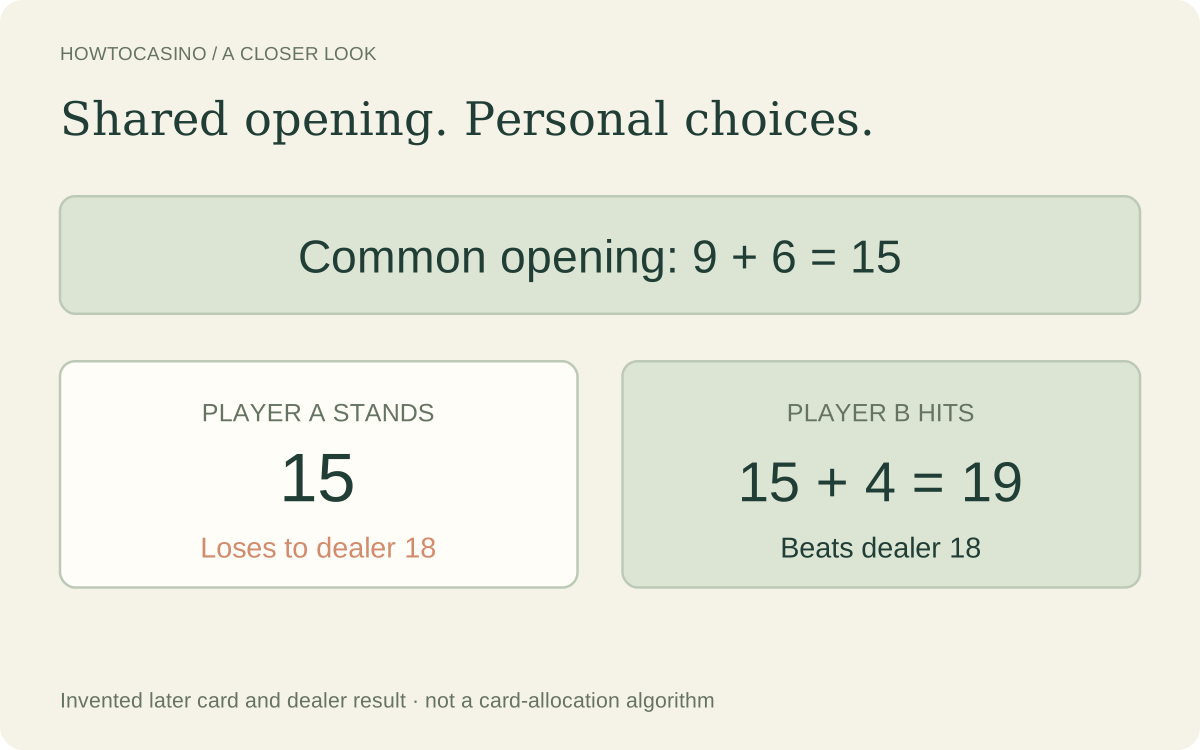
Suppose the common opening hand is 9 and 6, totalling fifteen, and the dealer shows a 7. One player can stand while another takes a card. If the latter player’s next card is an illustrative 4, that hand becomes nineteen. Assume the completed dealer hand is eighteen and neither player has another wager.
| Hypothetical player with a £5 main stake | Final player hand | Ordinary main result |
|---|---|---|
| Player A stands | 15 | Loses to dealer 18; £0 returned, £5 lost. |
| Player B hits and receives the illustrative 4 | 19 | Beats dealer 18 at 1:1; £10 returned, £5 profit. |
This is an example of different choices and results, not a claim that a particular next card is available to both accounts or that hitting fifteen always wins. It also does not establish that a player can see or select another customer’s later cards before deciding.
Other customers are not opponents competing for your main wager. Your result is settled against the dealer and any special rule in the selected model, rather than through a shared player-versus-player poker pot.
What does a round involve?
- Read the selected Infinite title and main rules, then place the main stake. Optional side wagers are separate amounts.
- Receive the common initial two-card hand and see the dealer’s face-up card.
- Read any insurance, dealer-blackjack check or special continuation message under that client’s procedure.
- Choose from the actions actually offered for your hand, such as hit, stand or an eligible double or split.
- Your later hand develops according to your accepted decisions and the game’s dealing system.
- Settle the main result and each optional wager separately using the applicable tables.
Blackjack card values still matter. An ace can count as one or eleven, picture cards count as ten, and a hand above twenty-one busts. Sharing an opening hand does not remove the need to distinguish a soft total, a natural blackjack and a total reached with three or more cards.
The beginner blackjack guide covers the basic sequence. Our card-values guide explains the totals without assuming that every twenty-one receives a natural-blackjack payout.
Which main rules does the original supplier factsheet describe?
| Rule field | Original supplier factsheet model |
|---|---|
| Decks | Eight standard 52-card decks. |
| Dealer drawing | Hits 16 or less; stands on 17, including soft 17. |
| Ordinary main win | 1:1 profit. |
| Original two-card natural | 3:2 profit when it is a winning blackjack. |
| Double | Additional equal stake; exactly one further card. |
| Split aces | One additional card for each split ace; no doubling of those split-ace hands. |
| Six Card Charlie | A qualifying six-card total of 21 or less wins the main stake at 1:1 in this model. |
The factsheet’s short split paragraph does not justify inventing a complete resplitting allowance or one universal double-after-split rule for every Infinite client. Those are fields to read in the actual selected rules. The same applies to surrender and the exact dealer-check sequence.
A soft-seventeen rule is about the dealer’s behaviour, not permission for the player to change the dealer’s action. Our soft-17 guide explains why an ace-containing seventeen and a hard seventeen need careful labels.
How does Six Card Charlie work in the original model?
The original described rule pays a main-hand win at 1:1 when the player holds six cards totalling twenty-one or less. Six cards are required: a five-card hand does not qualify merely because it has not bust. For example, 2,3,2,3,2,4 makes six cards totalling sixteen and meets the stated six-card condition.
A hand of 2,3,4,2,5,6 instead totals twenty-two and busts; the sixth card does not protect it. The qualifier is the card count together with the permitted total, not the count alone. The publication treats split hands separately, so do not combine cards from two split hands to reach six.
The dated original factsheet also gives Charlie priority even against dealer blackjack. In its dealer-ace procedure, if the check finds blackjack and the player does not have blackjack, an initial player total below eighteen can continue towards Charlie; an initial eighteen or more loses. If both initial hands have blackjack, the main wager is a push. This is a specific original-format procedure, not an ordinary blackjack rule to apply elsewhere.
Follow the selected client’s options and messages; do not assume you can always keep drawing after a dealer natural. The broader Charlie guide explains why five-card tricks, six-card Charlies and optional side bets must be distinguished.
Why can another Infinite rules document offer different actions?
The separately published PokerStars-hosted Infinite rules describe a two-side-bet model with surrender and double after split, except split aces. That document does not state the original Charlie feature. Its existence is evidence of a different published rules model, not proof that every customer currently receives it.
| Field to check | Original-format supplier material | Separate published two-side-bet model |
|---|---|---|
| Optional side wagers | Any Pair,21+3,Hot 3,BustIt | Any Pair and 21+3 listed. |
| Six Card Charlie | Expressly described | Not stated in the consulted document. |
| Surrender | Do not infer a universal rule from absence in the short original factsheet | Described after the dealer-blackjack check. |
| Double after split | Read the selected detailed rule; split aces restricted | Expressly permitted except for split aces. |
| Dealer stands on soft 17 | Yes | Yes. |
The practical check is to match the main rules and side-bet menu within one client. Combining surrender from one publication, Charlie from another and an unrelated table’s blackjack-check sequence creates a rule set that neither document supplies. We have not verified present GB account access to either specific deployment.
Which optional side bets are in the original format?
The current supplier overview lists Any Pair,21+3,Hot 3 and BustIt for the original format. Their different card selections and winning conditions need their own checks. Six Card Charlie, by contrast, is the described main-hand rule rather than a fifth separately staked wager.
Hot 3 uses the original two player cards plus the dealer’s upcard. Later hits do not rewrite its result. Our Hot 3 guide explains the separately documented 100/20/4/2/1 table; check the selected client’s side-bet rules.
The 21+3 guide explains the three-card poker condition. Do not treat the names Any Pair and Perfect Pairs as proof of an identical paytable, and do not confuse BustIt with the separately named Buster Blackjack wager.
How should you count the main and optional stakes?
For a hypothetical £5 main stake with no side bet, an ordinary 1:1 win returns £10: £5 profit plus the £5 stake. A winning natural paid at 3:2 returns £12.50. A qualifying 1:1 Charlie returns £10 in the original described model; it is not automatically paid at 3:2 because six cards happen to total twenty-one.
| Illustrative accepted wager/result | Committed | Returned / net result |
|---|---|---|
| £5 main stake; ordinary 1:1 win | £5 | £10 / £5 profit |
| £5 main stake; winning 3:2 natural | £5 | £12.50 / £7.50 profit |
| £5 main plus £5 double; ordinary doubled win | £10 | £20 / £10 profit |
| £5 main loses; £1 Hot 3 wins 4:1 | £6 | £5 / £1 loss |
| £5 main wins 3:2; £1 Hot 3 loses | £6 | £12.50 / £6.50 profit |
The final two rows illustrate different possible rounds, not extra payments added to the first three rows. A positive side-bet animation does not establish a profitable round if the larger main wager lost. Similarly, losing a small optional wager does not erase a larger main win.
Our 3:2 payout guide explains the difference between profit odds and money returned. For a split, each additional main stake must also be counted; the common opening does not make additional accepted wagers free.
Is Infinite the same as multi-hand blackjack?
No. Multi-hand generally concerns one customer playing more than one main hand. Infinite concerns many customers sharing an opening and taking personal actions. One description is about a customer’s hand count; the other is about how a table serves its participants.
Neither phrase establishes the other’s number of stakes, dealing method or permission to play several simultaneous games. Our multi-hand guide explains those distinctions and the relevant GB interface restrictions.
What should you verify before making a decision?
- Match the exact Infinite title and the side-bet menu.
- Read dealer soft 17, natural payout and the actual blackjack-check procedure.
- Check surrender, split, double-after-split and split-ace restrictions.
- Confirm whether Charlie exists and what it does against dealer blackjack.
- Read each optional wager’s card selection, paytable, accepted stake and cap.
- For an unexpected outcome, keep the initial cards, accepted actions, final cards, stake record and round reference.
The shared opening does not make a particular action profitable in every situation. A basic-strategy chart needs the matching rule model, and a previous customer’s result does not predict your next round. Our strategy guide explains how rule assumptions affect a decision chart.
Related questions
Do all Infinite Blackjack players receive the same cards?
They share the same initial two-card hand in the described supplier format. Individual actions can create different later hands. The supplier describes physical and virtual cards; this guide does not claim independent private shoes.
Is Infinite Blackjack a game against other players?
The main wager is settled against the dealer and the applicable game rules. Other customers sharing the opening hand are not opponents competing for your stake.
What does Six Card Charlie pay?
In the dated original supplier model, six cards totalling 21 or less win the main stake at 1:1. Five cards or a busting sixth card do not meet that condition. Check whether your selected version includes Charlie.
Can I always surrender or double after a split?
No universal rule is established for every Infinite client. The separate published two-side-bet model expressly describes surrender and double after split except split aces. Match the actual selected rules instead of merging models.
Does every twenty-one pay 3:2?
No. The cited original 3:2 payment concerns a winning natural blackjack. An ordinary multi-card win or a qualifying Charlie has its own settlement, ordinarily 1:1 in that model.
Does a main blackjack RTP cover money placed on Hot 3?
No. Main and optional wagers have different conditions and return models. An overall result must count every accepted stake and the separate returns; a main-game percentage is not a combined-wager guarantee.