Does early payout mean surrender, cash out or a withdrawal?
Start with the game and the event the button settles. Early payout is not one standard rule shared by every blackjack supplier. The words can refer to a variable main-hand settlement, a particular product name, or a different kind of betting position.
| Term | What to establish |
|---|---|
| Early main-hand cash out | The amount offered, decision stage and hand/bet that ends if it is accepted |
| Conventional surrender | Whether the specific table allows a half-stake surrender and when |
| Exchange blackjack Cash Out | Whether the product closes a betting position through offsetting exchange bets |
| Casino withdrawal | Movement of an available account balance through a payment route |
For example, Betfair’s Exchange Games help describes Cash Out through offsetting bets on a selection, with execution affected by prices and liquidity. Those are exchange-product rules. They should not be copied into the explanation of a live-dealer main hand.
A hand-settlement button also does not establish that money has reached your bank. If the question is payment from a casino account, use the withdrawal-stage guide; ending a hand and withdrawing an account balance are separate events.
What do published blackjack cash-out rules actually establish?
A publicly accessible Evolution rules compilation hosted by the South African operator Hollywoodbets describes a Blackjack Early Cash Out Feature. The file name contains 30 December 2024; it does not establish a current GB game version. The following is a documented mechanism example, not a recommendation of that operator or confirmation that a particular GB account can use the feature.
In that published model, accepting Cash Out ends the specified main hand. The offered amount varies with the player’s hand total and the dealer’s upcard. The payout description refers to a static fixed table. It does not disclose a complete cell-by-cell formula or establish that every offer is current expected value minus one fixed fee.
The decision stage matters. This document describes the feature after cards are dealt, conditional on no dealer blackjack. It specifies an Ace-upcard peek but not a peek on a ten-value upcard, so that wording should not be read as a completed blackjack check against every upcard. Read the precise rule for when the control is available, what prior actions remove it and how dealer-blackjack checks work. Do not assume an offer can always be accepted after another card, after a bust, after doubling or on every split hand. The same upcard procedure is not universal across blackjack tables.
The document concerns the main bet. Separate side bets and other hands need their own settlement rules; closing one main hand does not automatically refund every wager on the screen. A table or client setting can also affect whether the feature appears.
Evolution’s global blackjack overview contains several distinct products and says features can depend on jurisdiction. The exact current GB cash-out build, full offer table and availability were not established by these public sources. Check the actual service’s help rather than treating a general supplier page or an old lobby listing as confirmation.
For GB games, the Commission requires understandable applicable rules to be available before a customer commits to gamble. Ask for clarification of an unexplained settlement control through the verified operator’s own help route.
How do you calculate profit or loss from a cash-out offer?
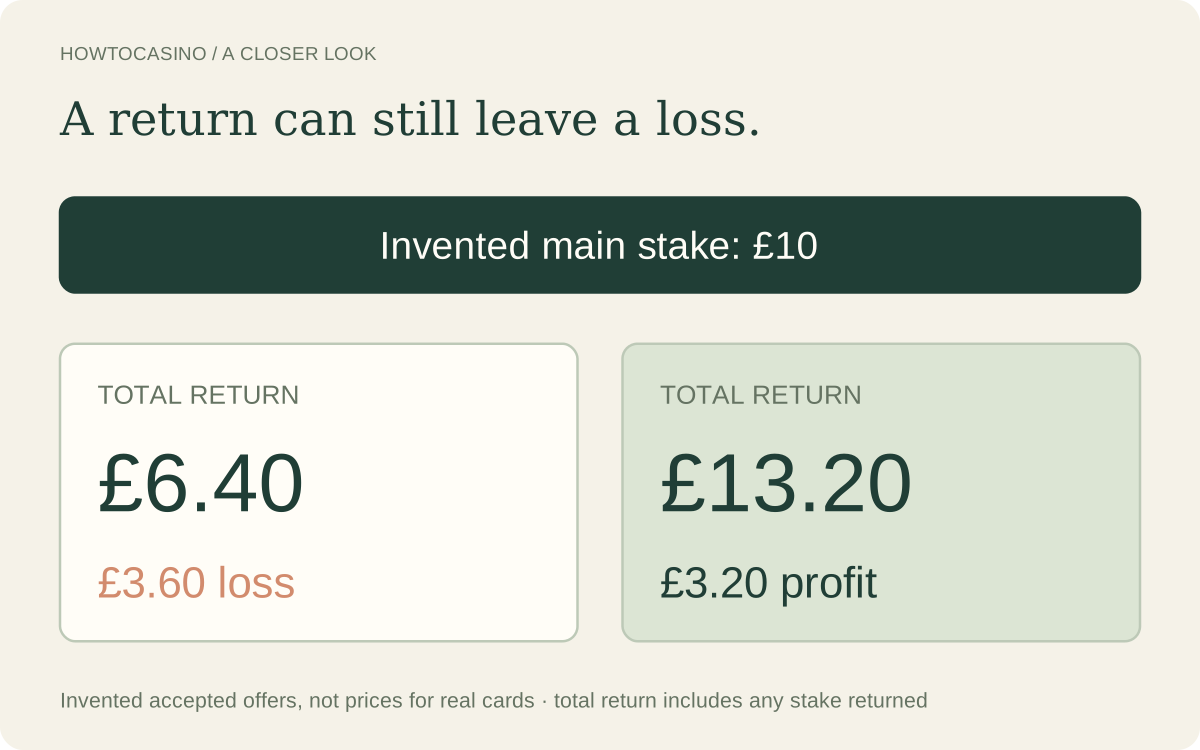
First establish whether the amount is total money returned or profit only. The examples here expressly use total return. They are invented accepted offers for a £10 main stake, with no side bets, additional hands, bonus, fees or rounding. They are not actual prices for any card combination.
| Invented total return accepted | Calculation against the £10 stake | Net main-hand result |
|---|---|---|
| £6.40 | £6.40−£10 | −£3.60 |
| £10.00 | £10−£10 | £0 |
| £13.20 | £13.20−£10 | +£3.20 |
A £6.40 return is not a smaller profit: it is a £3.60 loss against this stake. A £13.20 return is not £13.20 profit: £10 of the return recovers the original stake. If a screen uses another convention, establish its definition before applying the calculation.
Dividing the £13.20 total return by the £10 stake gives 132% of the stake returned. That cannot be read as a 132% probability of winning. A return ratio and an event probability are different quantities; a quoted settlement alone does not reveal all win, push and loss probabilities.
If several main hands or optional wagers exist, add the returns for the relevant completed record and subtract all money committed to it. Do not silently subtract only the original stake after adding a split or double. The split explanation shows how additional stakes change that base.
How is variable cash out different from surrender?
Conventional surrender gives up a hand for half the stake under a table’s stated conditions. On an eligible £10 stake, a half-stake surrender returns £5 and leaves a £5 loss. Early and late surrender describe timing relative to the dealer-blackjack procedure, rather than two sizes of variable offer.
| Mechanism | Example result on £10 | Important boundary |
|---|---|---|
| Accepted half-stake surrender | £5 returned; £5 loss | Only if that surrender rule and timing apply |
| Invented variable cash-out offer of £6.40 total | £6.40 returned; £3.60 loss | Not a universal entitlement for a particular hand |
| Ordinary completed push | £10 stake returned; no main-hand profit | A tie settled under the game rules, not an early offer |
| Ordinary 1:1 winning hand | £20 returned; £10 profit | Requires the eventual qualifying win |
| Ordinary losing hand | £0 returned; £10 loss | Not a cash-out settlement |
The ordinary outcomes illustrate what those terms mean; they are not the known future outcome of a hand for which an early offer appears. Naturals, special hands and side bets can have other settlements. Nor should an early-payout label be treated as proof that a conventional early-surrender option is available.
The existing surrender and push guides explain their separate rules. Keep a surrender chart tied to its stated deck, dealer and timing assumptions; it is not a paytable for a variable offer.
Does a certain payout mean a better expected result?
Accepting an available offer exchanges an uncertain remaining outcome for the specified settlement, subject to the feature’s rules and acceptance. That does not establish that the offer has the best mathematical expectation. A description such as locking in a return must still distinguish a loss from a profit.
Consider a wholly invented comparison, unrelated to real cards or a supplier’s offer table. A £10 main stake has modelled continuation outcomes of £20 returned with 40% probability, £10 with 10%, and £0 with 50%. These assumptions sum to 100%; they are not estimates for a named hand.
| Invented alternative | Expected total return | Expected net against £10 |
|---|---|---|
| Continue under the stated model | 0.40×£20+0.10×£10+0.50×£0=£9 | −£1 |
| Accept an invented £8.50 total offer | £8.50 certain settlement once accepted | −£1.50 |
The offer is 50p below the modelled expected total return, while removing uncertainty about that hand’s remaining result. The continuation still has a 50% losing branch; its £9 expected return is not a payment anyone receives as a guarantee. These invented probabilities cannot be inferred from an actual cash-out quote.
A basic-strategy chart assumes a specific rule set and available actions. It should not silently be extended to a new cash-out control or a different game’s RTP. No exact current GB cash-out strategy or universal return figure is established here. The basic-strategy explanation discusses how rule assumptions affect a comparison.
What should you check before relying on an early-payout label?
- Exact supplier, product and current table rules; a shared blackjack lobby is not proof that every feature applies.
- The point at which an offer becomes available, expires or changes, and how acceptance is confirmed.
- Whether the quoted amount is total return or profit, and precisely which hand or betting selection it settles.
- How other hands, split/double stakes, side bets, caps and any promotional conditions are treated.
- The round ID, accepted main stake, displayed offer and complete final settlement record if something appears inconsistent.
Do not treat an absent button as evidence of cheating or a universal right to a particular payment. It may concern a different game, jurisdiction, client setting or decision stage. Equally, an unexplained accepted settlement deserves a specific answer under the actual rules.
If the display and account history disagree, preserve both and contact the operator through its verified process. The general fairness guide separates outcome generation, settlement and account-payment disputes; a screenshot of an offer alone may not show that it was accepted.
Related questions
Is blackjack early payout the same as cashing out a casino balance?
No. An early main-hand settlement ends a specified betting position. A casino withdrawal moves an available account balance through a payment route. The feature name does not establish bank receipt.
Does a payout below my stake still count as profit?
No, if the figure is the complete return. An invented £6.40 return against a £10 stake leaves a £3.60 loss. Establish whether the screen quotes total return or profit before comparing amounts.
Is every early-payout offer half the stake?
No. Conventional surrender and a variable cash-out feature are different. A particular game’s offered amounts and eligibility must come from its own rules.
Can an offer divided by my stake tell me my chance of winning?
Not by itself. It is a return ratio; it does not reveal all continuation outcomes or the supplier’s complete pricing model. Do not treat 132% returned as a probability.
Does every GB blackjack table have cash out?
No universal availability is established. Products, jurisdictions and table settings differ; the dated public rule example here does not verify a current GB account feature.
Does accepting cash out also settle every side bet?
Do not assume so. The documented live-hand example concerns the main bet. Check each separately accepted wager and hand under the relevant rules.