Where do you find the minimum for a particular table?
Read the displayed limits and the named game’s help before committing a wager. Identify the currency and whether the minimum describes the main position, an optional side bet or another wager. A lobby title and a cashier deposit minimum are not a complete set of table rules.
For a dated public example, Betfred’s £1 Blackjack description, consulted on 30 October 2026, gives a £1 minimum, £50 maximum and a £5 maximum side bet. It does not establish the side minimum, an explicit combined-side basis or an all-round exposure cap. We have not loaded the game or tested account eligibility.
Those published figures illustrate why the fields need separating. They are not a promise that every Betfred game, live table, currency or account has that range, and not evidence that every GB table starts at £1. The example is described as a virtual-studio product; it is not our report of playing with a physical live dealer.
GB standards require accessible applicable rules and payout information before commitment. If the limit basis is unclear, ask the operator to identify the relevant rule rather than guessing from a page that describes another variant.
Which minimums and maximums need separate checks?
| Field | What to establish |
|---|---|
| Opening main minimum and maximum | Permitted amount on the stated main position |
| Each optional side wager | Its own permitted range and any main-bet requirement |
| Explicit combined limit | Whether a stated cap covers particular positions or the full layout |
| Paid action additions | Whether a permitted double/split fits the exact game’s stake and cap rules |
| Maximum win or payout | Amount, profit/return basis, scope and applicable period |
| Total Bet display | Which accepted positions or stages the displayed total includes |
Sky’s public Playtech Mega Fire Blaze Blackjack rules explicitly describe the lobby/table range as the main-position range. They say the main position, Dealer Pair, Player Pair and 21+3 have their own limits, and describe a separate maximum-win condition. That is an attributed example of distinct fields, not a numeric side-limit or payout-cap quote.
Do not add, multiply or transfer maxima unless the actual rules establish how they interact. A maximum for one position does not automatically permit the same amount on every other spot. Nor can this guide infer whether a displayed opening maximum includes or excludes later paid additions.
An opening-layout 2× control can increase a selected layout; an in-hand Double Down is a different action with its own rules. The same word double does not prove that both controls have the same cost or eligibility.
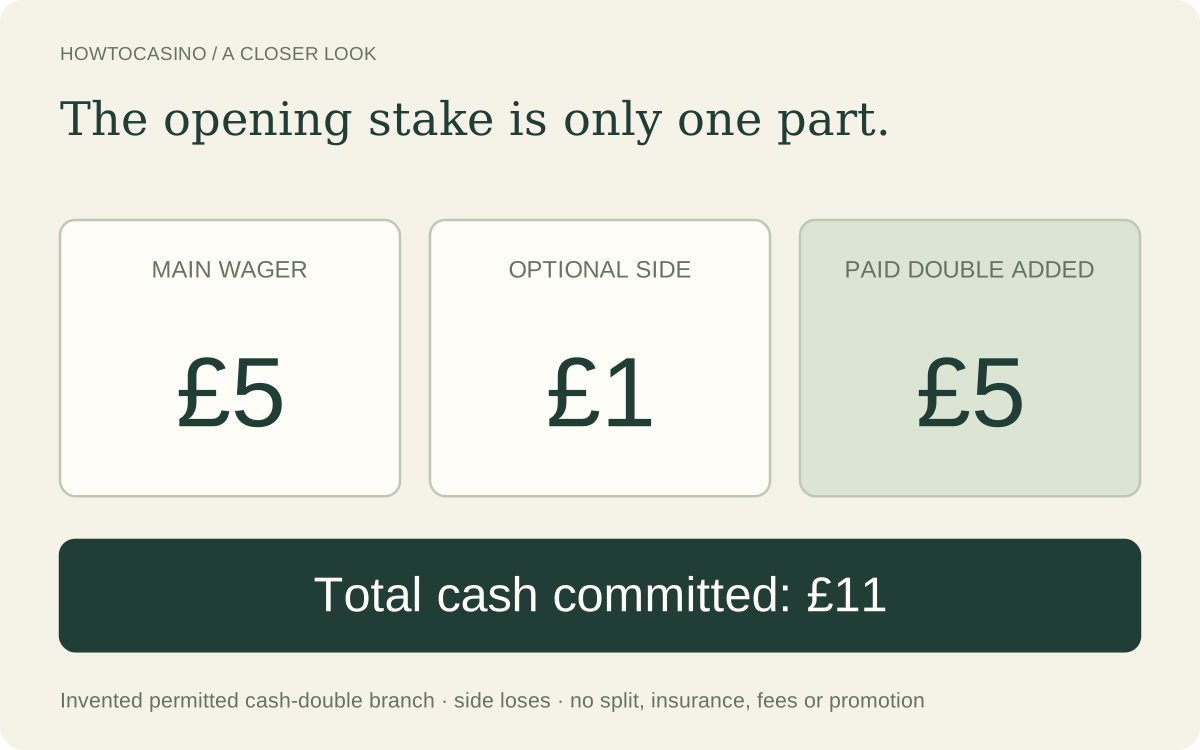
How can a £5 main wager commit £11 in one round?
Consider separate fictional conventional-cash branches. Each starts from a £20 cash balance, with a £5 main wager and one accepted optional £1 side wager that loses. Assume the stated actions are allowed, ordinary wins pay 1:1, returned totals include returned stakes, and there is no bonus, fee, re-split or double after a split. These amounts are not a real table offer.
| Separate branch and final result | Total cash committed | Cash returned | Net result | Ending balance |
|---|---|---|---|---|
| No additional action; main wins normally | £6 | £10 | +£4 | £24 |
| Paid double adds £5; doubled main wins normally | £11 | £20 | +£9 | £29 |
| Paid double adds £5; doubled main pushes | £11 | £10 | −£1 | £19 |
| Paid double adds £5; doubled main loses | £11 | £0 | −£11 | £9 |
| Paid split adds £5; one hand wins, one pushes | £11 | £15 | +£4 | £24 |
| Paid split adds £5; both hands win normally | £11 | £20 | +£9 | £29 |
| Paid split adds £5; both hands lose | £11 | £0 | −£11 | £9 |
In the winning double branch, the main wager contains £10 of player cash and returns £20. After including the lost £1 side bet, the overall gain is £20 − £11 = £9. The £20 credit is not £20 profit. A main-hand push can also leave an overall £1 loss because the side wager lost independently.
In the mixed split branch, one £5 hand returns £10 on its normal win and the other returns £5 on its push. The combined £15 return minus the £11 committed gives £4 profit. These are alternative branches; do not add their returns together.
Our double-down and split guides cover action eligibility and individual hand settlement. Here the purpose is to count the entire cash commitment, including a separate losing wager.
Can insurance change the cost without adding to the main bet?
Yes. In the cited standard GB help, insurance is separately settled and costs half the main stake when offered against a dealer ace. Use another branch of the fictional example: £5 main, £1 losing side wager and £2.50 insurance. Total cash committed is £8.50.
| Separate insurance branch | Total return | Overall net result from £8.50 committed |
|---|---|---|
| Dealer has blackjack; player has no natural | Insurance returns £7.50; main returns £0 | £7.50 − £8.50 = −£1 |
| Dealer has no blackjack; main later wins normally | Main returns £10; insurance returns £0 | £10 − £8.50 = +£1.50 |
At 2:1 profit odds, a winning £2.50 insurance wager makes £5 profit and returns its £2.50 stake: £7.50 total. In the first branch, that offsets the £5 main loss, but not the additional £1 lost side wager. Insurance does not turn every combined layout into a guaranteed break-even result.
The branches exclude further double or split payments and any player natural. They explain accounting, not when insurance is advisable or the probability of dealer blackjack. Our insurance guide covers that separate wager and its limitations.
Are table limits, deposit limits and payout caps the same?
| Different limit | What it measures |
|---|---|
| Table/position stake range | The permitted stake on the specified game position |
| Round cash commitment | All cash added across the relevant wagers and actions |
| Maximum win or payout | A rule limiting a stated result or total, under its defined basis |
| Account deposit limit | Money paid into the account during the defined period |
| Account stake or loss limit, where offered | A different period-based measure with its own definition |
| Cashier minimum | A deposit or withdrawal request, not the opening blackjack stake |
A table minimum does not specify a budget, the amount deposited or the most a session can lose. An available balance also does not create permission to exceed a personal or operator restriction. Account-limit availability and product scope need their own check; not every service offers every optional limit.
The age-based GB online-slot caps are not blackjack stake limits. UKGC’s guidance explicitly says that particular rule applies to online slots and excludes blackjack and roulette. This does not mean blackjack is free of all legal, operator or account restrictions.
The deposit-and-withdrawal minimums guide explains why a casino payment amount is a different field. Do not increase a protection limit or add funds merely because a selected table action would require more cash.
What should you check before relying on a table-limit figure?
- Confirm the exact provider/title, currency and current table or position.
- Read main, side and any explicitly combined ranges separately.
- Check the permitted paid actions, their additional cash and how maxima apply.
- Read any maximum-win/payout definition and applicable scope or period.
- Compare the accepted total with all separately settled wagers, keeping the actual ledger.
- Ask verified support about an unexplained limit or debit before placing another wager.
A single opening stake does not capture every variant. In Free Bet Blackjack, a qualifying funded component has different cash accounting from a conventional paid double or split. Do not apply this guide’s £11 cash example automatically to funded actions.
If the amount deducted or returned seems wrong, preserve the round ID, main and side stakes, extra actions, final result and applicable limit text. The question is which exact wager or cash addition produced the entry, rather than whether a generic headline said low stakes.
Related questions
Is £1 the minimum bet at every UK blackjack table?
No. A named public £1 product is one dated example, not a universal minimum. Check the specific game, currency and position’s displayed range and current rules.
Does the table minimum include optional side bets?
Do not assume it does. Named rules can give the main position and side wagers their own limits. Read any dependency or combined cap explicitly.
Does a £5 main stake limit the round cost to £5?
Not necessarily. In a conventional paid-action model, side wagers, doubles, splits or insurance can add cash when permitted. The fictional £5 main plus £1 side plus £5 double commits £11.
Can I double above the displayed maximum?
This guide has not established that permission. Check whether the exact maximum governs opening stakes, later additions or another defined total. Do not infer an exception from the name of the action.
Do the GB £2 and £5 online-slot caps set blackjack limits?
No. That particular guidance explicitly excludes blackjack and roulette. Blackjack still has the applicable table, operator, account and other requirements; this is not a claim that no restrictions exist.
Is a casino minimum deposit the minimum blackjack bet?
No. A cashier request and a game-position stake are different transactions. Read each field separately rather than using one amount as evidence for the other.