What does free mean in this blackjack variant?
The word refers to a funded component of a game action. It does not mean the opening hand is risk-free, that every double is funded, or that a casino has awarded a general promotional balance. This guide concerns the named blackjack variant, rather than a welcome offer or a no-deposit promotion.
Evolution’s current Classic product overview describes funded doubles on two-card hard totals of 9, 10 and 11, and funded splits of pairs other than tens and face cards. The detailed settlement examples here follow BetMGM UK’s public seven-seat, eight-deck Live Free Bet Blackjack help, consulted on 30 October 2026. That help warns that variants can differ.
The two descriptions corroborate those main eligibility rules. They do not prove which supplier build a particular person would load through an account. We have not opened a table or placed a bet. Read the exact game’s Help and Paytable before treating a general explanation as its complete rules.
| Component | Who supplies it in the example? | What can be returned? |
|---|---|---|
| Original £10 wager | The player’s cash balance | The stake and any applicable cash profit |
| Eligible £10 Free Bet component | The game funds it under its rules | Cash profit if it wins; the free stake is not paid back |
| Optional separate side bet | An additional wager, if chosen | Its own paytable outcome, separate from the main hand |
For the ordinary actions without funded components, see our explanations of double down and splitting. A paid action can require extra cash; a funded action changes that accounting.
How does a £10 free double settle?
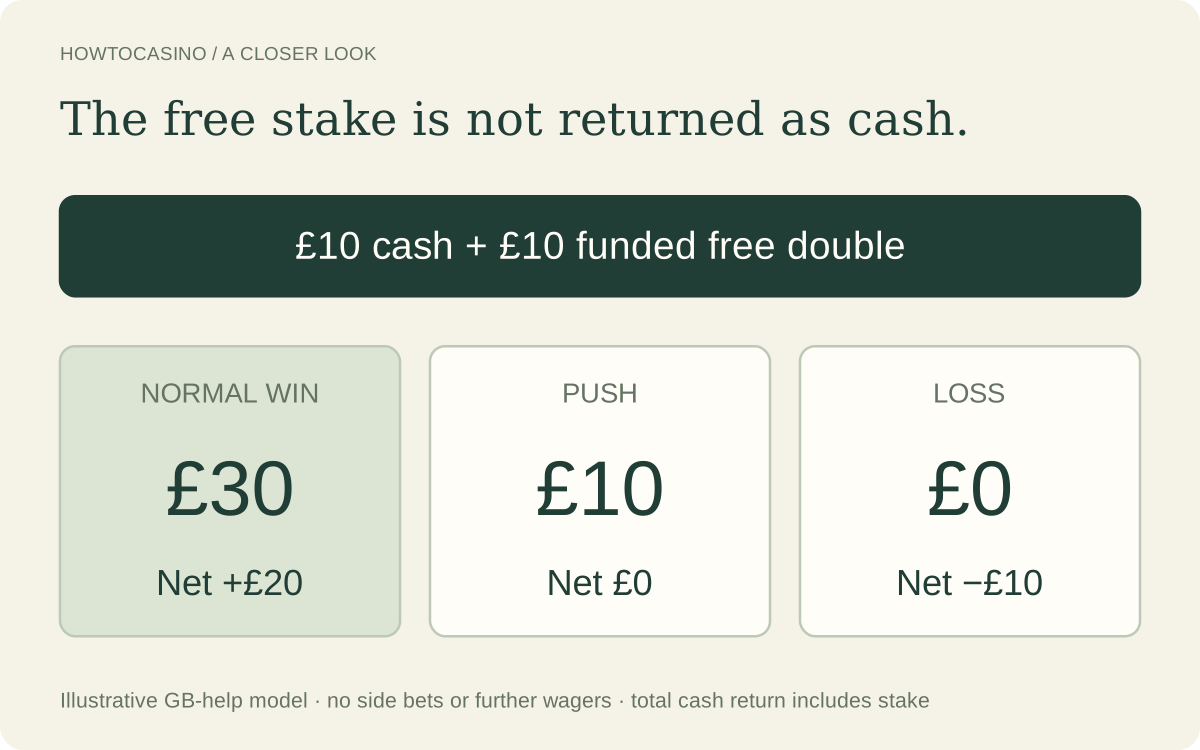
Assume a qualifying two-card hard 11, a £10 original cash wager and an eligible £10 free double. Hard means the total does not count an ace as 11. The funded component adds no further player cash in this example, and the double receives one additional card. It does not double the value of the cards.
| Final main-hand result | Cash credited after settlement | Net change from the original cash stake |
|---|---|---|
| Normal winning double | £30: £10 original stake + £10 profit on it + £10 funded-component profit | +£20 |
| Push | £10 original cash stake only | £0 |
| Loss | £0 | −£10 |
The normal winning hand is credited £30, not £40: there is no £10 cash refund for the funded stake. Nor is the £30 credit all profit, because £10 of it was the player’s original money. These figures exclude insurance, other side bets, later actions and any promotion.
Check the actual control. The GB help distinguishes buttons labelled Free from ordinary action buttons. A hard total outside the funded eligibility, a soft total or an ordinary paid double must not be assumed to carry the same cash exposure. The exact table may offer a different set of actions.
How do cash-funded and free-funded split hands differ?
In the documented free split, the original cash funds one hand and the game funds the other for the same amount. They settle separately. A winning free-funded hand pays its win amount without refunding a funded stake; its push does not return a cash stake either.
| Hand funded by £10 | Normal win: cash credited | Push: cash credited | Loss: cash credited |
|---|---|---|---|
| Player’s original cash | £20 | £10 | £0 |
| Free Bet component | £10 | £0 | £0 |
Suppose the original £10 cash hand loses and the free-funded hand wins normally. The combined cash credit is £10, so the player breaks even against the £10 opening stake. If both win normally, £20 + £10 = £30 is credited, giving £20 net profit. If the cash hand wins and the funded hand pushes, the credit is £20 and the net profit is £10.
The same visible result word can therefore have different accounting: a push returns an existing cash stake, while a free-funded push does not create a new cash entitlement. The GB example also gives split aces only one additional card each. Do not assume that drawing 21 after a split is automatically an original two-card natural with the premium payout.
Re-splitting and doubling after a split need a separate rule check. The public GB help used here does not establish their complete limits. A rule from another provider, an old PDF or a similarly named table cannot fill that gap automatically.
Why does the dealer-22 rule matter?
Under this model, an unbusted main hand ordinarily pushes when the dealer finishes on 22. In conventional blackjack, a dealer bust would normally lose against a surviving player hand. The altered result is an important part of the variant, not a cosmetic change.
| Position when the dealer reaches 22 | Treatment in this model |
|---|---|
| Unbusted cash-funded main hand | Push: the relevant cash stake returns, without normal win profit |
| Free-funded split hand that survives | Push: no free stake is refunded as cash |
| Player hand already over 21 | The hand has already lost; dealer 22 does not rescue it |
| Qualifying original natural blackjack | Settles under the natural-blackjack rules before a later dealer-22 possibility |
| Separate side bet | Uses its own winning conditions and settlement |
A £10 cash hand standing on 20 therefore returns £10, rather than the £20 total return of a normal even-money win, when this dealer-22 rule applies. This example illustrates settlement only; it is not an estimate of how often 22 occurs or an argument that another bet is due to win.
The published GB model pays qualifying winning naturals at 3:2 and pushes two naturals. It does not say that every hand totalling 21 earns 3:2. Our payout guide explains the difference between profit, stake return and total credit.
Are Classic, Infinite and Pot of Gold the same rules?
No. Treat the complete provider and game title as part of the rules. Evolution names Classic and Infinite separately. Pragmatic Play’s current Free Bet Blackjack description explicitly includes qualifying funded doubles after a split. That is enough to show why a blanket statement that every Free Bet game forbids that action would be wrong; it does not establish personal GB availability.
Pot of Gold is a separate side-wager concept in some Free Bet rule sets, associated with funded-bet markers collected during a round. The Pennsylvania rule cited below documents one land-based regulatory model. It is not GB law, and its paytable or split limits cannot be imported into an online GB table.
Pot of Gold is not established by the principal GB help used for our worked examples. That help names Perfect Pairs and 21+3 instead. Check the exact table before assuming a named side bet is present. An optional side bet needs a separate stake and paytable; its presence does not change what the original cash and funded main components mean.
- Full provider, title and rule/help version, where shown.
- Eligible hard totals and pairs; whether each offered action is cash-paid or funded.
- Re-split, double-after-split and split-ace restrictions.
- Dealer-22 exceptions, natural payout and dealer soft-17 rule.
- Separate side bets, stake units and their exact paytables.
Does the free funding remove the house edge?
No such conclusion follows from the funded component. A comparison must include the altered dealer settlement and every other applicable rule. The current sources used here do not establish one numeric RTP or house edge for all named Free Bet variants, so this guide does not assign a universal percentage.
A conventional basic-strategy chart is not automatically a chart for this variant. A useful recommendation must specify the exact game model and available actions; it must also distinguish a funded decision from one requiring extra cash. A generic claim that the free option always makes a game better leaves out the settlement differences.
If a recorded payment looks wrong, preserve the hand/round ID, original cash stake, funded components, final totals, natural or split status and each separate side bet. Ask the operator for the rule and cash calculation that produced the credit. A funded stake not being refunded can be correct; an unexplained mismatch still needs a specific answer.
For the complaint process after an unresolved financial discrepancy, use the unpaid-winnings guide. Do not place another bet merely to reproduce the issue.
Related questions
Is Free Bet Blackjack a no-deposit bonus?
The named variant funds particular eligible doubles and splits within a hand. The opening cash wager remains at risk. That is different from a promotional free-bet or no-deposit offer, which has its own terms.
Does a winning £10 free double return £40?
Not in the documented example. A £10 original cash stake plus a £10 funded component returns £30 on a normal win: £10 original stake and £20 combined profit. The funded £10 stake is not refunded.
Does dealer 22 push every bet?
No. In this model it pushes surviving main hands. Already-busted hands still lose, a qualifying natural settles before a later dealer 22, and side bets follow their own rules.
Can you double after a free split?
It depends on the exact variant. The principal public GB help does not specify the complete limit. Pragmatic Play describes qualifying funded doubles after a split in its own named game, so do not apply a universal ban.
Does a free-funded split hand return money on a push?
No funded stake is refunded as cash in the documented GB model. The original cash-funded hand has different accounting: its relevant cash stake returns on a push.
Is Pot of Gold on every Free Bet Blackjack table?
No. It is a separate side-wager feature in some rule sets. The principal GB help used here names other side bets and does not establish Pot of Gold availability. Read the exact game rules.