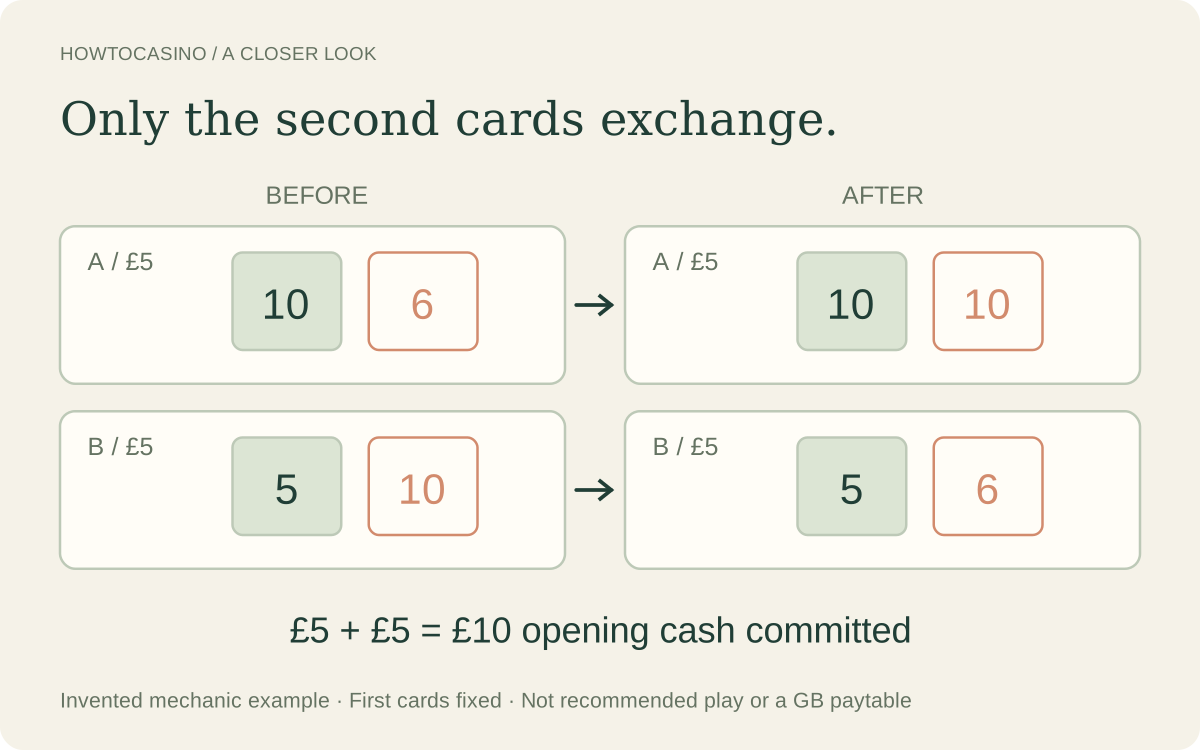
Which cards can be switched?
The casino variant starts with two hands and equal opening stakes. The switch exchanges the second card of one opening hand with the second card of the other. It does not exchange dealer cards, merge the hands, change all four cards or give a cost-free second wager.
| Invented opening hand | Before exchange | After exchanging second cards |
|---|---|---|
| Hand A, fictional £5 stake | 10 first, 6 second: total 16 | 10 first, 10 second: total 20 |
| Hand B, fictional £5 stake | 5 first, 10 second: total 15 | 5 first, 6 second: total 11 |
| Combined initial cash committed | £5 + £5 = £10 | Still £10 before any paid action |
This rearranges the same four cards. It does not establish the best decision against a particular dealer card or predict either result. The card-values guide explains the totals; subsequent play and settlement need their own rules.
This page concerns casino Blackjack Switch, not the British shedding card game sometimes called Switch or Black Jack. For the basic casino objective and hand sequence, start with the blackjack guide.
Which rule model do these examples use?
The worked settlements use Loto-Québec’s public Blackjack Switch rules, a Canadian land-based educational model consulted on 30 October 2026. No revision date was established. Fictional pounds are arithmetic units, not a currency conversion, a stake recommendation or evidence of a current GB table.
In that model the exchange precedes other actions and is available only if the dealer has no blackjack. A switched ace plus ten is soft 21, not a natural. The document allows the table to specify either of two dealer soft-17 policies; do not assume one universal H17 rule.
A current public Paddy Power description names Playtech Blackjack Switch, but its linked detailed Game Help was inaccessible during this research. It establishes a public description, not the exact current GB treatment of switched naturals or a played-account result. A separately named Red Rake product likewise does not establish its current GB deployment.
We therefore do not label the Canadian model as today’s Playtech GB rules or combine it with a different supplier’s chart. The full help for the exact game must answer any rule or version question before its outcome is inferred.
Does every dealer 22 mean all bets are returned?
No. In the chosen model, dealer hard 22 pushes surviving ordinary main hands, including switched soft 21. An original natural remains a winner against a non-blackjack dealer. An already-busted player hand loses; the later dealer total does not revive it. Separate optional wagers have their own settlement.
| Player hand in the chosen model | Against dealer hard 22 | Why the distinction matters |
|---|---|---|
| Ordinary surviving total, including multi-card 21 | Push | Returns that main stake; no profit |
| Ace + ten obtained by switching | Push | It is soft 21, not an original natural |
| Original unswitched natural | Wins at the assumed 1:1 general price | The natural exception remains distinct |
| Busted hand over 21 | Loses | Later dealer 22 does not refund it |
A switched two-card 21 and an original natural can therefore have the same points but different settlement status. Do not carry an ordinary 3:2 blackjack assumption into these calculations; the chosen general price is 1:1. The payout guide explains why the quoted odds and stake return both matter.
Push means that the affected stake returns without profit. It does not mean the whole round broke even if another hand or optional wager lost. The push guide explains the individual-bet distinction.
What happens to two £5 stakes in a round?
These are independent fictional settlement cases under the stated model and assumptions. Start with £5 on each main hand, so opening cash committed is £10. Total returned includes any returned stake; net result subtracts all cash committed.
| Two-hand outcome | Cash committed | Total returned | Net result |
|---|---|---|---|
| Two ordinary hands push to dealer 22 | £10 | £5 + £5 = £10 | £0 |
| Original natural wins; ordinary hand pushes to dealer 22 | £10 | £10 + £5 = £15 | +£5 |
| Switched A+10 and ordinary hand both push to dealer 22 | £10 | £5 + £5 = £10 | £0 |
| One hand busts; other pushes to dealer 22 | £10 | £0 + £5 = £5 | −£5 |
| One ordinary hand wins at 1:1; other loses | £10 | £10 + £0 = £10 | £0 |
| Both ordinary hands win at 1:1 | £10 | £10 + £10 = £20 | +£10 |
A winning £5 wager at 1:1 returns £10, made up of £5 stake and £5 profit. If the other £5 wager loses, the combined round is even. Describing only the winning hand would hide the loss on the second stake.
These totals exclude every paid double, split, insurance or side wager. Once another cash stake is added, £10 is no longer the total exposure. Reconcile all bets rather than subtracting only the initial stake from the final receipt.
Do doubles, splits and optional wagers cost more?
In the chosen model, eligible doubles and splits require extra equal cash stakes. They are not supplier-funded Free Bet tokens. A two-card double takes one final card; the document permits double after split except split aces. Split aces have their own one-card restriction. These are model rules, not a general permission for every product.
| Independent fictional cash path | Extra cash beyond £10 opening | Total cash committed |
|---|---|---|
| Double one £5 hand | £5 | £15 |
| Split one £5 hand once | £5 | £15 |
| Split one £5 hand once, then double one eligible resulting hand | £5 + £5 | £20 |
| Add a fictional £1 optional wager only | £1 | £11 |
The £20 path contains four £5 cash units: two opening stakes, one split addition and one double addition. It assumes that particular action is eligible. It does not infer the maximum possible hands, a casino limit or a recommended sequence.
The double and split guides explain added-stake accounting. The Free Bet guide covers a different variant; its token funding and exceptions must not be imported into Switch.
Optional wagers also vary by product. The Québec document describes Buster, while the separate Seminole and public Paddy Power descriptions name Super Match. Those events and prices are not interchangeable. This page does not insert a Super Match paytable into the chosen Québec model or assume the main-hand result settles the side wager.
A separate £1 loss would reduce an otherwise even £10 main-hand round to a £1 net loss: £10 returned minus £11 committed. Optional stakes increase exposure; they do not repair the main-game rules. The side-bet guide explains separate-event settlement.
What should a GB reader check in the exact game help?
- Exact title, supplier, game-help version and availability for the relevant GB service.
- Two-hand stake basis and whether the displayed limit is per hand or combined.
- Exchange timing and whether switched ace-plus-ten is an ordinary 21 or receives special treatment.
- Natural payout, dealer-22 exceptions and dealer soft-17 rule.
- Paid-action permissions, split restrictions and any fees or payout overrides.
- Separate optional wagers, events, prices and cash costs.
If a public summary omits a detail, do not fill it with another jurisdiction’s terms. Keep the round identifier, wager amounts, cards and applicable help if asking support to explain an existing settlement. This guide has not opened an account, placed a bet or tested an operator’s cashier.
There is no universal RTP, house edge or optimal switch decision calculated here. A percentage or chart needs an identified complete rule set and decision assumptions. The strategy and odds guides explain those dependencies; merely improving one visible total does not prove the best combined decision.
You do not need to fund a round to compare the published rules. If the exact model remains unclear, keep the uncertainty rather than using a generic example as a personal outcome prediction.
Related questions
Is the second hand free in Blackjack Switch?
No. The described opening mechanic uses two equal cash stakes. Two fictional £5 bets commit £10 before any paid double, split or optional wager.
Can you switch any two cards?
The described mechanic exchanges the second card of each opening player hand. It does not exchange first cards or dealer cards. Exact timing and permitted actions need the current game rules.
Does a switched ace and ten count as blackjack?
In the chosen Loto-Québec model it is soft 21, not a natural. Do not assume that establishes the current rule for every provider or GB game build.
Does dealer 22 return a busted player stake?
Not in the model used here. A busted hand loses. Dealer hard 22 pushes surviving ordinary hands, while the original-natural exception remains separate.
Do Blackjack Switch doubles and splits use free tokens?
The chosen model requires extra cash for eligible doubles and splits. Free Bet Blackjack is a different variant with its own funding and settlement rules.
Are these verified current UK Playtech rules?
No. The worked examples are a clearly identified Canadian educational model. The public GB Playtech description was read, but its detailed linked help was inaccessible, so current GB switched-natural treatment was not established.