Which Lightning Dice game does this explain?
This is Evolution’s live three-dice game with the transparent Lightning Tower. It is different from Lightning Roulette and from the mobile game Random Dice. Evolution’s current overview lists numbered totals plus Low, High, Any Double and Any Triple; older guides may describe only the numbered layout.
Sic Bo also uses three dice, but its bet definitions and exceptions must be read separately. For example, do not transfer a Sic Bo Small or Big rule to a Lightning Dice Low or High spot just because the boards look similar.
The numbered payouts below use published operator rules. The side-bet definitions are cross-checked against theScore Bet’s public Help, which is a foreign reference with dated screenshots. This explains the rules and arithmetic; it does not confirm your casino’s current installation, limits or access.
What happens between the bet and the result?
- During the betting window, an accepted chip backs the specific spot on which it is placed. The round’s total stake is the sum of all accepted bets.
- After betting closes, lightning selects bet spots. Evolution’s current description says two to four spots receive boosts.
- The host releases three six-sided dice through the tower. Add their final face values to obtain the numbered total.
- Check each backed spot against that result. A struck spot elsewhere on the board does not give your bet its multiplier.
- Settle winning bets at their applicable ordinary or boosted return, then compare the money credited with everything staked in the round.
A lightning selection and a winning dice result are separate conditions. If you backed total 10 and lightning struck 18, a result totalling 10 is an ordinary win on your 10 bet. If the dice instead total 18, your 10 bet loses even though another position carries a large award.
What do Low, High, Any Double and Any Triple mean?
| Bet | Winning condition in the published reference | Important boundary |
|---|---|---|
| Numbered total | The three faces add to that exact number, from 3 to 18. | A 10 bet does not win on 11. |
| Low / High | Low covers totals 3–9; High covers 12–18. | Totals 10 and 11 match neither. |
| Any Double | Exactly two dice have the same face. | A triple loses this bet. |
| Any Triple | All three dice show the same face. | It is a separate bet from Any Double. |
For example, dice 2, 2 and 2 total 6. In that reference layout the result matches Total 6, Low and Any Triple, but fails Any Double. You would still need an accepted bet on each relevant position to receive its award. The dice do not create bets for you.
The definitions above identify outcomes, not a promise that every matching spot receives a lightning award. The boost must be assigned to the particular winning position. Check the current Help if your board has different labels or conditions.
Does 4:1 mean the same thing as a 5× return?
Yes, when 4:1 describes profit odds and the original winning stake is returned. On a 20p winning bet, 4:1 pays 80p profit plus the 20p stake, giving £1 credited. A 5× total return gives the same £1. The two displays use different units.
| Numbered total, each separately | Ordinary profit odds in the published paytable | Total return per winning £1, stake included |
|---|---|---|
| 3 or 18 | 149:1 | £150 |
| 4 or 17 | 49:1 | £50 |
| 5 or 16 | 24:1 | £25 |
| 6 or 15 | 14:1 | £15 |
| 7 or 14 | 9:1 | £10 |
| 8 or 13 | 6:1 | £7 |
| 9 or 12 | 5:1 | £6 |
| 10 or 11 | 4:1 | £5 |
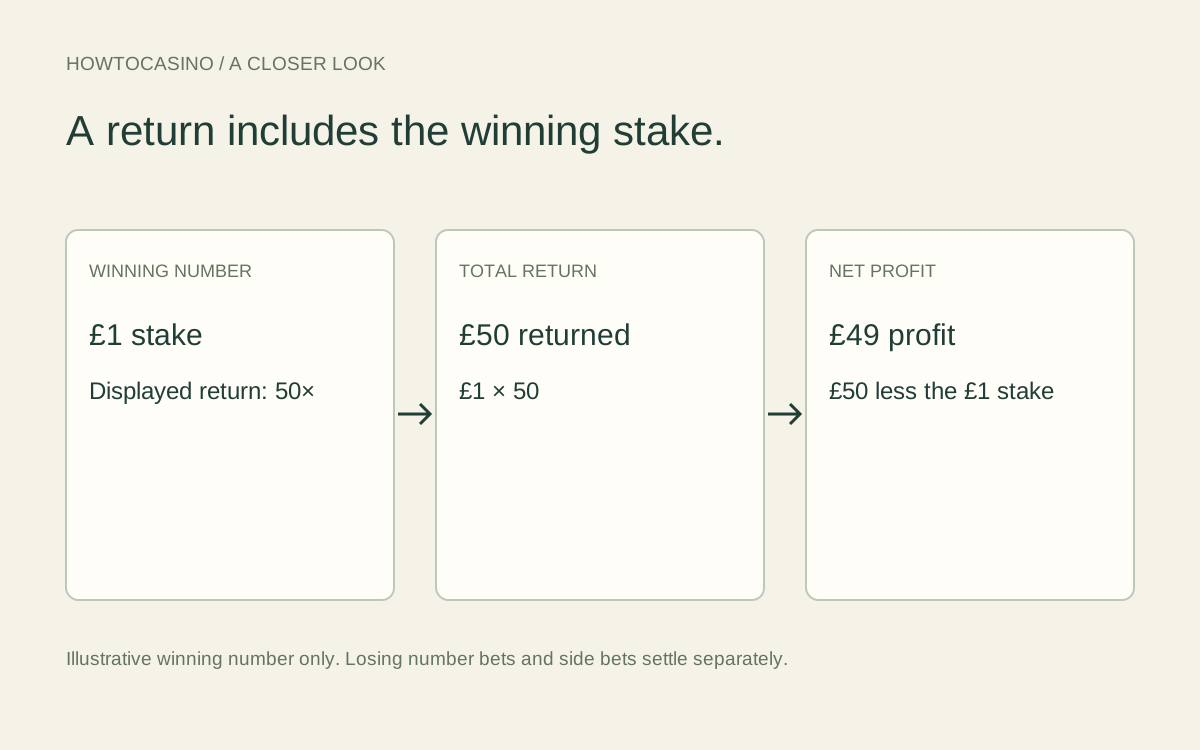
Paddy Power explains that a lightning return replaces the standard prize. Suppose a winning 20p bet on total 10 has a displayed 50× total return. That gives 50 × £0.20 = £10 credited, equivalent to £9.80 profit on that one bet. It is not the ordinary £1 return multiplied by 50, and it is not £10 plus another £1.
These are hypothetical stakes applied to the published conventions, with no cap, fee, rounding or currency adjustment assumed. If a statement instead quotes profit odds, add the winning stake once. A labelled total return already includes it; adding it again would overstate the credit.
The general odds and house-edge guide explains the difference between profit odds, total return and the chance of winning.
Can Bet on All win a bet but lose money overall?
Yes. Bet on All Numbers backs all sixteen numbered totals. At an assumed 20p per total, the round costs 16 × £0.20 = £3.20. A winning numeric bet is present, but its return can be smaller than that £3.20. This example excludes side bets, refunds, caps and rounding adjustments.
| Assumed result and award | Money credited | Net result after the £3.20 total stake |
|---|---|---|
| Total 10, ordinary 5× total return | £0.20 × 5 = £1.00 | £1.00 − £3.20 = £2.20 loss |
| Total 5, ordinary 25× total return | £0.20 × 25 = £5.00 | £5.00 − £3.20 = £1.80 profit |
| Total 10, assigned 50× total return | £0.20 × 50 = £10.00 | £10.00 − £3.20 = £6.80 profit |
Only the chip on the winning total receives that numbered award. The other fifteen chips still form part of the round’s cost. Multiplying a 50× award by the whole £3.20 would wrongly apply it to losing positions.
The numeric button does not also cover Low, High, Any Double and Any Triple. A separate accepted side bet would add another stake and its own settlement. Read the Total Bet amount rather than assuming that one button represents one chip.
Are 3 and 18 as likely as 10 and 11?
No. For three independent fair six-sided dice there are 6 × 6 × 6 = 216 equally likely ordered outcomes. Only 1,1,1 totals 3, giving 1/216, about 0.463%. There are 27 ordered outcomes totalling 10, giving 27/216 = 12.5%. Total 18 mirrors 3, and 11 mirrors 10.
Backing both 10 and 11 covers 54/216 = 25% of outcomes under that model and costs two bets. This is the probability of matching one of those totals, not a claim about the chance of a particular lightning award or a recommendation to use the layout.
A total’s ordinary payout and dice probability do not establish the full game RTP. That calculation also needs the probabilities and sizes of lightning awards for the relevant bet. Operator pages quote different headline RTP figures and scopes, so use the exact table’s current Help rather than treating an old maximum as a universal figure.
A run of results on the history board records previous rolls. Under the independent fair-dice model, a long absence of 3 does not make its next-roll probability greater than 1/216. A tracker cannot turn the displayed maximum prize into a due payment.
What should you keep if a result appears wrong?
- The exact game name, casino domain and round ID.
- Every accepted bet spot and amount, plus the round’s Total Bet.
- The final three dice faces and the assigned lightning positions.
- The payout readout, whether it means profit odds or total return, and the amount credited.
- The Help version, applicable limits, and any cancellation or error notice.
A short clip of a struck number may omit whether that position was backed, whether the dice matched it or whether the round was cancelled. The payout-dispute guide explains how to put a precise settlement question to the operator.
Research note: these are public supplier and operator documents checked on 5 November 2026. We did not open a gambling account, place a bet, test a withdrawal or verify a live GB table. The foreign Help reference and older numbered-only pages establish the stated reference rules, not current GB eligibility, a universal RTP or today’s money limits.
Related questions
Does lightning change the total shown by the dice?
The boost selects a betting position and its award; the final dice faces establish the result. A high multiplier on a position that fails its winning condition does not pay that position.
Does a 1,000× maximum apply to every bet?
No. A headline maximum is not the return on every winning spot or every round. The applicable paytable, selected boost and any limits determine the award. A large potential return is also different from its probability.
Is Bet on All a guaranteed profit?
No. It places separate chips on all sixteen numbered totals. The return on the matching chip can be smaller than the combined cost, as the £3.20 example shows.