How many cards are in one, two, four, six or eight decks?
In the standard-pack models here, one deck contains 52 playing cards: four suits, with 13 ranks in each suit. Combining decks multiplies the card inventory. It does not turn every card into a different rank or suit.
| Standard decks | Total playing cards | Aces | Ten-value cards: 10, J, Q, K |
|---|---|---|---|
| 1 | 52 | 4 | 16 |
| 2 | 104 | 8 | 32 |
| 4 | 208 | 16 | 64 |
| 6 | 312 | 24 | 96 |
| 8 | 416 | 32 | 128 |
For D complete standard decks, the totals are 52D cards, 4D aces and 16D ten-value cards. The fresh proportion of aces remains 1/13 and the proportion of ten-value cards remains 4/13. A different deck count does not change those starting ratios.
Special variants can specify a different card inventory. Do not multiply by 52 until you have checked what the particular game calls a deck. The standard 52-card forms described here exclude jokers.
This table counts cards in the game’s complete inventory. It does not say how many cards you receive. Conventional player hands start with two cards and can change through the permitted actions. The beginner blackjack guide explains the round; the card-values reference explains how to total the cards you hold.
What is a shoe, and what triggers a shuffle?
A physical dealing shoe holds the cards used to supply a game. In a finite-shoe model, cards leave the active inventory as rounds are dealt. Discards remain out of that inventory until the specified reset or recycling procedure returns them.
A cut card is a marker rather than an additional playing card in the 52D count. It can trigger a shuffle or replacement shoe. The game procedure determines the trigger and how the current round is handled. Seeing a marker is not evidence that every table deals the same fraction of its cards.
| Published procedure | What it describes | What you still need to establish |
|---|---|---|
| Complete decks reset before each hand | A new full inventory for the next hand | Deck count and within-hand dealing rules |
| Continuing shoe with a cut card | Rounds can share a depleted inventory until the reset | Actual cut-card and round-completion procedure |
| Batch shuffler prepares another shoe | The next batch is prepared while the current one is used | When the shoes are exchanged |
| Continuous shuffling | Returned cards are recycled during ongoing play | The actual return and mixing procedure |
An automatic machine can shuffle a complete batch for later use. That alone does not make it a continuous shuffler. Equally, a live camera does not tell you whether the active inventory continues unchanged between hands. Those details belong in the exact game procedure.
What do published GB game rules say about decks?
PokerStars UK Classic specifies eight 52-card decks shuffled before every hand. Premium specifies four 52-card decks shuffled at the start of each hand. Those examples show why the number of decks and the reset frequency are separate fields.
BetMGM UK’s standard Live Blackjack help describes up to eight standard 52-card decks. Its shuffle section describes play continuing until a cut card, followed by a dealer or machine shuffle; a separate shuffle table can prepare a second shoe. The page also directs readers to check each variant’s own Help and Paytable.
These are dated readings of the public documents, consulted on 30 October 2026. They establish what the documents describe, rather than a tested account, a lobby-wide inventory or a measurement of the shoe currently on camera. Other products can use other arrangements.
The Gambling Commission’s rules guidance lists deck numbers and shuffle frequency among the information relevant to virtual card games. Look in the game’s information panel for both. If a generic overview and the selected table disagree, ask the operator to identify the applicable rules.
How can two identical-looking cards appear in blackjack?
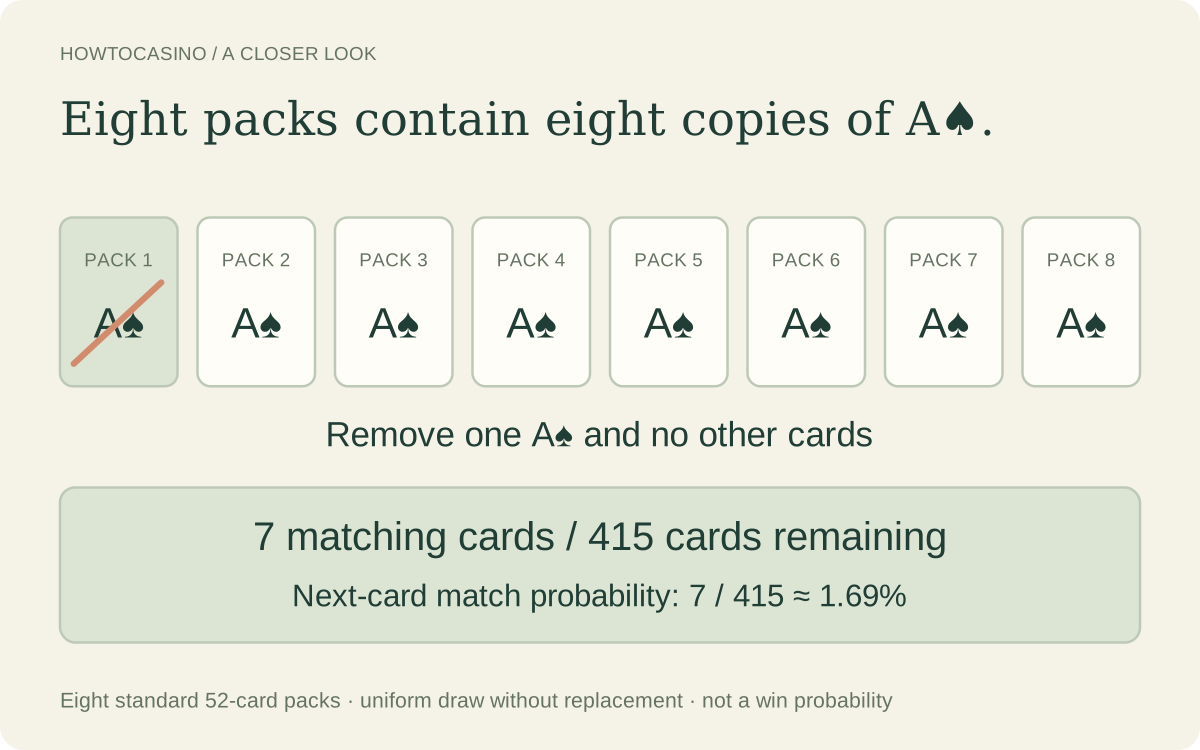
Every complete standard pack contains an ace of spades. An eight-deck inventory therefore contains eight separate copies of that card face. Two copies appearing in a multi-deck game can be consistent with the published inventory.
For a deliberately limited calculation, start from D complete standard decks. Observe and remove one ace of spades, with no other removals. If the next card is selected uniformly from the remainder, D−1 cards have that same rank and suit among 52D−1 remaining cards.
| Complete decks before removal | Matching faces left after one A♠ | Next-card probability |
|---|---|---|
| 1 | 0 of 51 | 0% |
| 4 | 3 of 207 | Approximately 1.4493% |
| 8 | 7 of 415 | Approximately 1.6867% |
This calculation concerns the immediately next card in the stated model. It is not the probability of winning a hand or receiving a natural blackjack. Same rank and suit also differs from same rank alone: after an ace of spades leaves four decks, 15 aces of any suit remain, but only three are aces of spades.
A matching face alone cannot prove that a game is fair, either. Compare the observation with its actual inventory and procedure. Keep the game and round reference if you need the operator to investigate an apparent inconsistency.
What does deck penetration mean?
Deck penetration describes how much of an inventory is dealt or removed before a reset, under the definition being used. It should identify its denominator and which cards are counted. The cut-card marker itself is not a playing card.
Suppose an invented eight-deck shoe starts with 416 playing cards and resets after 312 playing cards have left it. The fraction used is 312/416, or 75%, leaving 104. If some removed cards were burned or otherwise unseen, the fraction used is greater than the fraction whose identities an observer recorded.
That example does not establish the penetration of a named GB table. The number of rounds is not a substitute for a card count: hands can consume different numbers of cards, and more players can change how quickly a continuing shoe is used.
Our online card-counting explanation examines the information a continuing shoe can preserve and the separate question of operator permission. A penetration percentage alone establishes neither a profitable method nor permission to use an external aid.
Do fewer decks mean a better overall game?
Deck count changes some conditional probabilities, even though the complete-pack rank proportions remain the same. After a known card is removed, the denominators and remaining copies differ. Whole-game expected return also depends on payouts, dealer rules, permitted doubles, splits and other conditions.
A comparison between a single-deck table and an eight-deck table must therefore retain the rest of each rule set. A 3:2 natural payout and a 6:5 payout are different terms; so are standing and hitting on soft 17. A deck label cannot replace that comparison.
The blackjack odds guide separates natural frequency from winning a hand and whole-game return. Our basic-strategy explanation shows why a chart needs the correct rule profile.
- Read the exact game and variant name.
- Record the cards per deck, number of decks and shuffle trigger.
- Check the main payouts and dealer/extra-stake rules.
- Keep the help version or round reference when asking about a discrepancy.
These checks support an explanation of the game. They are not a recommendation to increase a stake, change accounts or treat a particular deck count as a winning guarantee.
Related questions
How many cards are used in blackjack?
The question can mean the whole inventory or one hand. Standard complete decks contain 52 cards each; eight contain 416. A conventional player hand starts with two cards and can receive more through permitted actions.
Do all UK online blackjack games use eight decks?
No single count applies to every variant. The published GB examples here include four- and eight-deck games; read the exact game rules.
Are jokers included in the card totals?
The standard 52-card models in this guide exclude jokers. A special variant with a different inventory needs its own count and rules.
Does an automatic shuffler mean continuous shuffling?
Not necessarily. A machine can prepare the next complete batch while another shoe remains in use. Continuous recycling is a different procedure.
Can the same rank and suit appear twice?
A multi-deck inventory contains several distinct copies of each card face. That can make repeated rank-and-suit faces consistent with the rules; the observation alone does not certify the game.
Does 75% penetration mean a 75% chance of winning?
No. In the invented example it means 312 of 416 playing cards have left the active shoe before its reset. It is a fraction of an inventory, not a hand-winning probability.