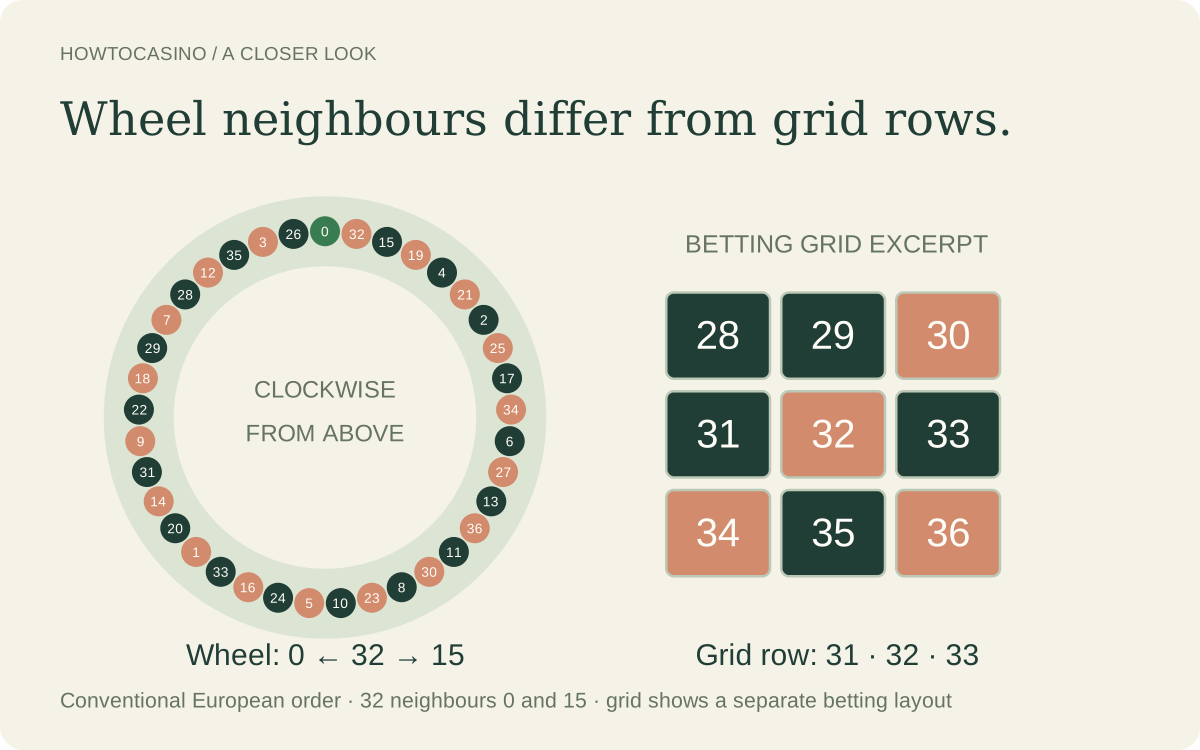
Why is the wheel order different from the betting layout?
The wheel is a circular sequence of labelled pockets. The betting layout groups numbers so that a stake can identify a single number, a shared border or a defined group. Reading one as a picture of the other gives the wrong neighbours.
For example, the numbered grid row containing 32 also contains 31 and 33. On the conventional single-zero wheel, 32 sits between 0 and 15. A bet described by a section of the wheel can therefore cover numbers spread across the numbered grid.
The sequences here are read clockwise when looking down at the wheel. The choice to start listing at 0 fixes a reference point in a circle; it does not make 0 the first result or describe the direction of ball travel. A mirrored picture or a list read anticlockwise will look reversed.
The beginner roulette guide explains the order of play. The inside/outside reference covers betting-grid placement, covered outcomes and the cost of multi-chip groups.
What is the conventional single-zero wheel order?
Starting at the green 0 and reading clockwise from above, the conventional single-zero sequence is:
0 → 32 → 15 → 19 → 4 → 21 → 2 → 25 → 17 → 34 → 6 → 27 → 13 → 36 → 11 → 30 → 8 → 23 → 10 → 5 → 24 → 16 → 33 → 1 → 20 → 14 → 31 → 9 → 22 → 18 → 29 → 7 → 28 → 12 → 35 → 3 → 26 → back to 0.
This contains 37 pockets: 18 red, 18 black and one green zero. Positive numbers 1–36 appear once each. The numbers do not proceed as 1, 2, 3 around the ring.
| Example pocket | Previous neighbour in this clockwise list | Next neighbour in this clockwise list |
|---|---|---|
| 0 | 26 | 32 |
| 13 | 27 | 36 |
| 17 | 25 | 34 |
| 32 | 0 | 15 |
Previous and next describe positions in the printed sequence, wrapping around its ends. They do not identify the next spin. On a fair equal-pocket single-zero model, every individual number still has probability 1/37.
Our roulette odds article explains how a covered group’s chance relates to its payout and stake. A number’s closeness to zero does not create an additional chance of winning.
What is the conventional American double-zero order?
For the conventional American double-zero arrangement, start at 0 and read clockwise from above:
0 → 28 → 9 → 26 → 30 → 11 → 7 → 20 → 32 → 17 → 5 → 22 → 34 → 15 → 3 → 24 → 36 → 13 → 1 → 00 → 27 → 10 → 25 → 29 → 12 → 8 → 19 → 31 → 18 → 6 → 21 → 33 → 16 → 4 → 23 → 35 → 14 → 2 → back to 0.
That arrangement contains 38 pockets. The 18 red and 18 black positive numbers have the usual colours; 0 and 00 are green. In this particular sequence the two zero pockets are opposite each other.
Pocket count alone does not establish that sequence. Crown Perth’s roulette rulebook, updated on 18 May 2026, permits two double-zero arrangements in Rule 2.3. One is the American sequence above; the other places 00 immediately after 0 in the conventional single-zero sequence.
That Australian primary rulebook supplies a documented layout exception, not a GB licensing rule or a claim that a particular GB table uses it. Its diagrams were checked on 30 October 2026. For the game in front of you, use its help diagram and actual wheel.
A game with an additional zero or another special wheel needs a separate inventory. Our single-zero versus double-zero comparison discusses the added outcome without assuming that every roulette-branded product uses either of these two models.
What colour is each roulette number?
Use this lookup for the conventional colour assignment. In particular, 13 and 17 are black, while 21 is red. The added 00 belongs only to a wheel that actually includes it.
| Colour | Odd/even bet group | Dozen | |
|---|---|---|---|
| 0 | Green | — | — |
| 1 | Red | Odd | 1 |
| 2 | Black | Even | 1 |
| 3 | Red | Odd | 1 |
| 4 | Black | Even | 1 |
| 5 | Red | Odd | 1 |
| 6 | Black | Even | 1 |
| 7 | Red | Odd | 1 |
| 8 | Black | Even | 1 |
| 9 | Red | Odd | 1 |
| 10 | Black | Even | 1 |
| 11 | Black | Odd | 1 |
| 12 | Red | Even | 1 |
| 13 | Black | Odd | 2 |
| 14 | Red | Even | 2 |
| 15 | Black | Odd | 2 |
| 16 | Red | Even | 2 |
| 17 | Black | Odd | 2 |
| 18 | Red | Even | 2 |
| 19 | Red | Odd | 2 |
| 20 | Black | Even | 2 |
| 21 | Red | Odd | 2 |
| 22 | Black | Even | 2 |
| 23 | Red | Odd | 2 |
| 24 | Black | Even | 2 |
| 25 | Red | Odd | 3 |
| 26 | Black | Even | 3 |
| 27 | Red | Odd | 3 |
| 28 | Black | Even | 3 |
| 29 | Black | Odd | 3 |
| 30 | Red | Even | 3 |
| 31 | Black | Odd | 3 |
| 32 | Red | Even | 3 |
| 33 | Black | Odd | 3 |
| 34 | Red | Even | 3 |
| 35 | Black | Odd | 3 |
| 36 | Red | Even | 3 |
| 00 | Green | — | — |
The first dozen is 1–12, the second 13–24 and the third 25–36. Green 0 and 00 are outside those positive-number dozens and are not ordinary odd/even betting outcomes. The dash in the table marks that distinction.
In the conventional numbered grid, column one contains 1, 4, 7 and so on to 34; column two contains 2, 5, 8 through 35; column three contains 3, 6, 9 through 36. Rotating a drawing does not change those groups. Special zero-related bets require the actual layout and paytable.
How should you check a wheel map or neighbour display?
- Confirm which pocket labels exist, including every zero.
- Check the stated viewpoint and clockwise or anticlockwise direction.
- Locate 0 and one known pocket such as 32, then compare the adjacent labels.
- Keep wheel neighbours separate from row, column and border positions on the betting grid.
- Read the selected game’s rules for any wheel-section or multi-chip bet, including its total cost.
A display can shade pockets, add multipliers or highlight recent results without changing what a conventional number colour means. Establish what each visual marker describes before using it as a reference. A game can also alter its payouts or mechanics, so matching the picture does not establish matching odds.
Our hot/cold-number guide explains the separate statistical question. A map describes positions; a result panel describes a chosen history. Neither supplies a forecast merely by highlighting a number.
Related questions
What colour is 13 on a roulette wheel?
In the conventional roulette colour assignment, 13 is black. On the conventional single-zero ring it lies between 27 and 36.
What colour is 17 in roulette?
17 is black in the conventional assignment. On the single-zero clockwise sequence shown here, its neighbours are 25 and 34.
What colour is 21 in roulette?
21 is red in the conventional assignment. Its colour does not depend on whether a standard extra 00 pocket is present.
Are all double-zero wheels numbered in the same order?
No. The conventional American order is one arrangement. The cited primary rulebook also permits a double-zero version of the single-zero sequence with adjacent 0 and 00. Check the exact game.
Are 31 and 33 the wheel neighbours of 32?
They share 32’s conventional numbered-grid row. On the conventional single-zero wheel, 32 is between 0 and 15. These are different positional relationships.
Does a neighbouring pocket become more likely after a result?
The map alone establishes no such change. Under a fair independent single-zero model, each number remains 1/37 on the following spin. Use the actual rules for any other outcome model.