What do hot and cold roulette numbers mean?
A hot-number panel ranks numbers that appeared relatively often in a chosen sample. A cold-number panel ranks numbers that appeared relatively rarely. The labels depend on the sample length, the game’s outcomes and the panel’s rules for ties. They do not identify a fixed class of winning and losing numbers.
The displayed ticker and the statistics panel can even use different windows. A published Casino Roulette rules document hosted by Loto-Québec describes a 10-result ticker but hot/cold statistics over 100 spins. BetConstruct’s Q2 2022 Auto Roulette data sheet describes statistics over the last 500 spins.
Those are dated product-document examples, consulted on 30 October 2026, rather than measurements of a current GB table. Check the selected game’s own help for its actual window. Two panels with different denominators can show different leaders while each describes its own record correctly.
| Panel detail | Why it matters |
|---|---|
| Number of spins | A recent 20-spin sample and a 500-spin sample answer different descriptive questions. |
| Wheel outcomes | Single zero has 37 labels; conventional double zero has 38. |
| Tie rule | Several numbers may share the highest or lowest count. |
| Ticker versus statistics | The visible list need not contain the whole statistical window. |
| Changing the table or version | A new record may use a different starting point or rule set. |
Does a recent win or long absence change the next-spin chance?
Define the model before using the numbers: a conventional single-zero game, 37 equally likely pocket labels and independent spins under unchanged rules. Then any particular number has probability 1/37, approximately 2.7027%, on the next spin. Conventional red has probability 18/37, approximately 48.6486%; zero makes that less than 50%.
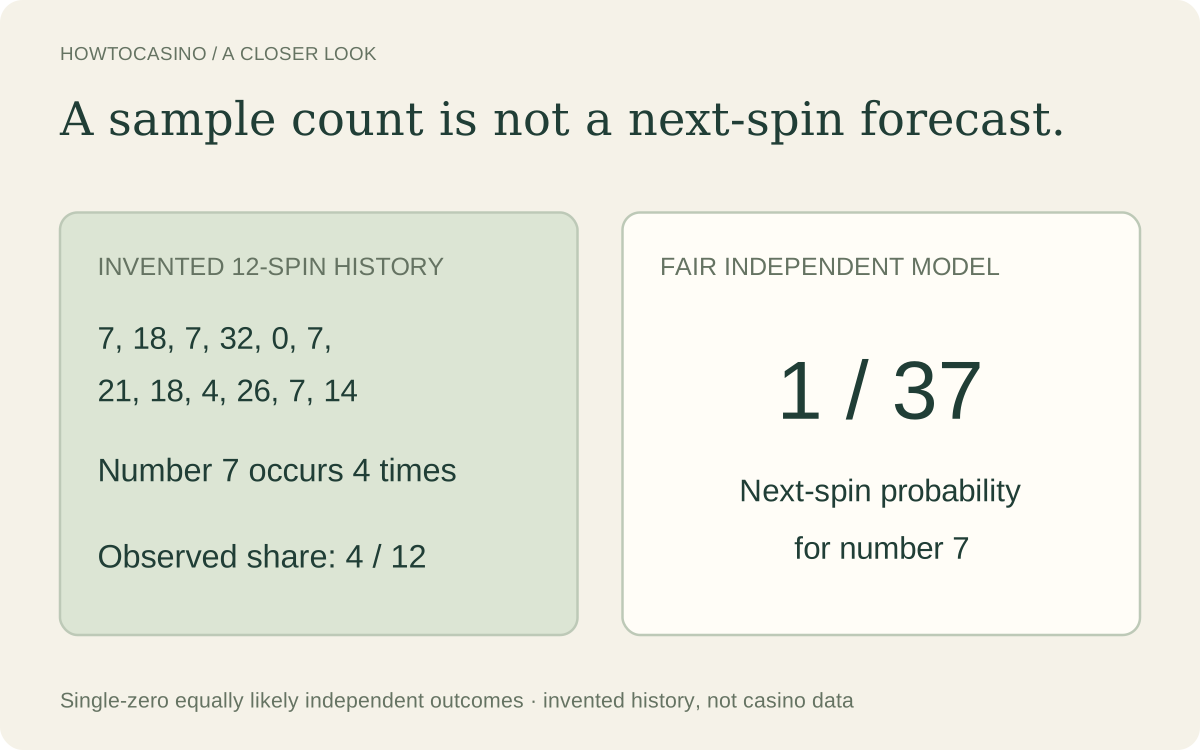
Independence means that conditioning on earlier results leaves those next-spin probabilities unchanged. If the last result was 7, the chance that the next result repeats 7 is 1/37. If 7 has been absent for a while, its next-spin chance in this model is also 1/37.
For an invented sequence, use 7, 18, 7, 32, 0, 7, 21, 18, 4, 26, 7, 14. Number 7 appears four times out of 12, so its sample frequency is 4/12, or one third. That is a description of these 12 entries. It is not the next-spin probability assigned by the model.
Our roulette odds reference separates chance from payout. A large advertised multiplier or a number’s position on a leaderboard does not replace the game’s underlying outcome probabilities.
How unusual is it for a number to be missing from 100 spins?
Choose one number before looking at the record. Under the same fair independent single-zero model, its count across 100 spins has expected value 100/37, approximately 2.7027. An expected count is a probability-weighted average; an actual count must be a whole number and can be zero.
| Preselected-number calculation across 100 spins | Result |
|---|---|
| Expected appearances: 100 × 1/37 | Approximately 2.7027 |
| Count variance: 100 × (1/37) × (36/37) | Approximately 2.6297 |
| Count standard deviation | Approximately 1.6216 appearances |
| No appearance: (36/37)^100 | Approximately 6.4577% |
The 6.4577% figure concerns a number selected in advance. It is not the probability that at least one of all 37 numbers is missing, or that the most eye-catching gap on a panel is unusual. Choosing the coldest or hottest number after seeing the results changes the statistical question.
There is also no requirement for 37 spins to contain each number exactly once. A 38-entry list of valid single-zero results must contain some repeated label because only 37 labels are available. That counting fact does not identify which number the next spin will produce.
A short sample can look uneven even when its generating probabilities are equal. Replacing the sample with another window can change the ranking. The average does not impose a deadline by which a missing number must appear.
Why is a streak found somewhere in a long history less surprising?
Compare three different questions in the stated model. First, before any results are seen, the probability that the next 10 spins are all red is (18/37)^10. Second, a 100-spin history supplies many possible starting positions for a run. Third, after 10 reds have already occurred, a question about the following spin concerns only that next result.
| Event being calculated | Probability in this model |
|---|---|
| The next fixed 10 spins are all red, before seeing them | Approximately 0.0743% |
| At least one run of 10 or more reds anywhere in a fixed 100-spin sample | Approximately 3.4580% |
| The following spin is red, after an observed run of 10 reds | 18/37, approximately 48.6486% |
We calculated the second figure with an exact recurrence for avoiding a 10-red run, then checked it separately against a state-based calculation. Overlapping 10-spin windows share results, so multiplying independent-window probabilities would give the wrong calculation.
A screenshot chosen because its history looks remarkable has already gone through selection. You cannot interpret it as though someone committed to that exact sequence and starting point before the spins happened. None of the three calculations establishes that black is due next.
Can choosing hot numbers or changing the stake improve the modelled return?
If a selection rule uses only previous independent results, each number it chooses still has the same next-spin probability in this model. Calling the choice hot, cold, overdue or a neighbour does not change that probability. A different payout rule would be a separate change to analyse.
Increasing the stake changes the money exposed to the next result. It does not make a historical pattern predictive. The roulette betting-systems guide works through a bounded progression and its larger losing branch; this page concerns what information a result history supplies.
Physical wheel neighbours are also different from numbers beside each other on the betting grid. The wheel-order reference shows the distinction without treating neighbouring pockets as a forecast.
Does this prove every actual roulette game is fair?
No. The calculations start from specified assumptions. The Commission’s random-outcome standard requires appropriate randomness and prohibits compensated adaptive behaviour; its live-studio standard includes equipment monitoring and audit controls. Those obligations are not our test of a particular implementation.
Physical measurements of a ball and wheel, or evidence of biased equipment, would pose a different inference problem from sorting a short list of previous numbers. Published physical research does not establish that an ordinary hot/cold panel predicts a current GB game.
A game with weighted outcomes, changing features or special payouts also needs its actual rules. Do not apply a conventional 1/37 model merely because the screen uses roulette imagery.
If a settlement or game record seems wrong, retain the game name, round reference, result and applicable rules, then use verified support and the formal complaints route. Our roulette fairness guide explains the separate checks involved.
Related questions
Which roulette number wins most often?
A finite record can have one or several leaders. In a fair independent single-zero model, every number has the same 1/37 chance on the next spin. The observed leader is not a uniquely favoured next choice.
Is a number due after a long absence?
The absence does not change its next-spin probability under the stated independent model. Equal long-run probabilities do not require every short window to contain balanced counts.
How often does roulette repeat the last number?
For the next spin on the stated fair independent single-zero wheel, repeating the last number has probability 1/37. A question about any repetition across a longer sample is a different event.
Does a 50-spin ticker explain a 500-spin hot-number list?
Not by itself. A short ticker may show only part of the statistical window. Read the product’s own help for each panel’s denominator.
After 10 reds, is black more likely?
In the stated unchanged independent single-zero model, red and black each remain 18/37 on the following spin, with 1/37 for zero. The observed run does not create a compensating next result.
Can a result history prove a wheel is unbiased?
A short public history is not a complete equipment or software audit. It can describe the results displayed, but assessing a suspected problem needs appropriate records, methods and the actual game rules.