Does Match the Dealer mean tying the blackjack hand?
The name refers to a card-matching side bet. It does not require your final blackjack total to equal the dealer’s total, and it does not change the objective of your main hand. In the standard upcard model, the relevant cards are your first two cards and the dealer’s face-up card.
The worked paytables below use published Masque Match The Dealer Blackjack rules held by the Washington State Gambling Commission, with the rank and timing distinction also confirmed in Massachusetts’ April 2026 blackjack rules. These are clearly identified rule examples. Their publication does not make them current rules at every GB casino or establish a game’s availability on a particular account.
Our guide to a blackjack push explains how an ordinary equal-total main hand returns its stake. That is a different settlement from winning this side bet.
What counts as a match?
A rank match uses the card’s identity: a seven matches a seven, an ace matches an ace, and a queen matches a queen. A ten, jack, queen and king each count 10 in the main blackjack hand, but they do not match each other for this bet.
A suited match has both the same rank and the same suit. Matching the suit alone does not qualify: a seven of hearts does not match a king of hearts. An unsuited match has the same rank but a different suit.
| Dealer upcard | One of your original cards | Classification |
|---|---|---|
| 7 of hearts | 7 of clubs | Unsuited rank match |
| 7 of hearts | 7 of hearts from another deck | Suited rank match |
| 7 of hearts | King of hearts | No match |
| King of spades | Queen of spades | No match |
| King of spades | King of diamonds | Unsuited rank match |
Multiple decks make an exact rank-and-suit match possible. If the dealer shows the seven of hearts, another deck can supply another seven of hearts to the player. With only one standard deck, that exact card has already been used.
When is the Match the Dealer bet decided?
- Check the exact side-bet name, deck count, paytable and which dealer card it compares.
- Place the permitted main blackjack wager and any optional Match the Dealer wager before cards are dealt.
- After the opening deal, compare each of your two starting cards with the specified dealer card.
- The standard upcard bet pays or loses from those cards, before the ordinary blackjack decisions continue.
- Play and settle the main blackjack hand under its own rules.
A later hit that happens to match the dealer does not rescue a losing opening-card side bet. Splitting your hand also does not create a fresh Match the Dealer wager from the resulting split hands. The comparison has already used the original two cards.
The published standard model requires a main bet to place the side wager. Its own minimum and maximum can differ from the main-hand limit. Do not assume the chip amount shown for blackjack covers both bets.
What are the six-deck and eight-deck payouts?
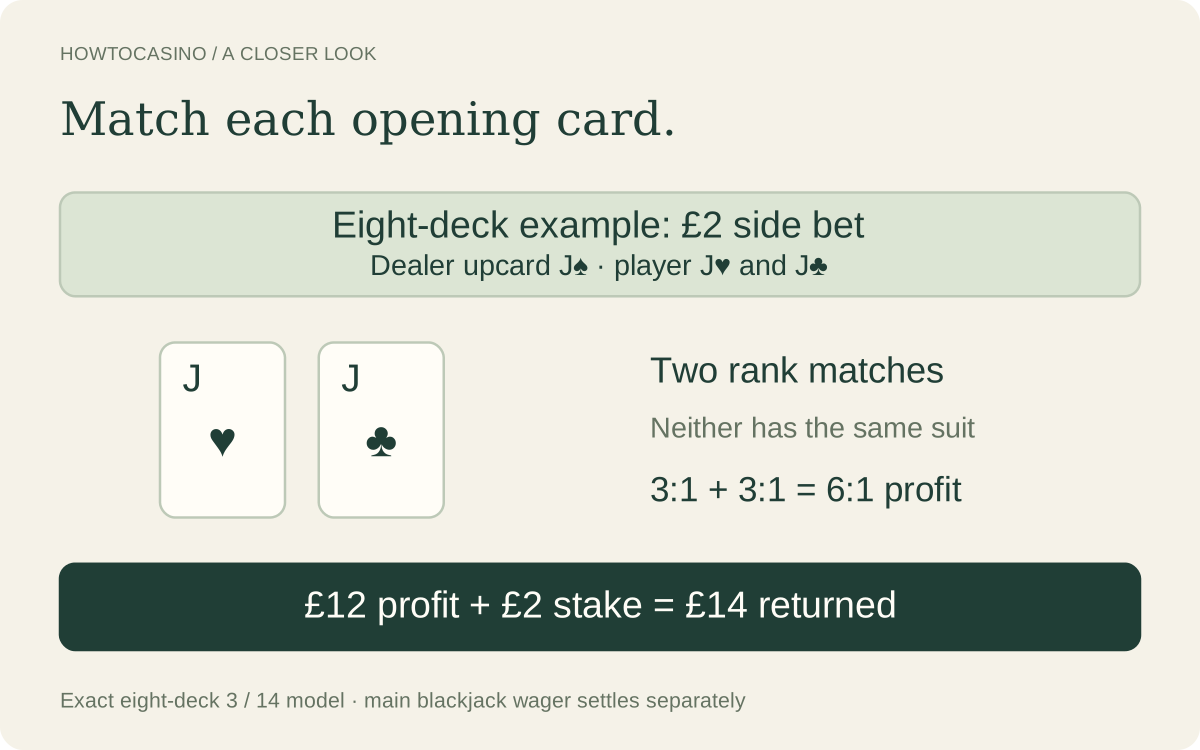
The following two non-progressive schedules come from the same supplier rule document. Each qualifying card earns the stated rank or suited payout on the side-bet amount. If both starting cards match, add the two payout winnings. This produces five possible winning combinations.
| Original two cards against the upcard | Six decks: 4/11 model | Eight decks: 3/14 model |
|---|---|---|
| One unsuited match; other card does not match | 4:1 | 3:1 |
| Two unsuited matches | 8:1 | 6:1 |
| One suited match; other card does not match | 11:1 | 14:1 |
| One suited and one unsuited match | 15:1 | 17:1 |
| Two suited matches | 22:1 | 28:1 |
These odds express profit relative to the side-bet stake. The stake itself returns once on a winning bet. In the six-deck model, one suited plus one unsuited match gives 11+4=15 units of payout winnings for each 1 unit staked; it does not create two separate returned stakes.
The document also contains other deck counts, alternative schedules and progressive models. The labels six-deck or eight-deck alone are therefore not enough to promise these odds in another game. Use the actual paytable supplied with the selected version.
What does a £1 Match the Dealer bet return?
Assume the six-deck 4:1 unsuited and 11:1 suited schedule, a £1 side bet, and no progressive wager. The figures below are for the side wager alone. The main blackjack stake has not yet been included.
| Side-bet outcome | Payout winnings | Stake returned | Total credited |
|---|---|---|---|
| No rank match | £0 | £0 | £0 |
| One unsuited match | £4 | £1 | £5 |
| Two unsuited matches | £8 | £1 | £9 |
| One suited match | £11 | £1 | £12 |
| One suited and one unsuited match | £15 | £1 | £16 |
| Two suited matches | £22 | £1 | £23 |
For a card example, the dealer shows seven of hearts and you start with seven of hearts plus seven of clubs. One card is a suited match and one an unsuited match. The £1 side bet credits £16: £15 payout winnings and the £1 stake. Whether a later blackjack decision makes the main hand win or lose does not change that completed side-bet comparison.
In the documented eight-deck 3/14 model, the same matching pattern instead gives 17:1 profit. A £1 side wager returns £18 including its stake. Comparing only the words one suited and one unsuited while ignoring the schedule would miss that difference.
Can I win the side bet and lose money on the round?
Yes. Work out the combined result from all wagers. Suppose you commit £10 to the main hand and £1 to Match the Dealer, using the six-deck schedule. The initial total cost is £11; assume no double, split, insurance or other added wager.
| Hypothetical completed results | Main credit | Side-bet credit | Combined credit | Net against £11 cost |
|---|---|---|---|---|
| Main hand loses; one unsuited match | £0 | £5 | £5 | £6 loss |
| Main hand loses; one suited match | £0 | £12 | £12 | £1 profit |
| Main hand pushes; no side-bet match | £10 | £0 | £10 | £1 loss |
| Main hand wins at 1:1; no side-bet match | £20 | £0 | £20 | £9 profit |
A side-bet win does not necessarily make the round profitable. Equally, a losing side bet can sit beside a profitable main hand. A history panel that shows one positive credit should be compared with the combined amount committed to that round.
Doubles and splits can add further money to the main game. Our explanations of doubling down and splitting separate those commitments, so the £11 example should not be reused after extra stakes have been placed.
What is the chance of matching the dealer?
For the two standard full-deck schedules above, we recalculated the opening-card probabilities using a fresh, randomly shuffled shoe and no previously known removed cards. After fixing a dealer upcard in six decks, 311 cards remain: 5 identical rank-and-suit copies, 18 same-rank cards of other suits and 288 non-matching cards.
There are 48,205 unordered pairs of player cards from those 311 cards. Of those, 41,328 contain no rank match. The remaining 6,877 pairs contain at least one qualifying match, giving 6,877÷48,205≈14.2662%. This is the chance the side bet pays something, not the chance the whole blackjack round makes a profit.
| Fresh-shoe model | At least one rank match | Two suited matches | Side-bet house edge |
|---|---|---|---|
| Six decks; 4:1 unsuited/11:1 suited | About 14.2662% | About 0.020745% | About 4.0618% |
| Eight decks; 3:1 unsuited/14:1 suited | About 14.3985% | About 0.024446% | About 3.6738% |
The house edges combine every winning combination with its stated payout and every loss of the side stake. They apply to these schedules, 52-card decks and fresh-shoe assumptions. A depleted shoe, 48-card Spanish deck, altered odds or progressive jackpot has a different calculation.
For the six-deck model, a 4.0618% edge is an average expected loss of about 4.06p per £1 side bet over extensive play. It is not a fixed fee charged on each bet or a prediction that your next £1 will return 95.94p. In most individual rounds the side bet loses the whole £1.
Does hitting or standing improve the side bet?
The standard upcard wager is settled from the original cards, so a later hit, stand, split or double does not change its result. Those actions still matter for the main blackjack hand under that table’s rules. A payout on the side bet does not make an otherwise unsuitable main-hand decision better.
Adding the wager increases the total amount committed. A £1 side bet beside a £10 main stake raises the opening outlay by 10%. The side wager then introduces its own payout distribution and expected loss. It is optional in the documented standard model, so understanding it does not require placing it.
Our general blackjack side-bets guide compares the questions asked by 21+3, pairs and other extra wagers. Their names and card combinations should not be substituted for Match the Dealer.
What changes with Down Card, Spanish 21 or Progressive?
| Related label | What needs checking |
|---|---|
| Match the Dealer Up Card | Your original two cards are compared with the visible dealer card. |
| Match the Dealer Down Card | A separate permitted wager compares the original player cards with the dealer’s hidden card when exposed; timing and eligibility differ. |
| Spanish 21 Match the Dealer | Spanish decks omit printed tens. Do not reuse the 52-card shoe probabilities or assume identical odds. |
| Match the Dealer Progressive | A separate fixed wager can involve jackpot percentages or different fixed awards. It has its own paytable and conditions. |
The supplier document allows upcard-only and upcard-plus-downcard configurations. It also shows multiple progressive paytables. A progressive award cannot be inferred from the ordinary 22:1 or 28:1 row, and an ordinary rank match does not establish a jackpot win.
For a GB player, the practical check is the exact game supplied by a licensed operator. An overseas regulator’s published example is useful for understanding the mechanism, but it does not prove that a GB casino currently offers that same game or payout schedule.
What should I check if the payout looks wrong?
- Keep the game title, table or version, round identifier and the first two player cards.
- Identify the comparison card: the visible upcard or a separately permitted downcard.
- Compare rank first and suit second; do not group all ten-valued cards together.
- Use the actual deck count and complete paytable, including whether each matching card is paid.
- Separate payout winnings, the returned side stake and the main-hand result before comparing the account credit.
If the rules and recorded result still disagree, ask the operator for the settlement calculation using the round identifier. A screenshot of a matching final total will not by itself show a Match the Dealer win; the original cards and the exact side wager are what matter.
Related questions
Is Match the Dealer the same as a push?
No. A main-hand push normally concerns equal valid final totals and returns the main stake. Match the Dealer compares specified opening cards and settles a separate side wager.
Does a queen match a king because both count 10?
No, in the documented standard model. The cards must match in rank. A queen matches another queen; it does not match a king, jack or printed ten merely because they count 10 in blackjack.
Does the same suit without the same rank win?
No. A suited match requires both rank and suit. A seven of hearts against a king of hearts has the same suit but is not a qualifying Match the Dealer card.
What if both of my starting cards match the dealer?
The documented non-progressive model pays for each matching card. In the six-deck 4/11 schedule, one suited and one unsuited match gives 15:1 profit. A £1 bet returns £16 including the single £1 stake.
Can I match the dealer with a card I draw later?
A later hit does not count for the standard opening-card upcard bet. Only the original two player cards and the specified dealer card decide that wager.
Is Match the Dealer always a 3.67% house-edge bet?
No. About 3.6738% is our fresh-shoe result for the documented eight-deck 3/14 non-progressive schedule. Another deck count, paytable, Spanish deck or progressive model requires its own calculation.