Why is there no simple inventor-and-date answer?
“Who invented roulette?” can mean several things: who first used the name, who made a numbered wheel, who developed the betting game, or who introduced a particular zero arrangement. Evidence for one of these does not automatically answer the others.
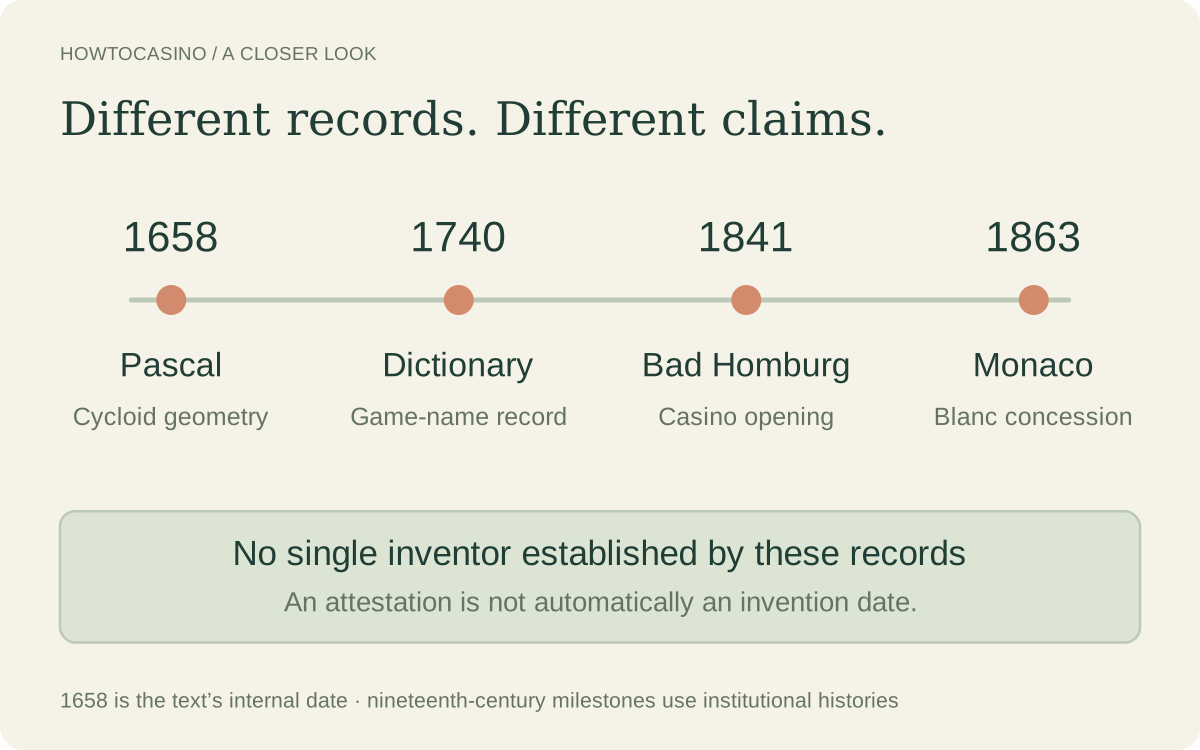
The checked sources document a geometric use of the word in 1658, a gambling sense in an eighteenth-century dictionary, and nineteenth-century casino developments. They do not supply a contemporary account that identifies one person as the inventor of the modern game and fixes a single invention date.
It is therefore more accurate to explain what each record establishes than to present the familiar Pascal story as settled fact. This is a bounded history based on the records linked below, not a claim that no further archival evidence exists.
What does roulette mean in French?
Roulette means a little wheel. The Académie française traces the word through older French forms associated with a wheel. Its dictionary also records several different senses, including the casino game.
A word’s history is not the same as a game’s history. An early reference to a little wheel, a small wheeled object or a mathematical curve does not by itself show that a casino betting game existed at that date.
The 1740 edition gives roulette a separate game-of-chance meaning. That is evidence that the gambling name was in use by publication of that edition. The brief entry does not describe the wheel, its numbered pockets or its payouts.
Did Blaise Pascal invent the roulette wheel?
Pascal is often named in accounts of roulette’s origin. His actual Histoire de la roulette, however, is about the cycloid: the curve traced by a point on the circumference of a circle as that circle rolls along a straight line. It is a mathematical work.
The text checked here is a transcription from an identified 1914 scholarly edition and is internally dated 10 October 1658. Its title uses roulette alongside the terms trochoid and cycloid. The Bibliothèque nationale de France’s Pascal exhibition dossier likewise treats the roulette problem as geometry.
This gives a firm reason to distinguish Pascal’s roulette from a casino wheel. It does not support treating that work as a description of a numbered gambling rotor, a betting layout or a casino payout system.
The narrower conclusion is useful: Pascal wrote about a curve called roulette. That fact alone is insufficient to credit him with inventing the casino game. It also does not prove every claim about every wheel he may have encountered during his life.
A chronology of the records we can distinguish
| Date | Checked record | What it establishes |
|---|---|---|
| 1658 | Pascal’s internally dated mathematical text | Roulette is used for the cycloid in this work, not a casino rulebook. |
| 1740 | Académie française dictionary, third edition | The name is recorded as a game of chance; no inventor or wheel specification is supplied. |
| 1835 | Académie française dictionary, sixth edition | A ball-and-compartment gambling description appears, with details that should not be silently replaced by modern rules. |
| 1841 | Bad Homburg casino’s official retrospective history | The casino opened on 23 May under the Blanc brothers. |
| 1843 | Bad Homburg history | The casino moved into the Kurhaus. This entry does not establish a first single-zero wheel. |
| 1863 | Bad Homburg and Monte-Carlo institutional histories | François Blanc’s Monaco concession and SBM’s development belong to this period. |
| 1866 | Monte-Carlo corporate chronology | The Monte-Carlo name was established later than the 1863 business milestone. |
A publication date tells us when a source appeared, not necessarily when the described practice began. The casino histories are retrospective institutional accounts. They are useful evidence of the organisations’ own histories, but differ from a retrieved rulebook or dated record written at the time.
The 1835 dictionary provides a good warning against modernising an old source. It describes 76 numbered compartments. That is what this particular entry says; it is neither a reason to replace the figure with 37 nor proof that every wheel of that period had the same construction.
What did François Blanc change?
Monte-Carlo SBM’s 2013 anniversary dossier attributes single-zero roulette to François Blanc in its account of the casino’s development. This concerns a particular form of roulette. It does not make Blanc the documented inventor of every earlier wheel or gambling game called roulette.
The often-repeated exact date of 1843 for the first single-zero wheel needs its own evidence. Bad Homburg’s official 1843 entry describes the move into the Kurhaus; the checked Monte-Carlo dossier does not establish that date for the first single-zero game. We therefore do not use those pages to certify the claim.
The chronology also matters for Monaco. Bad Homburg’s history dates Blanc’s Monaco concession to 1863 and its own casino closure to 1872. A story in which the move into Monaco only began after that closure puts those events in the wrong order.
For present-day rules, the important distinction is the number of pockets and the exact settlement terms. Our single-zero and double-zero guide explains the mathematical comparison. A historical label alone does not tell you whether a current game includes la partage, en prison or a special feature.
Do the numbers add up to 666?
The integers from 1 to 36 add up to 666: there are 18 pairs with a sum of 37, so 18 × 37 = 666. Adding zero does not change the total. This is arithmetic, not evidence about an inventor’s motives or a supernatural origin.
A claim that one roulette inventor suffered a particular fate also depends on first identifying the person and then finding reliable biographical evidence. The records checked for this guide do not establish a single inventor, so we do not attach a sensational biography to the game.
Historical curiosity is separate from how a current game works. The beginner roulette guide covers a round and settlement; the wheel-order guide explains why the betting grid and the physical wheel have different arrangements.
Related questions
Who invented roulette?
The sources checked here do not establish one inventor of the modern casino game. They show different stages: Pascal’s geometric writing, early use of roulette as a gambling name and later casino developments.
Did Blaise Pascal invent roulette in 1655?
That precise casino-invention claim is not established by the checked Pascal or BnF sources. Pascal’s internally dated 1658 Histoire de la roulette concerns the cycloid, a geometric curve.
When was roulette invented?
There is no single invention date established here. The Académie française recorded roulette as a game of chance in its 1740 edition, but that is a published attestation, not proof of the first game.
What does roulette mean in French?
It means a little wheel. The word has several senses, so an early occurrence of the word does not by itself document a casino game.
Did François Blanc invent single-zero roulette?
Monte-Carlo SBM’s anniversary history attributes single-zero roulette to François Blanc. That is a retrospective institutional attribution; the material checked here does not prove a first-ever event in 1843 or make him the inventor of the whole game.
Why do roulette numbers total 666?
The integers 1 to 36 have that sum: 36 × 37 ÷ 2 = 666. Zero adds nothing. The calculation does not establish a story about the game’s origin or anyone’s intentions.