What makes French roulette different?
Start with the actual wheel and help. A conventional single-zero wheel has 37 pockets: 1–36 and zero. French language or a racetrack panel does not, by itself, establish what happens to a bet on zero. A different product can use French terminology without adopting every rule found elsewhere.
Evolution’s public French Roulette description, consulted on 30 October 2026, specifically describes La Partage. The complete Loto-Québec French Roulette Gold help used below also specifies it. The latter is an identified Canadian educational rule model, not evidence of a current GB build or permission to use a foreign operator.
| Label you may encounter | Meaning to check in the exact game |
|---|---|
| Rouge / Noir | Red / black: a qualifying even-money pair in the described model |
| Pair / Impair | Even / odd: zero is not a winning even-money result |
| Manque / Passe | Low 1–18 / high 19–36 |
| Douzaine / Colonne | Dozen / column: 12-number wagers, not the same as the six even-money positions |
| La Partage / En Prison | Rules for particular stakes on zero; identify which is actually offered |
The beginner guide explains ordinary bets and play. The zero-wheel comparison separates a single-zero wheel from double-zero roulette; this article focuses on the settlement clauses that a wheel count alone cannot establish.
What happens to a £10 bet under La Partage?
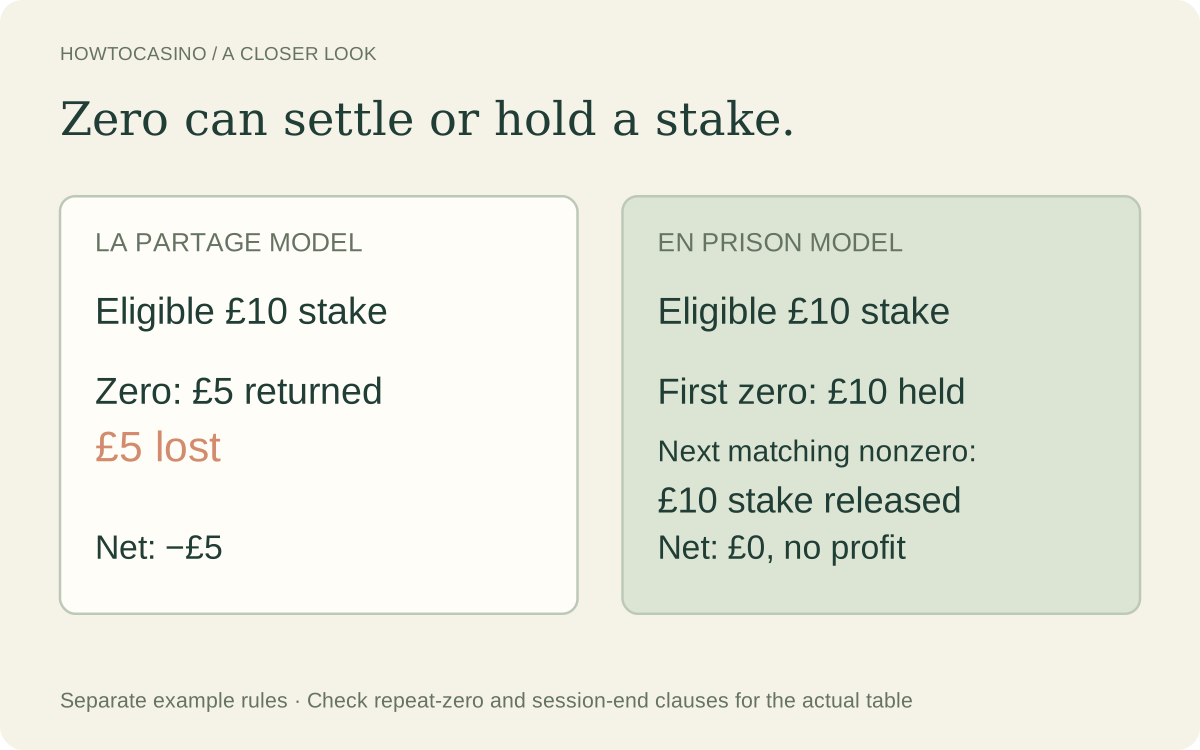
The described La Partage model applies to the six even-money positions: red, black, even, odd, 1–18 and 19–36. Each covers 18 nonzero numbers. On zero, half the relevant stake returns and half is lost. Columns, dozens and inside positions do not acquire that half-return treatment merely because they are on the same table.
These independent fictional cases each use one £10 red stake, ordinary 1:1 winning odds and the stated La Partage clause. There are no other wagers, fees or promotional balances. Returns include any returned stake.
| Result in the stated model | Total returned | Net result after £10 stake |
|---|---|---|
| Red wins | £20: £10 stake + £10 profit | +£10 |
| Black wins | £0 | −£10 |
| Zero lands, La Partage applies | £5 of the original stake | −£5 |
The zero outcome is a smaller loss, not a winning red bet. Nor is £5 a bonus added to another £10 return. A displayed half-return needs to be read as part of the same original stake.
Zero is also not an even-money even winner. In this model, an even stake on zero receives its specified half return, just as an odd stake does; the zero rule is separate from the arithmetic fact that the symbol is 0. The bet-coverage guide explains why the covered set matters.
Why is the La Partage house edge about 1.35%?
This calculation assumes a fair single-zero wheel with equally likely pockets, a 1:1 winning price, half-stake loss on zero, no fee and one qualifying even-money wager. It does not calculate an arbitrary table or an En Prison model with unspecified repeat-zero rules.
| Outcome for one unit staked | Probability in the stated model | Net change |
|---|---|---|
| The selected 18-number group wins | 18/37 | +1 unit |
| The opposite 18-number group wins | 18/37 | −1 unit |
| Zero | 1/37 | −0.5 unit |
Expected net change is (18/37 × 1) − (18/37 × 1) − (1/37 × 0.5) = −1/74 of a unit. The theoretical house edge is therefore about 1.351351%; theoretical RTP is 73/74, about 98.648649%. The cited help rounds that qualifying-wager RTP to 98.65% and separately gives 97.30% for its other wagers.
The probability of winning the original wager remains 18/37, about 48.65%. The zero concession changes the amount lost on that outcome; it does not make red cover more pockets or provide a personal 98.65% recovery guarantee.
At a £10 stake, the model’s theoretical average net change is −£10/74, about −£0.1351 per such wager across the model’s long run. A particular wager still has the concrete outcomes in the £10 table, not a predictable 13.5p deduction. The odds guide explains probability, expected return and actual results.
What happens when a stake is put En Prison?
En Prison holds the relevant stake after zero rather than immediately settling it as a new ordinary bet. To make the distinction concrete, the following uses Holland Casino’s Dutch land-based rules dated July 2026. It is a foreign educational example, not a verified current GB En Prison table.
| Fictional original £10 red stake in that model | Treatment |
|---|---|
| First zero; En Prison option taken | The original £10 remains held; no immediate £10 cash return |
| Next result is nonzero red | The original £10 is released without profit: total £10, net £0 |
| Next result is black | The held stake is lost: return £0, net −£10 |
| Another zero | The model reduces the held value and has further choices; do not substitute an ordinary red win |
A release without profit is not the £20 total returned by a newly winning £10 ordinary red wager. You do not need to add another paid bet to describe the settlement of the original held stake. The existing money remains exposed until the applicable process resolves it.
If an actual record also contains a new £10 wager, it is a separate cash commitment. For example, if the original held £10 is released and a separate £10 ordinary wager wins at 1:1, their combined return is £10 + £20 = £30 against £20 committed, giving £10 net profit. This is a fictional accounting comparison, not a recommendation to add that wager.
Keep held stake, newly accepted stake and returned money separate in a query about the round. A label such as released does not prove a second winning payment.
What if zero repeats or the table closes?
Read the exact repeat-zero clause. In the cited July 2026 Holland model, a second zero reduces the original wager’s value by half and presents further options; a third zero loses it. With a fictional original £10, the second-zero retained value is £5. That is not an assertion that £5 has already been refunded, or that every other En Prison game follows that rule.
Do not quote one universal En Prison house edge without a complete model. Repeated zeros, permitted choices and the treatment of the final round can change the calculation or the process. The La Partage calculation above is complete for its own stated assumptions; it is not evidence for every held-stake variant.
A table or session ending also needs its own clause: what happens to the held position, how a final result is treated, and which record or contact remains available. No current GB En Prison session-end policy was established in this research. A foreign land-based example is not a promise of transfer, a full refund or another available spin.
A device disconnection is a separate question again. UKGC interruption guidance distinguishes accepted wagers, the stage of play and whether further influence remains. Ask about the identified held position and relevant rule; do not assume closing the browser cancels it.
Do not delay needed gambling protection to wait for a held position. Ask the operator to resolve the existing money through its verified process alongside the protection request. The account-closure guide explains why ending access, formal exclusion and money resolution need separate confirmation.
What should you check in the table help?
- Exact title, supplier, market and current rules.
- Wheel pockets and ordinary winning prices.
- Which positions qualify for the zero concession.
- Whether La Partage, En Prison, a choice or neither is specified.
- For held stakes: later results, repeat zero, session end and interruption.
- Whether a quoted RTP belongs to one bet type or the whole game.
A French layout and announced sector bets answer different questions from zero settlement. The racetrack guide explains the cost and coverage of Voisins, Tiers, Orphelins and neighbours. Those combinations do not inherit La Partage because their names are French.
For an unexplained debit or credit, preserve the table, round identifiers, accepted stake and applicable help. Ask which stake remained held, which was released and what was actually credited. The unpaid-casino guide covers the complaint route for an identified unresolved amount.
Neither rule removes the risk of loss or supplies a winning progression. The systems guide examines that separate claim. This article does not recommend a casino, verify an individual game account or infer a valid offer from a supplier description.
Related questions
Does every French roulette table offer En Prison?
Do not assume that from the name. Evolution’s public French description specifies La Partage; the cited En Prison example belongs to separate Dutch land-based rules. Check the exact game’s current help.
Does La Partage apply to dozens and columns?
Not in the described model. Its half-return on zero applies to the six even-money positions: red/black, even/odd and low/high. Dozens, columns and inside wagers have separate settlement.
Is zero a win for an even bet?
No in this model. Zero triggers the stated La Partage half-return for a qualifying even stake; it is not one of the 18 covered nonzero even numbers.
Does releasing an En Prison stake pay 1:1 profit?
In the cited model, a matching later nonzero releases the original stake without profit. A fictional £10 release returns £10 total, not £20. A newly paid ordinary wager is a separate commitment.
Do you lose only half after every repeated zero?
Repeat-zero treatment is model-specific. The cited July 2026 Holland rules reduce the held value on the second zero and lose the stake on the third. No universal GB rule is established.
Does French roulette give every bet a 1.35% house edge?
No. About 1.35% is the qualifying La Partage even-money model calculated here. Other positions, payouts, fees and held-stake rules require their own complete assumptions.