What does the racetrack represent?
The oval panel follows the wheel’s circular number order, not ordinary numerical order and not adjacency on the rectangular betting grid. It is a convenient way to select underlying wagers. The shape itself is not another physical wheel or evidence that a particular sector is more likely next.
This guide uses the conventional single-zero allocations in Sky Bet’s public Playtech Live Speed Roulette rules, cross-checked against Grosvenor’s public Premium European Roulette description on 30 October 2026. Those are named public rule descriptions; no logged-in table, live availability or button action was tested.
| Selection in the stated model | Chip units | Distinct pockets covered |
|---|---|---|
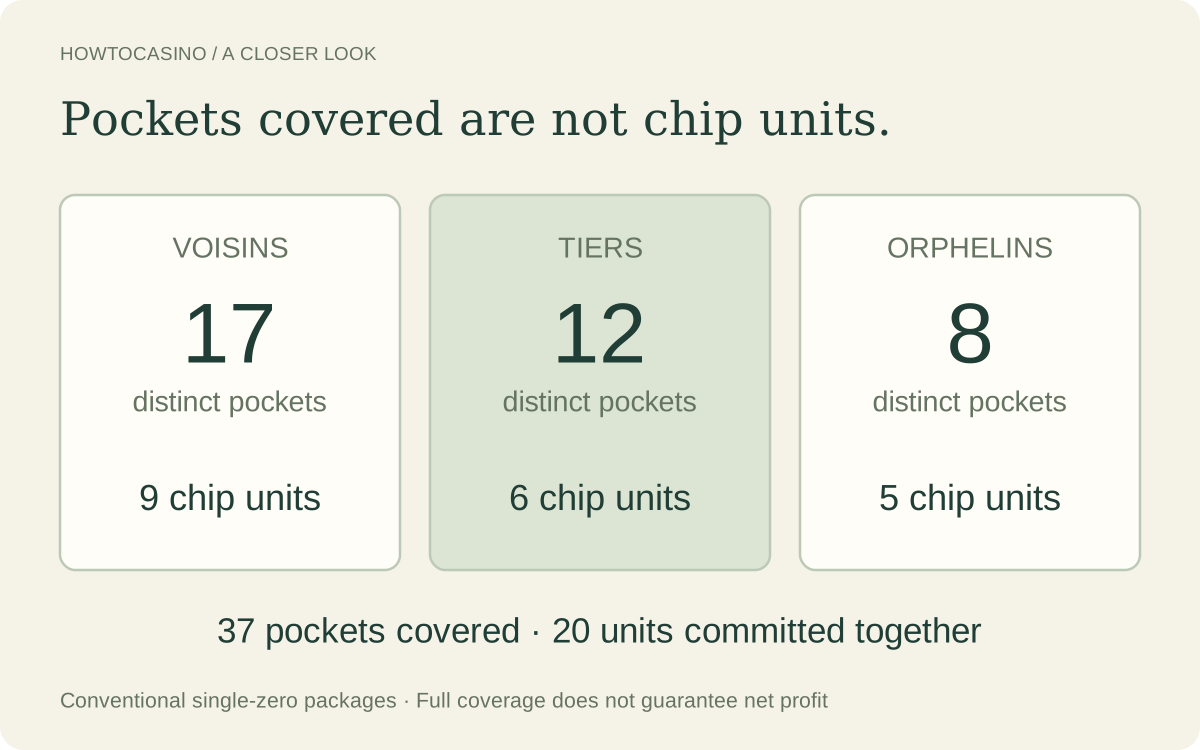
| Voisins du Zero | 9 | 17 |
| Tiers du Cylindre | 6 | 12 |
| Orphelins à cheval | 5 | 8 |
| Jeu Zero | 4 | 7 |
| A selected number plus two neighbours each side | 5 straight-up units | 5 |
The three main sectors—Voisins, Tiers and Orphelins—divide the 37 pockets. Jeu Zero is instead a smaller subset within Voisins. Adding it does not add seven previously uncovered pockets to an existing Voisins package.
The wheel-order guide supplies the conventional sequence. The inside/outside guide explains the split, corner and trio positions that these shortcuts place on the main grid.
Which bets make up Voisins du Zero?
In the stated model, Voisins covers the 17 wheel pockets in the zero-side sector from 22 to 25. Its nine units are distributed across seven betting positions. Two positions receive two units each; the others receive one.
| Underlying position | Units placed | Pockets in that position |
|---|---|---|
| Trio 0/2/3 | 2 | 0, 2, 3 |
| Corner 25/26/28/29 | 2 | 25, 26, 28, 29 |
| Split 4/7 | 1 | 4, 7 |
| Split 12/15 | 1 | 12, 15 |
| Split 18/21 | 1 | 18, 21 |
| Split 19/22 | 1 | 19, 22 |
| Split 32/35 | 1 | 32, 35 |
The unit count is 2 + 2 + 1 + 1 + 1 + 1 + 1 = 9. The distinct pocket count is 3 + 4 + 2 + 2 + 2 + 2 + 2 = 17. With a fictional £1 unit, the package costs £9; with a fictional 20p unit, it costs £1.80. These are denomination examples, not current table minimums.
Voisins is not the same as a straight-up stake on each of its 17 pockets. Replacing it with 17 equal straight-ups changes the stake allocation and cash outcomes, even if the covered set is identical. Keep the package definition with any quoted return.
How do Tiers, Orphelins and Jeu Zero differ?
| Named package | Allocation of one unit per position unless stated | Why the counts differ |
|---|---|---|
| Tiers: six units | Splits 5/8, 10/11, 13/16, 23/24, 27/30, 33/36 | Six disjoint splits cover 12 pockets |
| Orphelins à cheval: five units | Straight-up 1; splits 6/9, 14/17, 17/20, 31/34 | 17 appears in two splits, so the package covers eight distinct pockets |
| Jeu Zero: four units | Splits 0/3 and 12/15; straight-up 26; split 32/35 | One straight-up plus three splits cover seven pockets within Voisins |
Orphelins means the pockets left outside the two larger sectors. Its five-unit à cheval allocation is specific: do not silently replace it with eight equal straight-ups while keeping a five-unit price. Both allocations could cover eight pockets, but they would be different wagers.
The overlap on 17 matters at settlement: it wins both 14/17 and 17/20. It is not a ninth distinct covered number. Count unique pockets to describe coverage and count all placed units to describe cost.
Jeu Zero is also not the generic zero-plus-two-neighbours selection. Under the conventional order, that five-pocket neighbour set is 3, 26, 0, 32, 15. Jeu Zero additionally includes 12 and 35 and uses the component allocation shown above. Similar names and highlighted areas do not make their prices identical.
How much does a neighbour bet cost?
For one centre pocket plus k distinct neighbours on each side, before the two sides overlap, the count is 1 + 2k. If each selected pocket receives one straight-up unit worth u, the total is u × (1 + 2k). This formula assumes a single centre selection; multiple clicks or selected centres can create overlap and extra units.
| Fictional selection | Distinct pockets | Total at a 20p unit |
|---|---|---|
| Centre only, k = 0 | 1 | £0.20 |
| Centre plus one each side, k = 1 | 3 | £0.60 |
| Centre plus two each side, k = 2 | 5 | £1.00 |
| Centre plus three each side, k = 3 | 7 | £1.40 |
These are mathematical examples, not an assertion that a particular interface offers every listed value. Sky’s inspected help describes an adjustable neighbour count without establishing its numerical range; Grosvenor’s description specifies five straight-up chips. Read the actual selection and total-bet field.
Using the conventional clockwise order, two neighbours each side of 31 are 20, 14, 31, 9 and 22. Numerical 29, 30, 31, 32, 33 would be a different set. Pennsylvania’s published physical-wheel order is used only to corroborate this conventional sequence, not as GB law or software availability evidence.
If separate selections overlap, the same pocket can receive more than one unit. The highlighted coverage can stay similar while total cash rises. A table limit, per-position limit and total selected stake also need separate checks; a denomination is not the complete round cost.
What comes back if one of the covered numbers wins?
The following independent fictional cases use a £1 unit and the cited model’s ordinary profit prices: straight-up 35:1, split 17:1, trio 11:1 and corner 8:1. Returns include the winning units; net result subtracts every unit in that package. No fee, multiplier variant or other wager is included.
| Package and winning pocket | Total package stake | Total returned | Net result |
|---|---|---|---|
| Voisins: 0, 2 or 3 | £9 | 2 × £1 × (11 + 1) = £24 | +£15 |
| Voisins: any other covered pocket | £9 | £18 from the winning split or two-unit corner | +£9 |
| Tiers: any covered pocket | £6 | £18 from one split | +£12 |
| Orphelins: 1 | £5 | £36 from the straight-up | +£31 |
| Orphelins: 17 | £5 | £18 + £18 from two splits = £36 | +£31 |
| Orphelins: another covered pocket | £5 | £18 from one split | +£13 |
| Jeu Zero: 26 | £4 | £36 from the straight-up | +£32 |
| Jeu Zero: another covered pocket | £4 | £18 from one split | +£14 |
| Any package: a pocket outside its covered set | That package’s stake | £0 | Loss of that package’s stake |
For a five-number straight-up neighbour selection at £1 each, one winning pocket returns £36 but all five stakes cost £5, so the round’s net is £31. Paying 35:1 on the whole £5 would be a different and incorrect calculation for this model.
The ordinary payout model matters. A multiplier game or other special paytable cannot inherit these totals without checking its prices. The payout guide explains profit odds and returned stakes in more detail.
Does covering all three sectors guarantee a profit?
No. In this explicitly stated model, one £1-unit Voisins, one Tiers and one Orphelins package commit £9 + £6 + £5 = £20 and cover all 37 pockets. Every result wins at least one component, but that does not mean it returns the full £20.
| Result group for that fictional combined round | Number of pockets | Total returned | Net after £20 |
|---|---|---|---|
| 0, 2, 3 | 3 | £24 | +£4 |
| 1, 17 | 2 | £36 | +£16 |
| The other pockets | 32 | £18 | −£2 |
Assume a fair single-zero wheel with each pocket equally likely and the ordinary prices above. Expected return is (3 × £24 + 2 × £36 + 32 × £18) ÷ 37 = £720/37, about £19.4595. Subtracting £20 gives an expected net loss of £20/37, about 54.05p, for that combined stake.
Each package has the same 1/37, about 2.70%, theoretical house edge on its total stake under these assumptions. Broader coverage changes the range of outcomes; it does not make this a positive-expectation strategy or a guarantee of a full-stake return.
La Partage is a separate concession for specified even-money positions. These presets use inside components; being called French, covering zero or appearing on a French-style panel does not make those components qualify. The French-roulette guide explains the distinction.
Use the help to check the exact package, highlighted positions, chip denomination, total cash and paytable. A past sector run does not demonstrate a better next-spin prediction. The results-history guide addresses that separate misunderstanding.
Related questions
What is Voisins in roulette?
In the stated conventional single-zero model, Voisins du Zero is a zero-side sector covered by a nine-unit package of trio, corner and split positions. It covers 17 distinct pockets and has different returns for different winning pockets.
Does a £1 selected chip make Voisins cost £1?
Not in this allocation. A £1 unit makes nine-unit Voisins cost £9. Read the complete total stake, not only the currently selected denomination.
Why does Orphelins use five chips for eight numbers?
Its stated à cheval package combines straight-up 1 with four splits. Number 17 lies in two splits, so coverage and unit count are different; when 17 wins, both relevant splits settle.
Are roulette neighbours the numbers next to each other on the grid?
The described racetrack neighbours follow wheel order. For example, the conventional two-each-side selection around 31 is 20, 14, 31, 9, 22, not numerical 29 to 33.
Is Jeu Zero the same as zero plus two neighbours?
Not in this model. Jeu Zero covers seven pockets with four component units. Zero plus two neighbours each side covers five pockets with five straight-up units.
Can Voisins, Tiers and Orphelins together still lose money?
Yes. At a £1 unit in the stated ordinary model, their combined cost is £20. On 32 of the 37 pockets, total return is £18 and net loss is £2, despite one component winning.