What counts as a winning cluster in Sugar Rush?
The original game uses a 7 × 7 grid. Five or more matching symbols must form a group connected horizontally or vertically. A gap breaks the connection; symbols touching only at a corner do not form the required connection by that diagonal alone.
Winning symbols disappear and replacements fall into the spaces. Further qualifying groups can then pay within the same tumble sequence. A new arrangement of the grid is not automatically another paid stake.
This differs from a game that simply counts matching symbols anywhere. Our Fruit Party guide provides another named cluster example, while the original Gates of Olympus multiplier answer explains a different winning arrangement. Shared tumbling animations do not make their settlement rules interchangeable.
Why is a marked square not immediately a large multiplier?
A position is marked when a winning symbol is removed from it. The rules distinguish that first mark from the multiplier added after a second winning removal at the same location. Repeated qualifying removals then double its value, up to the original game’s 128× ceiling.
| Repeated qualifying use of a position | State shown by the rule |
|---|---|
| First winning removal | Marked position |
| Second winning removal | Multiplier starts at 2× |
| Further winning removals | 4×, 8×, 16×, 32×, 64×, then 128× |
| Already at the original 128× ceiling | Do not assume another doubling to 256× |
The history belongs to the square, not to a particular sweet. Replacements can occupy a marked square. A symbol merely landing there does not by itself establish a winning combination or another qualifying removal.
When checking a prize, use the values applied to that winning cluster. A screenshot taken after a later tumble can show a different state from the one used to settle an earlier award.
Are multiplier spots added or multiplied together?
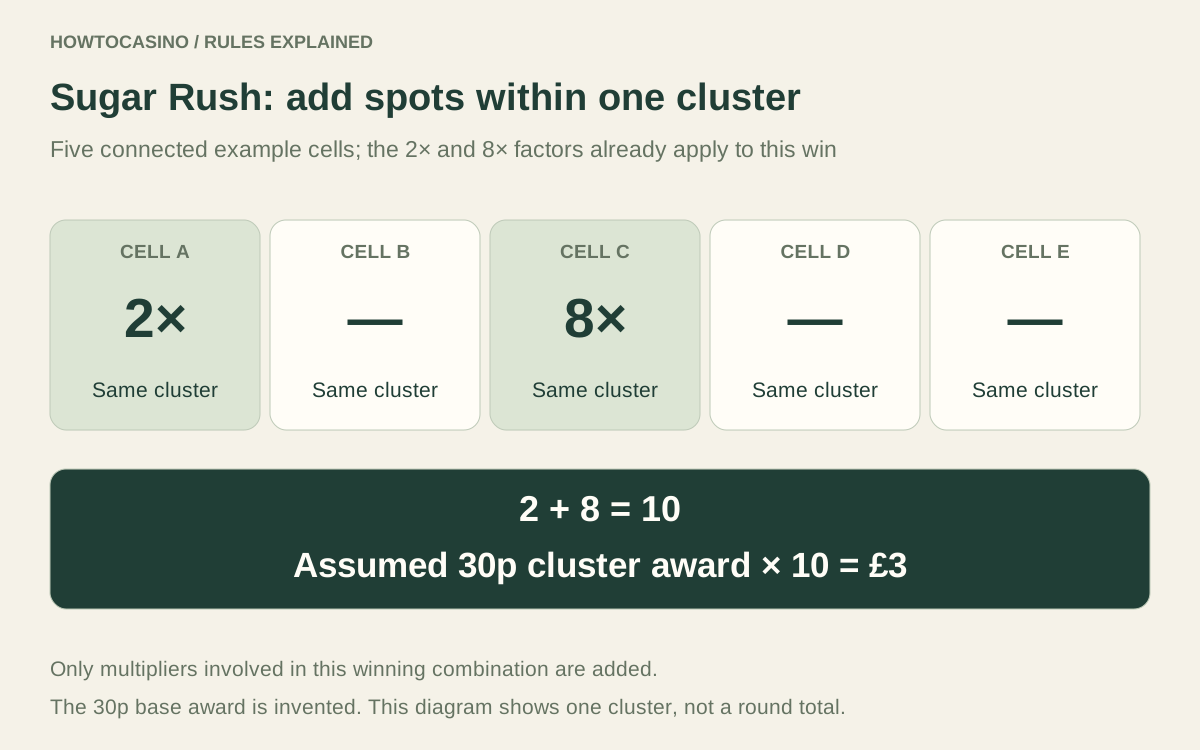
The rules say that multiple multipliers involved in the same winning combination add together. Two applicable spots showing 2× and 8× therefore give that cluster a combined factor of 10×, not 16×. Unmarked cells do not each add a separate 1× to that sum.
Count only positions involved in that winning cluster. A separate cluster has its own calculation; a multiplier elsewhere on the grid adds nothing to either award.
| What the record shows | Correct basis for the calculation |
|---|---|
| One cluster uses 2× and 8× spots | Add 2 and 8 for that cluster. |
| A second cluster uses no multiplier spot | Do not give it the first cluster’s 10× factor. |
| A multiplier sits outside both clusters | Its presence alone adds nothing to those awards. |
| The history already states a multiplied return | Do not apply the same factor again. |
If there is no applicable multiplier, read the ordinary cluster award from the selected paytable. The diagram is deliberately a small fragment with two already applicable values, not a reconstruction of the entire game screen.
How would the calculation work in pounds?
Assume an invented record with a 20p total paid-round cost. A qualifying cluster has a 30p pre-multiplier award and uses existing 2× and 8× spots. We stipulate the 30p amount to show the arithmetic; it is not a quoted price for a particular sweet or cluster size.
| Ledger entry in the example | Amount |
|---|---|
| Applicable multiplier sum | 2 + 8 = 10 |
| First cluster return | £0.30 × 10 = £3.00 |
| Separate assumed cluster with no applicable spot | £0.10 |
| Complete assumed return for the paid round | £3.10 |
| Total paid cost | £0.20 |
| Net round result | £2.90 profit |
Assume there are no other returns, additional paid elements or relevant cap effects. If the second cluster did not occur, the total would instead be £3 and the net result £2.80. If neither cluster paid, the result would be the loss of the assumed 20p paid cost.
A feature total and its component awards are not two independent payments. The rules copy specifically warns that the free-spin total shown in history contains the whole cycle’s win. Read the field definition before adding a headline total to amounts it already contains.
The rules-and-paytable guide covers these unit and total checks across slots. A multiplier calculation is useful for reconciling a return; it cannot establish how likely that return was.
When do the marks and multipliers reset?
| Mode | How long the relevant positions last |
|---|---|
| Base game | Until the current tumble sequence ends; they do not build indefinitely across separate ordinary paid spins. |
| Free-spin feature | They remain through the feature and can develop across its spins and tumbles. |
A feature spin can finish while the free-spin feature continues. Its board progress remains for the next feature spin; a new ordinary round starts a fresh base-game sequence.
Read any feature-start and settlement details in the actual help rather than assuming that every visible board state transfers between every mode. Persistence is a disclosed state mechanic, not proof that an already marked position must produce another winning cluster.
This is also different from claiming that a losing run makes a prize due. Our prediction guide separates a known persistent game state from unsupported forecasts based only on recent results.
What starts the free-spin feature?
| Scatters in the triggering result | Free spins |
|---|---|
| 3 | 10 |
| 4 | 12 |
| 5 | 15 |
| 6 | 20 |
| 7 | 30 |
The original-game descriptions give the same Scatter counts for additional spins awarded within the feature. The multiplier board persists during that feature. A retrigger should not be described as an automatic fresh deposit, a separate casino promotion or a guaranteed profitable extension.
These trigger rules describe an event, not its frequency. A full-looking board and a past sequence without Scatters do not supply a reliable number of spins until the next feature. The bonus-frequency answer explains which published statistic would actually be needed.
Does this also describe Sugar Rush 1000?
The main answer concerns original Sugar Rush and its 128× spot ceiling. Pragmatic Play’s dated Sugar Rush 1000 announcement describes a different version with spot multipliers up to 1,024×. That difference alone is enough to make an unlabeled screenshot or a generic family review unreliable for the precise ceiling.
Do not change the original rule simply because the sequel’s title includes a larger number. Xmas, Dice and other named editions also require their own help. Identify the full title before borrowing a trigger table, maximum, RTP or control from another edition.
A supplier headline RTP is another configuration question. This article does not establish which return model is installed at any particular casino. Our RTP guide explains why a model percentage cannot be read as the return on your next round.
How should you check a Sugar Rush award?
- Confirm original Sugar Rush rather than a similarly named version.
- Identify one winning cluster and the multiplier positions involved in it.
- Use the values applicable to that award, with the correct cash or stake units.
- Check whether a displayed total already includes its component returns.
- Record the game reference and ask the operator to explain a specific mismatch.
Use the exact game’s help for its cash units, configuration and GB controls. The third-party rules copy supports the cluster calculation and history-total warning, rather than an installed GB RTP or stake limit.
Sources, access limits and the GB check
We consulted the official supplier page, the undated rules copy and BetVictor’s indexed GB description on 2 November 2026. Direct BetVictor access was unavailable, so its description is corroboration rather than a fresh game-launch or availability test.
We matched betvictor.com to BV Gaming Limited, UKGC account 39576, with active Remote Casino activity. No account, game-launch or payment test was performed.
Current GB RTS 8 requires individual commitment to game cycles. International or historical control instructions do not establish the controls available in a GB service.
Related questions
What is the maximum multiplier spot in original Sugar Rush?
The original supplier description gives 128× per spot. The separate Sugar Rush 1000 announcement gives a different ceiling; the titles should not be merged.
Do 2× and 8× spots make 16×?
For one winning cluster involving both, the rules add them: 2 + 8 = 10. They are not multiplied together.
Do all visible multiplier spots count towards every win?
No. The addition rule concerns the multipliers involved in the same winning combination. A spot elsewhere on the grid is not automatically part of that cluster.
Why did my Sugar Rush multipliers disappear?
In the base game they clear at the end of the tumble sequence. During the free-spin feature they persist through the feature. Check which mode and boundary the record shows.
Do I add the feature total to every win listed beneath it?
Only if the history field definitions establish separate amounts. The rules copy says its free-spin history total includes the whole cycle’s win, so adding included components again would double-count.
Can building the board guarantee the next result?
No. The marked state explains how a qualifying future award would be evaluated. It does not guarantee that the required winning symbols will appear.