Which Quantum Roulette version does this explain?
This is the original Playtech Live Quantum Roulette model described in Sky Bet’s full public help and Sky Vegas’s single-zero product page, consulted on 30 October 2026. The pages are undated rule descriptions; they do not establish the latest account edition or prove that a particular reader can access it.
| Named product | Important boundary |
|---|---|
| Original Live Quantum Roulette | Single zero; reviewed ordinary straight-up price 29:1 and selected-number awards |
| x1000 Quantum Roulette | Sky’s separate description uses both 0 and 00 and different bet-specific returns |
| Quantum Roulette Instant Play | Separate product; Grosvenor’s feature wording includes different enhancement details |
A similar title is insufficient to transfer the number of zeroes, multiplier ceiling, payout table or fees. Start with the exact game identity and its selected rules. Our roulette basics explain the standard layout; this article concentrates on the Quantum changes.
What happens during the round?
- Accepted chips are placed on their selected positions before betting closes.
- The multiplier positions and values are revealed after the betting period ends.
- Occasional enhancement events may change displayed multipliers.
- The announced result settles each qualifying chip using its relevant payout rule.
Sky Bet’s help describes between one and five selected multiplier positions and lists 50x, 100x, 150x, 200x, 250x, 300x, 400x and 500x. Some multipliers may have the same value. A selected number is not guaranteed to become the roulette result.
Quantum Boost adds 50 to affected values; Quantum Leap doubles or triples affected values in this cited model. Those are changes to displayed award values, not an instruction to multiply every wager on the layout. Do not derive a universal final ceiling by combining feature descriptions from different titles.
The reviewed pages differ in how they narrate the precise wheel-launch sequence. The supported point needed here is that the multipliers are revealed after betting closes. No fixed countdown, reveal-time betting opportunity or tested studio procedure is claimed.
Which bets receive the multiplier?
| Accepted position | Does a selected-number multiplier apply? |
|---|---|
| Straight-up chip directly on the winning selected number | Yes, under the cited multiplier rule |
| Split, street or corner that happens to include that number | No; it keeps its own bet-type payout |
| Red/black, dozen, column or other outside bet | No; it is not a straight-up wager |
| Compound racetrack bet | Only any actual straight-up component on the winning selected number qualifies |
The racetrack button’s name is not the settlement unit. Sky Bet’s Jeu Zéro example contains a straight-up on 26 and three split chips. Only the chip on 26 can receive a number multiplier; the splits do not acquire the feature simply because they arrived through the same button.
The racetrack guide explains compound chip layouts. The complete price is the sum of their component wagers, and the return is the sum of the components that actually win.
How do 29:1, 49:1 and 50x differ?
| Qualifying result | Profit on £1 winning chip | Total returned from that chip |
|---|---|---|
| Unboosted straight-up at 29:1 | £29 | £30 |
| Selected straight-up displayed as 50x | £49 | £50 |
| Selected straight-up displayed as 100x | £99 | £100 |
| Selected straight-up displayed as 500x | £499 | £500 |
Sky Bet’s full help explicitly pairs a displayed 50x with 49:1 profit plus the winning stake back. It replaces the ordinary straight-up return. Do not multiply 29:1 by 50, add a separate 29:1 award or return the same winning stake twice.
For other winning positions, the cited profit odds are split 17:1, street 11:1, corner or four-number basket 8:1, six-number line 5:1, dozen/column 2:1 and even-money positions 1:1. Zero is outside red/black, odd/even, high/low, dozen and column coverage.
The lower ordinary straight-up payout is a material difference from conventional 35:1 roulette. A multiplier headline without the ordinary payout table is an incomplete description of the game.
How do you calculate profit on a mixed £6 layout?
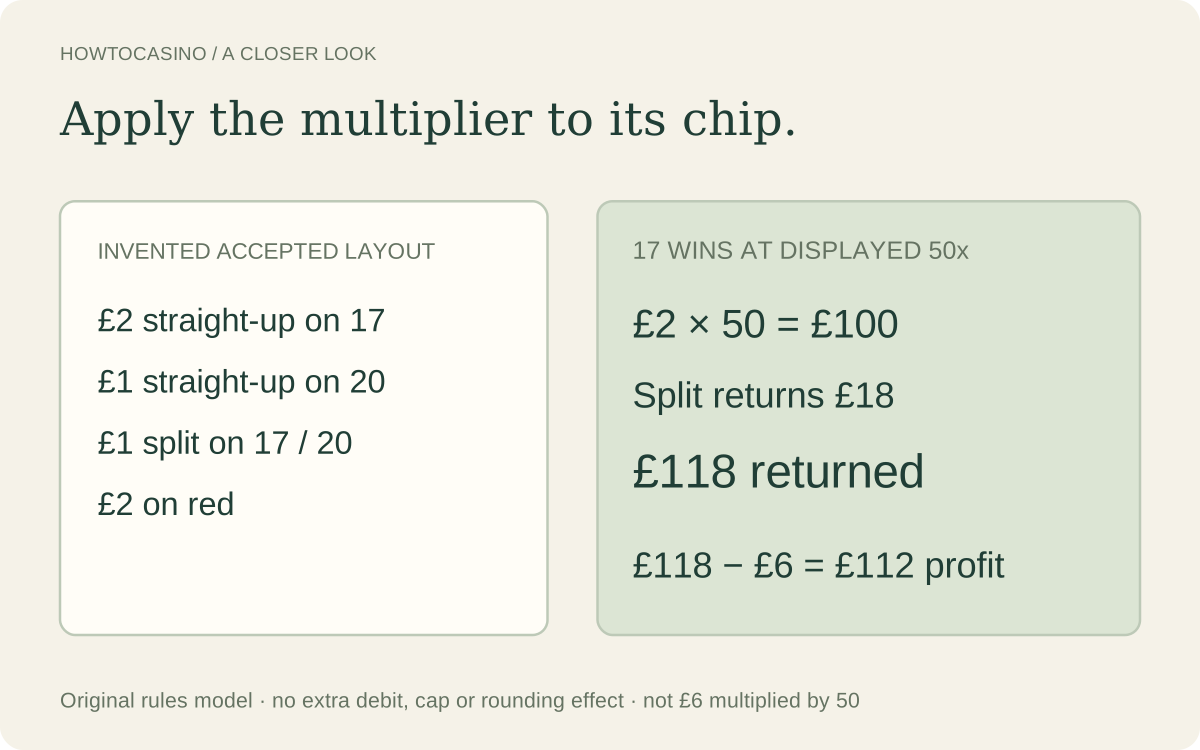
Construct an accepted layout with £2 straight-up on 17, £1 straight-up on 20, £1 on the 17/20 split and £2 on red: £6 committed. Assume no additional debit, fee, cap, other award or rounding effect. These are invented amounts, not table limits. Numbers 17 and 20 are black; 21 is red.
| Assumed result | Returns from winning chips | Total returned | Whole round: return − £6 |
|---|---|---|---|
| 17 with displayed 50x | £2 × 50 = £100; split £1 × 18 = £18 | £118 | £112 profit |
| 17 without a multiplier | £2 × 30 = £60; split £18 | £78 | £72 profit |
| 21, even if selected for a multiplier | Red £2 × 2 = £4; no straight-up on 21 | £4 | £2 loss |
| 0, with no zero coverage | No winning chip | £0 | £6 loss |
The first row does not return £6 × 50. Only the winning £2 straight-up receives that multiplier, while the winning split keeps its normal price and the other stakes lose. In the third row there is a winning red bet and an overall loss. Selection for a multiplier does not help when you have no qualifying straight-up chip there.
For a second invented layout, the four £1 components of Jeu Zéro cost £4: straight-up 26 and splits 0/3, 12/15 and 32/35. A 50x win on 26 returns £50, leaving £46 net. A win on 0 through its split returns £18, leaving £14 net, even if 0 displays a multiplier: that layout has no straight-up chip on 0.
What do the posted RTP and multiplier values tell you?
The cited original-game pages quote 97.30% theoretical RTP. That is an attributed figure for their described model, not a guarantee for a session, an independently reconstructed distribution or a percentage to assign to every bet on every Quantum version.
A multiplier value is an award conditional on a qualifying win. It is not the probability that its number lands. Nor is a frequency listed beside 500x necessarily the joint chance that your number receives 500x and the roulette result matches it. That needs the precise denominator and full feature-selection model.
For comparison only, an ideal uniform single-zero wheel gives a chosen number probability 1/37. That mathematical assumption is not a studio audit and cannot reconstruct the combined Quantum RTP without the feature distribution. Recent wheel results and previous multiplier selections do not establish when the next qualifying win is due.
Are there extra fees or a fixed cash maximum?
The reviewed complete help does not state a distinct surcharge or fixed pound-denominated cash win cap. That silence is not proof of a universal zero-fee policy. The worked examples expressly assume no extra debit; if the selected game deducts another amount, include it in the outlay before calculating net profit.
A displayed 500x award concerns the winning straight-up chip under its rule. It is not automatically a maximum of 500 times the total layout stake. Position limits, a possible overall table limit and any actual award cap must come from the selected table’s help and accepted-bet record.
Sky Bet’s public page also includes a generic predetermined-results footer alongside its live-game description. That conflict does not establish how a particular studio’s physical result is generated. This guide uses the specific bet-settlement clauses and makes no independent fairness or live-stream test claim.
What if the round is cancelled or the connection drops?
The cited help distinguishes a dealer-cancelled round, for which bets are returned, from a connection loss, for which recorded bets settle according to the round result. For the invented £6 layout, a complete £6 cancellation refund leaves £0 net. A frozen video alone does not establish cancellation or a refund.
Preserve the exact title, round identifier, accepted component stakes, multiplier map, announced number and account record. Check the applicable interruption and void terms rather than making the bet again to see what happens. The frozen-game and complaint guides address those next steps.
Related questions
Does 50x mean 50:1 profit in Quantum Roulette?
In the cited original rules, no: 50x is total return including the winning stake, equivalent to 49:1 profit. A £1 qualifying winning chip returns £50.
Does a split bet get the multiplier if one of its numbers is selected?
The cited rules apply number multipliers only to straight-up chips. A split keeps its own payout, including when it was placed as part of a racetrack or special bet.
Can a red bet win and the round still lose?
Yes. In the invented £6 mixed layout, the £2 red bet returns £4 when only red wins. The complete round therefore loses £2.
Can I place a bet after seeing the multiplier?
The described multipliers are revealed after the betting period closes. The guide does not establish a post-reveal betting opportunity.
Is x1000 Quantum Roulette the same wheel?
Sky’s separate x1000 description uses an American-style wheel with 0 and 00. Do not transfer its wheel, payout or return figures into the original single-zero product.
Does 97.30% RTP mean I get 97.30% of my money back?
No. It is a theoretical figure attributed to a named game model over extensive play. Individual results vary, and a mixed layout needs the correct rules and returns for each component wager.