Can a percentage of your balance tell you the right stake?
A rule such as “use a fixed percentage of your balance” cannot establish what you can afford to lose. It ignores bills, debts, income, spending elsewhere and whether gambling is already causing harm. A casino balance is an account figure, not a measure of spare household money.
MoneyHelper identifies borrowing to gamble, missing essential payments and trying to win back losses as reasons to seek help. GamCare’s money guidance includes tracking spending and protecting priority expenses. Neither supplies a personal stake recommendation from a slot balance.
The examples below explain how amounts differ. They do not prescribe a weekly gambling allowance, a target number of spins or a recovery plan. The slot-harm guide explains difficult-to-control gambling and points to independent support.
What amount are you actually committing on one round?
Read the displayed total and the applicable game help. A coin value, line unit or base price can differ from the full amount paid or risked. Optional paid components, where offered and permitted, need to be counted as part of the relevant game cycle; a small first number is not proof of a small total cost.
For example, an invented fixed-line interface charging 10 line units of 2p costs 20p in total. If its display already says “Total bet 20p”, multiplying that number by ten again would incorrectly produce £2. This illustrates a unit check, not the available controls of a named game.
The denomination and payline guides explain those mechanics. This page concerns what the complete stake means for money exposed and limits, rather than teaching another set of slot controls.
How can deposits, turnover and losses all be different?
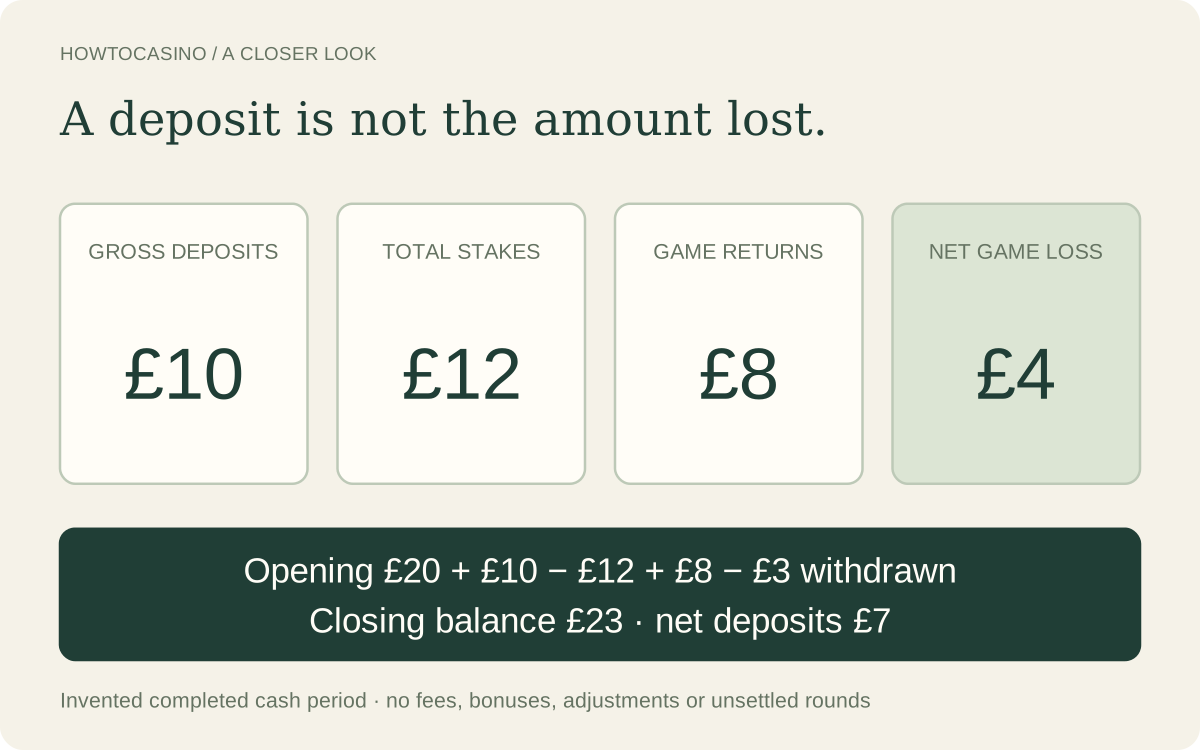
Consider an invented period with an opening £20 cash balance. During it, £10 is deposited, completed wagers total £12, game returns total £8 and £3 is withdrawn. There are no fees, bonuses, transfers, unsettled rounds or other adjustments.
| Measure over the stated period | Calculation | Amount |
|---|---|---|
| Gross deposits | New funds deposited | £10 |
| Total stakes, or turnover | All completed paid wagers counted once | £12 |
| Game returns | All returned amounts, including any returned stake | £8 |
| Net gambling loss | £12 stakes − £8 returns | £4 |
| Net deposits | £10 deposited − £3 withdrawn | £7 |
| Closing account balance | £20 + £10 − £12 + £8 − £3 | £23 |
The balance rises by £3 while the gambling itself loses £4. The extra deposit and withdrawal explain the difference. A displayed £23 balance is therefore not evidence of £3 gaming profit, and the £10 deposit is not the total stake or the amount lost.
For a wider period or several accounts, use consistent start and end points and include all relevant transactions. Do not mix a lifetime deposit figure with one session’s returns, or count a game’s return once as winnings and again as a separate stake refund.
Which account limit controls which amount?
The current RTS 12 text, consulted on 30 October 2026, distinguishes gross deposit limits from other financial limits. It requires account-level financial-limit facilities and, as a minimum, gross deposit limits. A withdrawal does not subtract from the deposits counted by a gross limit.
| Limit or control | Amount it concerns |
|---|---|
| Gross deposit limit | Money deposited over its defined period |
| Stake limit, where offered | Total money staked over its defined period |
| Loss limit, where offered | Stakes minus returns over its defined period |
| Net deposit limit, where offered | Deposits minus withdrawals over its defined period |
| Single-round or game-cycle maximum | The permitted cost of one game cycle, separately from period spending |
The regulator’s implementation update distinguishes the phases of these changes, including 30 September 2026 for the gross-deposit requirements. Read each control’s scope and period. A limit is a constraint, not a calculation of a safe stake for your circumstances. Reducing or stopping gambling remains possible without increasing a limit.
Does available balance mean the next stake fits your plan?
No. In a separate invented planning example, a person has chosen a £5 maximum loss for a period and has already lost £4. Those figures are not a recommended budget. Only £1 remains within that chosen ceiling.
| Proposed next commitment | If the entire stake is lost | Effect on the chosen £5 ceiling |
|---|---|---|
| £0.50 | Total loss becomes £4.50 | Within that numerical ceiling, without establishing affordability |
| £2 | Total loss becomes £6 | Exceeds it |
| No further wager | Loss remains £4 | No new game exposure |
If a game’s minimum stake is £2, there is no new stake in that game which fits a remaining £1 worst-case allowance. A minimum is not a reason to round the allowance up, deposit more or chase an earlier loss. The example is personal cash planning, not a claim about how every operator implements a loss-limit control.
A return is uncertain. Check the full possible loss of the next paid commitment rather than assuming a small payment will keep the net cost below the amount at risk. An existing balance or permitted account limit does not remove that uncertainty.
Does increasing the stake improve the odds?
A larger stake does not, by itself, prove better odds. Separate a change in cash scale from a change in the actual rules, eligible outcomes or configuration. Claims about special awards or stake-dependent eligibility need the exact game’s rules; there is no universal formula for every online slot or physical machine.
Here is a deliberately invented single-round model. At either stake, a positive return has probability 25%, pays 3.8 times the total stake and otherwise returns zero. The probabilities and return multiplier are stipulated unchanged, so the model’s RTP is 0.25 × 3.8 = 95%.
| Total stake in this invented model | Return on its paying outcome | Chance of that outcome | Expected return | Expected loss |
|---|---|---|---|---|
| £0.20 | £0.76 | 25% | £0.19 | £0.01 |
| £1 | £3.80 | 25% | £0.95 | £0.05 |
Increasing this model’s stake fivefold increases the cash amounts fivefold. Its paying-event probability and RTP stay unchanged by assumption. This is a calculation about a specified model, not evidence that every real slot uses identical probabilities at every available option. It also does not predict the result of a particular paid round.
RTS 7 prohibits adaptive compensation in remote random games. A losing run does not create a repayment obligation. Increasing the next stake to recover a loss changes exposure; it does not establish that the game is due. The hit-frequency guide explains why the probability of a payment and the frequency of profitable rounds also differ.
Are the GB £2 and £5 limits suggested stake amounts?
No. For GB online slots, the maximum total stake per game cycle is £2 for ages 18–24 and £5 for ages 25 and over. The initial £5 limit began on 9 April 2025, and the younger-adult £2 limit on 21 May 2025. A permitted maximum is not an instruction to use it, and the game or account can impose a lower constraint.
These caps apply to online slots, not every casino product or physical slot machine. They also do not replace deposit, period-stake or loss controls. The slot-controls guide covers the separate timing and design requirements.
What should you check before another paid round?
- Whether gambling would use essential money, borrowed funds or money being sought to repair previous losses. A lower stake does not resolve those problems.
- The complete cost of the commitment, using the selected game’s actual units and rules.
- The amount already deposited, staked, returned and lost over the same chosen period, including relevant play elsewhere.
- Which account controls apply, their time periods and any remaining numerical allowance. A balance alone is not the answer.
- Whether to make no further wager, reduce access or use independent support. There is no need to keep playing to validate a limit or a calculation.
A forum recommendation or someone else’s winning screenshot cannot establish a suitable amount for you. The comparison, RTP and volatility guides can explain game information; none can turn a negative-expectation gamble into a reliable income or a guaranteed affordable session.
Related questions
How much should I bet with a £20 slot balance?
A £20 account balance is not enough information to recommend a stake. It says nothing about essential expenses, other gambling or the amount affordable to lose. No further wager can be the appropriate choice.
Is a deposit limit the same as a loss limit?
No. A gross deposit limit counts money deposited over its period. A loss limit, where offered, concerns stakes minus returns. Withdrawals do not reduce the deposits counted by a gross deposit limit.
Does a bigger stake guarantee a bigger profit?
No. It exposes more money and can still return zero. In a model that scales prizes with stake without changing probabilities, cash amounts scale but the chance of the defined outcome does not improve.
Can the balance rise while the games lose money?
Yes. In the invented ledger, new deposits and a withdrawal leave the balance £3 higher while completed wagers produce a £4 loss. Cash movements and gaming results need separate totals.
Are £2 and £5 recommended UK slot stakes?
No. They are GB online-slot maximum stakes per game cycle for the respective age bands. They do not establish affordability, a budget or an obligation for a game to offer that maximum.
Does a low denomination make a whole spin cheap?
Only the complete paid stake answers that question. The total may depend on credits, lines and other stated components. Read the total rather than treating one coin or line unit as the entire cost.