Which game does “Pontoon” mean?
Pontoon can mean a British home banking game, a casino variant built around Pontoon and five-card tricks, or a different game sold under that name in another country. Familiar words are not enough to identify the rules.
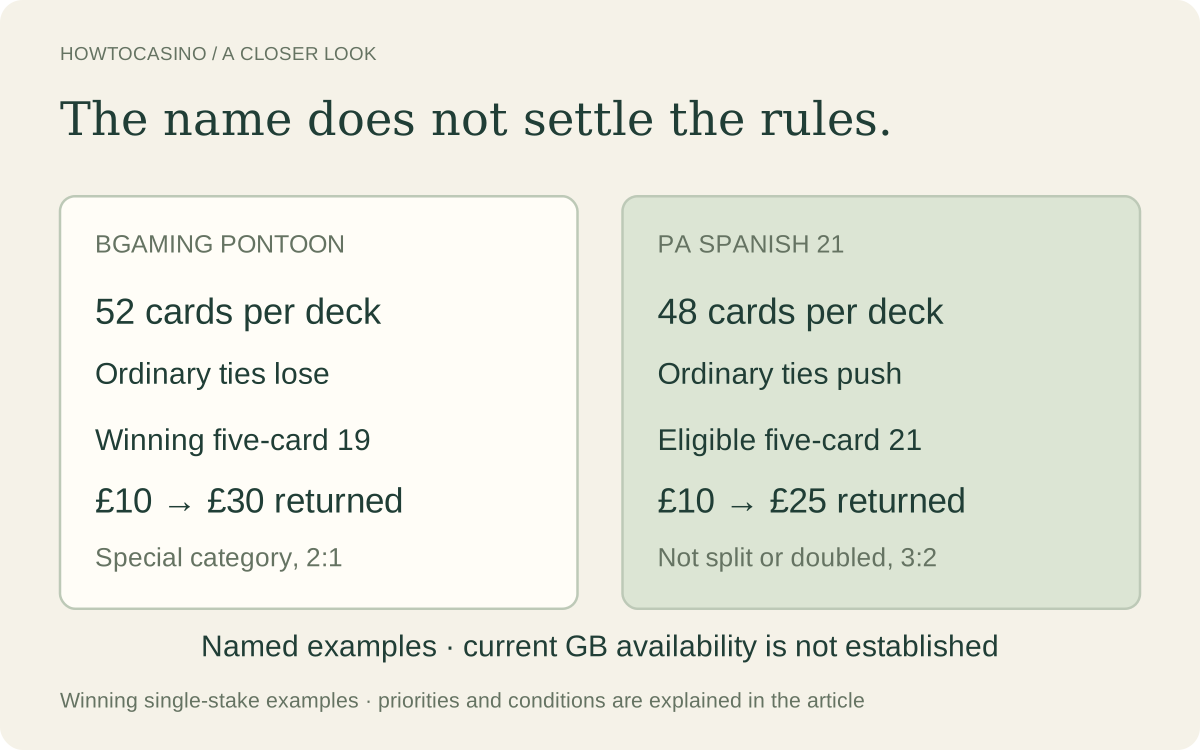
For a concrete casino comparison, this guide uses BGaming’s public Pontoon rules. For Spanish 21, it uses the Pennsylvania regulator’s published table-game rules. These are educational examples: neither source establishes that the exact game is currently offered by a GB-licensed operator. The Australian example below is a separate naming comparison.
Ordinary blackjack also varies by table. Its basic aim is to beat the dealer without exceeding 21, and its usual equal-total settlement is a push. The main blackjack guide explains a stated beginner model; the specific game’s own rules must settle questions about payouts, dealer behaviour and player actions.
What changes between the named models?
| Rule | BGaming Pontoon example | Pennsylvania Spanish 21 example |
|---|---|---|
| Deck composition | Eight full 52-card decks | Six or eight 48-card decks; numeric tens removed |
| Dealer’s first cards | Two face down, with an early check for Pontoon | One up and one down, with the specified blackjack check |
| Ordinary equal totals | Player loses | Stake returned as a push |
| Player’s natural | Ace plus a ten-value card: Pontoon | Ace plus a ten-value card: blackjack |
| Five cards totalling 19 | Qualifies as a five-card trick; priority rules still apply | An ordinary 19; no five-card-21 bonus |
| Winning special hand | Pontoon or five-card trick: 2:1 | Natural: 3:2; eligible five-card 21: 3:2 |
| Dealer soft 17 | Hits | Stands |
This table compares these two published models. It is not a universal chart for every product called Pontoon or Spanish 21. It also does not establish a house edge: card composition, action rules and settlement priority need to be considered together.
How do Pontoon and a five-card trick work?
In BGaming’s stated model, aces count as 1 or 11, picture cards count as 10 and other cards use their printed values. A two-card ace plus a ten-value card is Pontoon, the highest-ranked hand. A five-card hand that has not exceeded 21 is the next category. Ordinary hands with fewer cards rank below those categories.
A five-card trick is therefore not restricted to a total of 21. A five-card 19 can beat an ordinary two-card 20. But it is not an unconditional player win: the published model gives the dealer equal-ranked ties, and the five-card tricks are treated as equal to each other. Read the hand category before comparing totals.
A winning Pontoon or five-card trick pays 2:1; an ordinary winning hand pays 1:1. With a fictional £10 single stake, a winning five-card trick returns £30 in total: £20 profit and the original £10 stake. An ordinary winning hand returns £20. These examples assume the hand qualifies and wins, with no extra stake or side bet.
The dealer checks for an initial Pontoon before the normal drawing sequence. Do not construct an example in which the player draws to five cards and only then discovers a dealer natural that the earlier check should already have resolved.
Our five-card and Charlie guide explains why a special five-card rule should not be imported into an ordinary blackjack table.
Do twisting, sticking and buying mean the same as blackjack actions?
In descriptions of British home Pontoon, twist means take another card and stick means stop taking cards. Buying involves increasing the stake to receive a card. John McLeod’s published Pagat home rules require a player to reach 15 before sticking and distinguish buying before and after twisting. That is a named home-game description, not a rule to add to every casino product.
BGaming’s casino PDF describes doubling on a hand of two, three or four cards, once per hand, and permits hitting after doubling. This differs from a blackjack rule in which a double commits the player to just one more card. A familiar button name can therefore conceal a different action.
The checked PDF does not clearly settle every question. Its maximum-split wording is inconsistent, and we do not infer a mandatory hit-to-15 rule or a dealer stop at five cards from it. Before relying on such a condition, use the exact offered game’s help or obtain clarification from the operator.
Even where an action looks familiar, the cost must be counted. A split or double can add a separate stake. A special payout figure does not describe the total cash at risk after those actions.
What is Spanish 21, and where did the tens go?
In the Pennsylvania Spanish 21 model, each deck contains 48 cards because the four numeric 10 cards are removed. Jacks, queens and kings remain and are still worth 10. “No tens” is therefore misleading if it is read to mean that no card has a value of 10.
| One deck | Full deck | 48-card Spanish deck |
|---|---|---|
| Numeric 10 cards | 4 | 0 |
| Jacks, queens and kings | 12 | 12 |
| All ten-value cards | 16 of 52 | 12 of 48 |
| Ten-value share before any cards are dealt | 4/13, about 30.77% | 1/4 = 25% |
The different deck composition alone is not a complete comparison of player value: Spanish 21 changes other settlement and action rules too. It is not valid to copy a normal blackjack strategy chart or house-edge percentage merely because both games use 21 as a target.
The name Pontoon can also be used for a 48-card game. Casino Canberra’s public Australian description specifies four decks with numeric tens removed and an initial dealer deal of one card. That differs from both BGaming’s full-deck Pontoon and the named Pennsylvania hole-card model. It does not establish a common Australian or GB rule set.
How do Spanish 21 ties and five-card bonuses differ?
In the chosen Pennsylvania rules, ordinary equal totals push. A player blackjack beats a dealer blackjack, and equal multi-card totals of 21 favour the player. The same rules also state that dealer blackjack defeats a player’s non-natural 21. “Any player 21 always wins” is therefore too broad for this particular model.
Its five-card bonus requires a winning total of 21, rather than any unbusted five-card hand. Eligible five-card 21 pays 3:2, six-card 21 pays 2:1, and seven or more cards totalling 21 pay 3:1. The additional bonuses do not apply to doubled or split hands. Other combinations have their own stated conditions.
| Fictional £10 single-stake hand | Profit if it wins as described | Total return |
|---|---|---|
| BGaming Pontoon: qualifying five-card 19 | £20 at 2:1 | £30 |
| PA Spanish 21: five-card 19 beating an ordinary dealer 18 | £10 at 1:1 | £20 |
| PA Spanish 21: eligible, non-split, non-doubled five-card 21 | £15 at 3:2 | £25 |
A five-card 19 loses against a dealer 20 in the Spanish 21 example. The first row does not transfer to that model. “Five cards” is not a complete payout condition.
What should you check before using a Pontoon or Spanish 21 guide?
The Pennsylvania double rule permits an additional wager up to the original stake on a hand of two or more cards and then gives one additional card. On an eligible non-busted doubled hand, double rescue returns the added wager and forfeits the original. BGaming’s permission to hit after doubling must not be imported into this model.
For example, £10 originally staked plus a £5 permitted additional double wager commits £15. A qualifying rescue returns the £5 addition and loses the original £10. That is not half of the combined £15. If the addition were £10 instead, £10 would return from £20 committed. These are calculations from the named foreign rules, not GB offers.
- Find the supplier, exact game title and current rule help, then check the operator’s GB permission separately.
- Confirm whether the deck has 52 or 48 cards and which dealer cards are visible.
- Read equal-total and natural-hand priority, including what happens when both sides have a special hand.
- Check which five-card totals qualify and whether doubling or splitting removes a bonus.
- Confirm action costs, dealer soft-17 behaviour and any rule the summary leaves ambiguous.
The double-down, split and payout guides explain the usual terminology. Use them to understand a condition, then apply the exact product’s rules rather than a combined “best bits” version assembled from several games.
Related questions
Is Pontoon just another name for blackjack?
It is a related game, but the name does not guarantee ordinary blackjack rules. The BGaming example here changes dealer information, ties, hand ranking, actions and payouts; other games called Pontoon use different models.
What is a Pontoon hand?
In the BGaming model, it is an ace plus a ten-value card in a two-card hand, and is the highest-ranked category. A winning Pontoon pays 2:1. Use the exact product rules for special cases such as splits.
Does a five-card trick always win in Pontoon?
No. In the named BGaming model it outranks ordinary hands but sits below Pontoon, and the dealer wins equal-ranked ties. An ordinary blackjack game does not acquire this rule simply because the player draws five cards.
Does Spanish 21 remove picture cards?
No. The chosen Spanish 21 rules remove the four numeric tens from each full deck, leaving 48 cards. Jacks, queens and kings remain and still count as 10.
Can I use normal blackjack basic strategy for Pontoon?
Do not assume so. Deck composition, hidden dealer cards, ties, available actions and special-hand payouts can alter decisions. A strategy chart needs to match the exact rules; this comparison is not a strategy chart.
Are these exact Pontoon and Spanish 21 games available in Britain?
This guide does not establish current GB availability of the named models. It compares published supplier and foreign regulatory rules. Check the exact domain’s GB permission and the actual offered game’s current help before relying on a rule.