Is there one set of European blackjack rules?
The player’s main task remains to compare a non-busted hand with the dealer under the game’s rules. Hit, stand, double and split do not acquire one universal meaning or set of restrictions simply because European appears in the title. The beginner guide explains the ordinary round; this article focuses on the differences that the label can hide.
21.co.uk’s public variants article, dated 6 November 2024 and consulted on 30 October 2026, includes a European section. That establishes GB-facing use of the term, not current access to a specific playable version. The detailed linked article was inaccessible during this check, so its full rules have not been treated as verified.
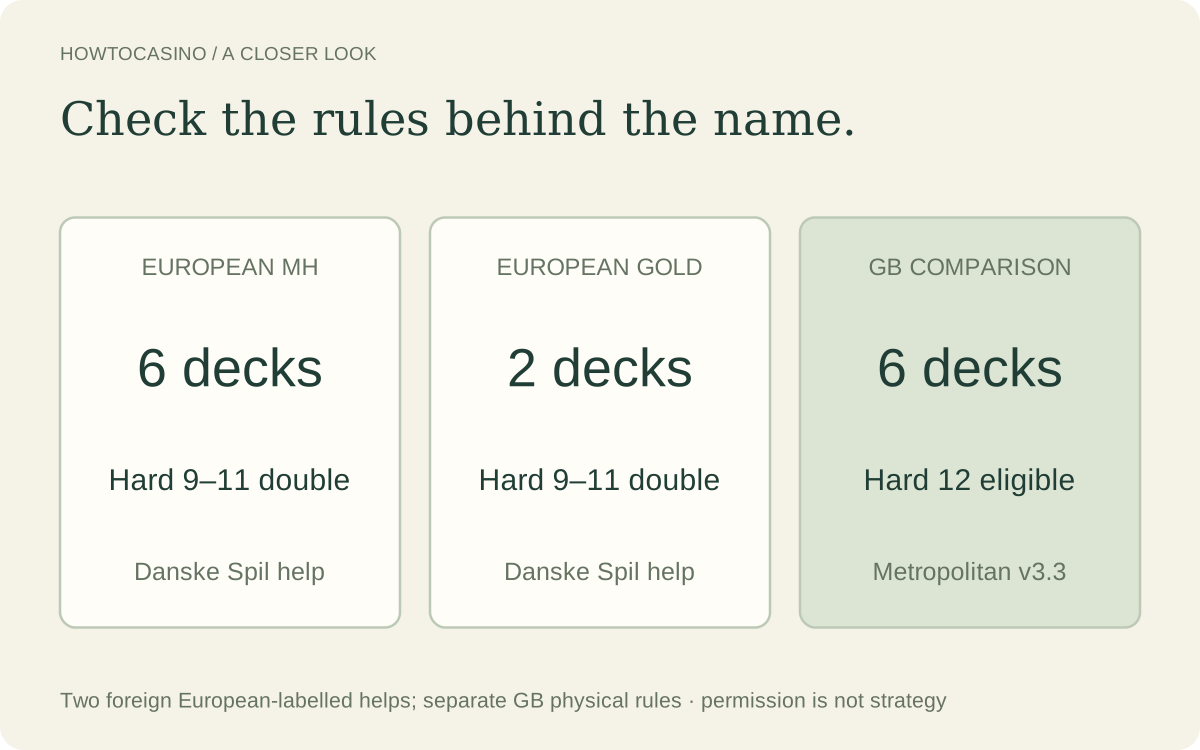
Play’n GO separately identifies a product called European BlackJack MH. More detailed European-labelled help pages at Denmark’s Danske Spil provide the two published models compared below. They are educational references from another market, not recommendations to use those services or tests of the latest GB game builds.
How do the documented deck and action rules differ?
The two Danske Spil help pages show a last-modified date of 16 November 2023. Metropolitan’s comparison is its GB physical Blackjack 6 Deck rulebook, version 3.3, July 2026. That rulebook is not renamed European here: it demonstrates why location and a broad dealing description cannot replace the exact table rules.
| Condition | European Blackjack Multihands: Danske Spil help | European Blackjack Gold: Danske Spil help | Metropolitan GB six-deck comparison |
|---|---|---|---|
| Deck count | Six; reshuffled each round | Two; shuffled before each game | Six, unless otherwise indicated |
| Dealer on 17 | Stands on all 17s | Stands on all 17s | Stands on 17 or more; ace 11 unless that busts |
| First-two-card double | Hard totals 9, 10 or 11 | Hard totals 9, 10 or 11 | Any first-two total except blackjack/21 |
| Double after split | Not explicitly established in this help | Not permitted | Explicitly permitted |
| Split qualification | Same value; help gives J+K as an example | Same denomination | Same value; rulebook gives J+Q as an example |
| Split-ace extra cards | One extra card per split ace | One-card-only restriction not established here | One extra card per split ace |
| Winning split 21 | Ordinary 21, not a natural | Ordinary 21, not a natural | Even-money ordinary win |
| Added stakes against dealer blackjack | Refund/forfeiture rule not explicitly established | Refund/forfeiture rule not explicitly established | Refund/forfeiture rule not explicitly established |
Unknown means that the cited text does not establish the detail, not that a player can choose the most favourable treatment. Likewise, a same-value split rule cannot be narrowed to identical face cards when the exact source expressly permits mixed ten-valued faces. Check the version actually offered for limits and permitted actions.
These documents do not establish one universal European RTP, minimum stake or number of hands. The deck-and-shuffle guide explains why deck count and reset timing are separate details.
Does no peek tell you what happens to doubles and splits?
No. A procedure for dealing or checking the dealer’s cards is different from the settlement rule for money added by a player. The Multihands help explicitly says no peek; the Gold help shows one initial face-up dealer card. Neither statement alone proves that every added double or split wager is lost, or protected, when a dealer natural is found.
Read the clause for dealer blackjack and additional stakes. Some published blackjack models expressly protect specified added wagers; others describe different exposure. Do not import the wording from a familiar game into a version whose rules do not state it. None of the three comparison texts above is used here to invent that missing rule.
The hole-card guide already explains a peek, a later dealer card and the cash difference between specifically stated settlement models. Insurance is a separate side wager; buying it does not automatically establish protection for all paid doubles or split additions.
This is also why an American-versus-European summary can be too broad. First identify the actual dealer-card procedure, then the exact rules for naturals and extra stakes. A geographic label cannot settle an account dispute by itself.
Why can the same hard 12 have different available actions?
Consider an invented £10 opening hand of 5+7, a hard 12. The two European help pages restrict the first-two-card double to hard 9, 10 or 11, so this hand is outside that permission. Metropolitan’s stated six-deck rule allows a first-two-card double on this total.
For a separate, fictional permitted Metropolitan branch, add £10 to double and receive an 8. The player then stands on 20. If the dealer finishes on ordinary 19, the £20 main stake wins at 1:1 profit odds: The total return is £40: the £20 stake plus £20 profit.
| Fictional branch | Cash committed | Return if the stated result occurs | Net |
|---|---|---|---|
| Metropolitan-permitted double: 5+7+8 beats 19 | £20 | £40 | £20 profit |
| Ordinary £10 hand reaches 20 and beats 19 without doubling | £10 | £20 | £10 profit |
These are alternative settlement examples, not advice to double hard 12 or a comparison of optimal expected values. The extra £10 in the doubled branch was additional money at risk. If that £20 hand instead loses, its return is £0 and its loss is £20. Permission to take an action is not evidence that it is the best decision.
The double-down guide explains the one-card restriction and stake calculation. Any strategy chart must match the exact model, including action eligibility and the unresolved dealer-blackjack exposure.
Does an ace plus a ten-valued card always pay 3:2?
Not when the rules classify that hand as a split 21 rather than an opening natural. In the stated Multihands model, an ordinary winning natural pays 3:2, while a 21 formed on a split hand remains ordinary 21. A qualifying £10 winning opening natural therefore returns £25: the £10 stake and £15 profit.
For a different fictional round under the Multihands split rules, start with A+A for £10, add £10 to split, then receive K on one ace and 8 on the other. The first hand is ordinary 21 and the second is 19. Assume the dealer finishes on ordinary 20, with no side wagers, insurance or additional awards.
| Final split hand | Paid stake | Settlement against ordinary dealer 20 | Returned |
|---|---|---|---|
| A+K: ordinary 21 | £10 | Ordinary 1:1 win | £20 |
| A+8: 19 | £10 | Loss | £0 |
| Whole split round | £20 | One winning hand and one losing hand | £20; net £0 |
The £20 returned by the winning split hand is not £20 round profit. The round paid £20 in total stakes and received £20. Nor should the winning split hand be paid £25 merely because its two cards total 21: the named rule expressly distinguishes it from a natural.
The split guide explains the additional stake. The 3:2 payout guide covers the separate natural calculation and the need to identify which hands qualify.
Which rules should you check before using a European blackjack guide?
- Exact supplier, title and rules version, rather than European alone.
- Deck count and shuffle/reset policy.
- Dealer-card procedure, soft-17 rule and late dealer-natural settlement of each paid stake.
- Eligible double totals, double after split, split qualification, ace restrictions and resplitting.
- Natural versus split-21 payouts, insurance, surrender and any separate side wagers.
- Posted limits, total paid additions and the account record for a disputed result.
The published Gold help expressly excludes surrender and double after split. The Multihands help does not establish every equivalent detail; absence from one summary is not proof of permission. Keep the named rules together rather than building a more generous hybrid from different pages.
For a disputed round, preserve the exact cards, action sequence, rule version, round identifier and each debit or credit. Ask the operator to identify the settlement clause. A generic comparison article is useful for spotting a question, but it is not the contract or the complete transaction history.
Related questions
Is European blackjack always played with two decks?
No. The two directly documented European-labelled examples here use two and six decks. Read the exact game’s deck and shuffle rules rather than treating a common description as universal.
Does European blackjack always mean no hole card and all added stakes lost?
The label does not establish that combination. Dealer-card procedure, checking and the treatment of added double or split money are separate clauses. If the applicable help does not state the settlement rule, ask the operator rather than inferring it.
Can you double a hard 12 in European blackjack?
The two European help models compared here restrict doubles to hard 9–11, so not in those models. A separate Metropolitan GB rulebook permits first-two-card doubles on other eligible totals. That comparison is about permission, not advice to double 12.
Can you split J and K?
The cited Multihands help expressly uses J+K as a same-value split example. The Gold help instead says same denomination. Check the exact model; do not turn either rule into a universal European rule.
Does split ace plus king receive the natural-blackjack payout?
In the stated Multihands model it is ordinary 21. A winning £10 hand at ordinary 1:1 returns £20, while a separately qualifying £10 opening natural at 3:2 returns £25. Other stakes in the round still need to be counted.
Is there a European blackjack strategy that guarantees a win?
No guarantee follows from the label or a chart. Available actions and their expected values depend on the full rules, while individual results remain uncertain. A permitted action, a higher payout or several hands does not guarantee profit.