Which three cards count?
Combine the first two cards of the player hand carrying the side bet with the dealer’s upcard. Do not include the dealer’s hidden card, a later player hit or a card from another player’s hand. The supplier’s product description confirms this three-card format; implementations using a community card need their own instructions.
A separate accepted main wager is required in the named rules used below. A £10 main bet plus £1 Lucky Lucky bet commits £11 before any later paid split, double or insurance. Having money on the main hand does not automatically place the side bet.
Commit the side wager before the deal. Seeing a qualifying three-card result does not allow an unplaced wager to be added afterwards. Check the accepted side stake on the associated hand, rather than relying on a chip selected but not actually placed.
Our blackjack side-bet overview explains the wider category. Here the focus is which three cards are priced and how to distinguish a side return from a whole-round profit.
What do suited, unsuited, 678 and 777 mean?
| Term | Complete three-card example | What to notice |
|---|---|---|
| Suited 678 | Player 6♥ + 7♥; dealer 8♥ | All three ranks are 6, 7 and 8, and all suits match |
| Unsuited 777 | Player 7♥ + 7♣; dealer 7♦ | Three sevens, not all the same suit |
| Suited 21 | Player 5♠ + 6♠; dealer K♠ | Total 21, all three spades |
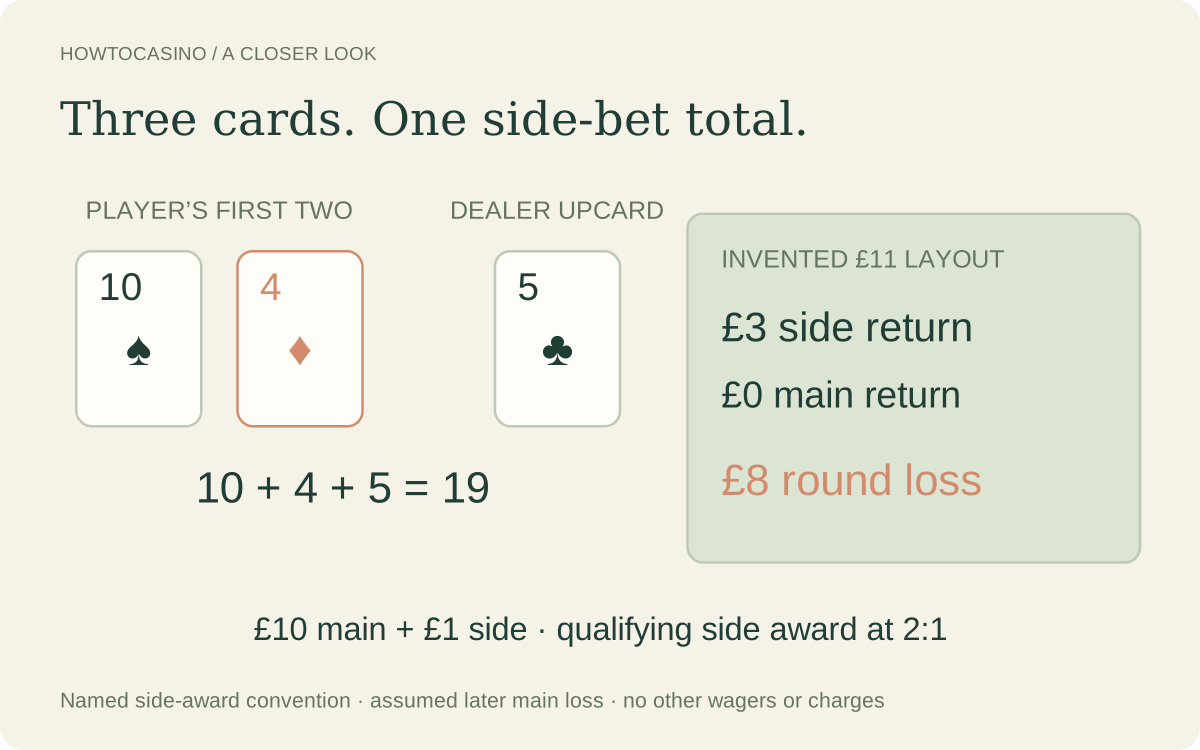
| Any 19 example | Player 10♠ + 4♦; dealer 5♣ | Total 19; the main player hand is only 14 |
| No listed total or pattern | Player 2♥ + 3♥; dealer 4♥ | A flush alone totals 9 and does not establish a Lucky Lucky award |
The order of the 6, 7 and 8 across the counting positions does not turn them into different ranks. Suited means all three selected cards share a suit. Two suited player cards are insufficient if the dealer’s upcard has another suit.
The Danish game’s rules value aces at 1 or 11, court cards at 10 and number cards at their printed values. That is why the illustrated 5♠, 6♠ and K♠ total 21. Use the card-value and qualifying-total instructions of the actual side bet when assessing an ace-containing combination.
Follow the selected game’s card-value and award clauses, particularly for aces and overlapping total/pattern labels. A main-hand value shown beside your two cards is not the three-card Lucky Lucky total.
What does Lucky Lucky pay in the named example?
The following unambiguous example is Playtech Lucky Lucky Blackjack help published by Danske Spil in Denmark, last modified 16 November 2023 and consulted on 30 October 2026. It illustrates the rules and profit-odds convention; it is not a claim about current GB availability or every UK game.
| Listed qualifying category | Published profit odds | £1 winning side bet: return if this award applies alone |
|---|---|---|
| Suited 777 | 200:1 | £201 |
| Suited 678 | 100:1 | £101 |
| Unsuited 777 | 50:1 | £51 |
| Unsuited 678 | 25:1 | £26 |
| Suited 21 | 15:1 | £16 |
| Unsuited 21 | 3:1 | £4 |
| Any 20 | 2:1 | £3 |
| Any 19 | 2:1 | £3 |
Some labels overlap: 777 and 678 also total 21. The displayed list is not permission to add every matching row together. Check the exact game’s category-priority or combined-award instructions; the public table alone does not establish a stacking rule.
Can Lucky Lucky win while the complete round loses?
Yes. For invented accepted stakes of £10 main plus £1 side, assume the named 2:1 total-19 award, no other charges or wagers and no additional award. Player 10♠ + 4♦ with dealer upcard 5♣ totals 19 for Lucky Lucky. The side returns £3: £2 profit and the £1 side stake.
Now assume the player finishes the main hand on 14 and loses to a completed dealer 21. The complete return is still £3 against £11 committed, so the round loses £8. This is a settlement example, not advice to stand on 14.
| Assumed later main result after that same £3 side return | Main returned | Complete round net |
|---|---|---|
| Main loses | £0 | £3 − £11 = £8 loss |
| Main pushes | £10 | £13 − £11 = £2 profit |
| Main wins at ordinary 1:1 | £20 | £23 − £11 = £12 profit |
Alternatively, suppose the counting cards are 6♥, 7♥ and 8♥ and the named 100:1 side award applies alone. A £1 side bet returns £101. If the £10 main hand later loses, the full round returns £101 from £11 outlay: £90 net profit. The side award is £100 profit on its own stake, not £100 profit on the complete round.
Do hits, splits or insurance change the counting cards?
The wager’s definition fixes the counting set to the two initial player cards and dealer upcard. Later blackjack decisions do not replace those original cards with a better-looking three-card selection. A split creates additional main-hand accounting; it does not, by itself, establish a fresh Lucky Lucky bet.
The named help explicitly separates insurance from the side bets. A main-hand push or an insurance win should therefore be entered separately in the round ledger. These settlements use some of the same cards, so “separate” does not mean their probabilities are statistically independent.
Use the split and insurance guides for the main-hand procedures. Keep any claimed side-bet settlement timing, replacement wager or void outcome tied to the actual game’s instructions.
How rare is suited 777 in a six-deck model?
Here is our calculation, not a quoted win-frequency guarantee. Assume a fresh complete shoe of six standard decks, 312 equally likely cards dealt without replacement, no jokers and no known removals. Each suit has six copies of its seven. There are four suits and 20 ways to choose three of those six copies, giving 80 suited-777 three-card sets.
The total number of three-card sets is C(312,3) = 5,013,320. Thus suited 777 has probability 80 / 5,013,320, about 0.00160%, or roughly 1 in 62,666.5 deals under these assumptions. This is the chance of that exact top pattern, not of any Lucky Lucky award.
| Fresh-shoe assumption | Suited 777 result |
|---|---|
| One or two standard decks | Impossible: fewer than three copies of any same-suit seven |
| Six decks | 4 × C(6,3) / C(312,3); about 1 in 62,666.5 |
| Eight decks; comparison only | 4 × C(8,3) / C(416,3); about 1 in 53,179.3 |
Removing known cards changes a live shoe’s composition. An average frequency also does not make the result due after a long absence. The number of intervening cards dealt to other hands does not justify treating every round as a guaranteed reset; use the actual shuffle rules.
What does RTP tell you, and is this the same as 21+3?
The Danish help publishes 96.05% theoretical return for its Lucky Lucky side bet separately from 99.58% for the base game. Those are attributed figures for that named model, not universal Lucky Lucky percentages or a combined return for a layout containing both stakes. We have not reconstructed the full side-bet return distribution.
Lucky Lucky prices listed totals and 678/777 patterns. The 21+3 wager prices poker combinations using the same three counting positions. A 2♥, 3♥, 4♥ combination illustrates why they differ: it is a three-card flush/straight-flush pattern, but it does not have one of the Lucky Lucky totals or special ranks described here. A win on one wager does not automatically win the other.
Lucky Ladies is another separately named side bet; its name is not an alternative spelling of Lucky Lucky. Perfect Pairs uses only two opening player cards. You need the exact wager name and help table, not just the word lucky.
What should you check before relying on a payout?
- The supplier, exact title, deck/shuffle model and all three counting-card positions.
- A complete, consistently labelled paytable, including any priority or combined-award clause.
- The side stake, total layout cost, side-specific limits and any stated maximum award.
- Recorded cards, accepted wagers and applicable interruption/void terms if a past round is disputed.
If public wording contradicts the in-game help or leaves a category ambiguous, preserve both versions and request clarification before relying on that award. An unexplained base-game RTP or a screenshot showing only two cards is insufficient evidence. The guide to reading game rules covers the relevant checks.
Related questions
Does Lucky Lucky use the dealer’s hidden card?
The named format uses the dealer’s first face-up card with the player’s two initial cards. It does not substitute the later-revealed hole card.
Are two suited player cards enough for suited Lucky Lucky?
No. All three counting cards must have the same suit for a suited category. The dealer’s upcard matters.
What does 200:1 mean on Lucky Lucky?
If that profit-odds award applies alone, a £1 winning side bet produces £200 profit plus the £1 stake returned: £201. It is not £200 including the stake or the net profit after other bets.
Does a total of 21 guarantee a blackjack win?
No. Lucky Lucky’s three-card total includes the dealer’s upcard, which is not part of your main hand. Your own two cards could form a much lower blackjack total.
Can one deck produce suited 777?
No. One standard deck has only one seven of each suit. A suited 777 needs at least three copies of the same seven, requiring at least three standard decks in the stated model.
Is every Lucky Lucky paytable the same?
No universal paytable is established here. The worked table is an explicitly named Danish Playtech example. Check the actual game’s rules, and do not silently resolve a conflicting GB row by borrowing another market’s help.